The
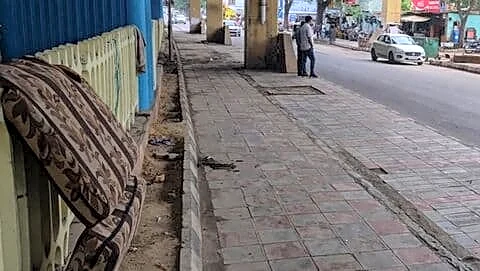
Supreme Court on Friday declared that the right to walk on a demarcated footpath is a fundamental right and should take precedence over the movement of motorised vehicles, while strongly advocating the creation of a dedicated regulatory body to protect and enforce pedestrian rights.A bench of Justices P S Narasimha and A S Chandurkar said citizens are entitled to seek restitutionary remedies if their right to walk safely on designated footpaths is violated.
Court Seeks Dedicated Footpath Regulator
The bench observed that a specialised regulator is necessary to effectively safeguard the fundamental right to walk. It said such a body should function with perpetual succession and institutional memory, enabling it to develop expertise through accumulated data, experience and information.According to the court, the regulator should employ professionals with domain expertise and operate independently without governmental or industrial influence. Transparency, accountability and institutional integrity, it said, are essential for protecting pedestrian rights.The observations came while hearing a motor accident compensation case involving a father who lost his five-year-old son in a road accident while taking him to school.Citizens Can Seek Remedies For ViolationsThe court clarified that if a person's right to walk on a demarcated footpath is violated, they can seek restitutionary remedies separate from compensation claims under the Motor Vehicles Act.It said remedies under the Constitution and Sections 38 to 40 of the Specific Relief Act, 1963 can be enforced against urban development authorities, municipal corporations, municipalities and panchayats responsible for maintaining public infrastructure.The bench stressed that Parliament and state legislatures have a positive obligation to enact laws that help citizens exercise and enjoy fundamental rights.Calls For New Law To Protect PedestriansReferring to laws such as the Right to Information Act, Right to Education Act and National Food Security Act, the court noted that modern legislation not only recognises rights and duties but also establishes regulatory institutions and legal remedies.The bench pointed out that while the right to walk is integral to Articles 21 and 19(1)(d) of the Constitution, there is currently no dedicated legislation governing its enforcement.The Supreme Court said a statutory framework is needed to formally recognise pedestrian rights, identify duty bearers, provide quick remedies for violations and establish a full-time regulator to plan, implement and enforce the right.The court directed its registry to send a copy of the judgment to the Union ministries of Housing and Urban Affairs, Rural Development, and Road Transport and Highways, as well as the Law Commission of India, urging them to examine the need for a comprehensive legal framework to protect pedestrians and ensure safe footpaths across the country.
/images/ppid_a911dc6a-image-178192825701992688.webp)

/images/ppid_a911dc6a-image-178183466934035600.webp)






/images/ppid_a911dc6a-image-178202392207991908.webp)




/images/ppid_a911dc6a-image-178185026061086047.webp)
/images/ppid_a911dc6a-image-178184763725437015.webp)