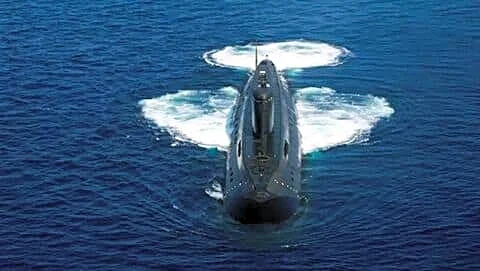
New Delhi: The Indian Navy is all set to move forward with its plans to strengthen its underwater combat capability, with the process for the negotiations on the construction of modern conventional submarines under the Project 75 India (P 75I) being “all set to be over in the next four months," said highly placed sources.The sources said, “The Inter-Ministerial Group is expected to approve it by the end of this month.” And “the process is expected to be over by September.”Meanwhile, the Pakistan Navy has added the fourth conventional submarine, which has the air-independent propulsion onboard.In an important move expected to give a boost to indigenous manufacturing, the MDL will lead the project under a strategic partnership (SP) with Germany’s
tkMS (ThyssenKrupp Marine Systems), involving Rs 70,000 cr as the cost of the project.Once the approval is granted and manufacturing begins, the stipulated delivery timeline to the Navy is set at seven years for the first submarine under the P-75I project after the contract is signed with the rest at the rate of one per year.As for the indigenised contents, the first submarine under P-75I is planned to have a minimum of 45%, which rises up to 60% in the sixth.The impetus to P-75I came with Germany’s tkMS in January 2025 getting confirmed as the foreign Original Equipment Manufacturer (OEM) partner of the MDL under MoD's Strategic Partnership (SP) model.As per the MoD, "SP model envisages indigenous manufacturing of major defence platforms by an Indian Strategic Partner, who will collaborate with foreign OEM to set up production facilities in the country."Also Read: More Power To Navy As India Gets Third Nuclear Submarine INS Aridaman, Stealth Frigate INS Taragiri - Key Features Under the contract, tkMS will transfer the submarine's design and technology to India. The Air Independent Propulsion (AIP) technology has to be an integral part of the six new boats to be manufactured indigenously.Submarines are Important:Submarines, in modern warfare, are critical combat military vehicles that operate underwater, giving stealth, resilience and deterrence.The submarines are discreet war machines due to their stealth and agility for covert operations. These combat machines are deployed by naval forces to operate where ships cannot go, strike as per the operation, and melt into the opaque waters.
https://www.youtube.com/watch?v=YEYttt_E0IE
AIP technology once amalgamated with the boat (submarine) it helps conventional submarines to remain submerged for longer durations; otherwise they have to surface in order to use oxygen to charge their batteries. At present only select countries have this technological know-how and India is also in the process to develop it.
India Developing indigenous AIP Module:The DRDO is also working to develop an indigenous AIP Capsule and, as per the sources, DRDO AIP Plan is to get over it by June this year and will be ready to get integrated with the second submarine of Scorpene Class which is planned to be docked for maintenance by the end of this year. As TIMES NOW reported in March, sources said that "By the end of 2026 INS Khanderi is set to be retrofitted with an indigenously developed Air-Independent Propulsion (AIP) system. The system has undergone extensive shore-based trials and have met the required benchmarks.There is a delay in the whole plan, as the AIP system was originally planned for INS Kalvari, which is the first of the Indian Navy’s six Kalvari-class diesel-electric submarines manufactured at Mumbai's Mazagon Dockyards Limited with the help of the French Naval Group. But since the system was not ready, the submarine is currently being refitted but without the AIP module. Challenges ahead for Indian NavyThe new underwater assets to be added to the Indian Navy are to offset the challenge emanating from Pakistan’s underwater combat capability rising.The Indian Navy has twin challenges: to counter the aging existing fleet of submarines and the expanding naval cooperation between China and Pakistan.The Indian Navy currently operates 16 conventional submarines, with 10 of them being very old. Pakistan Ahead In The AIP RaceThe point to ponder is that while India doesn't operate any submarine with the AIP, Pakistan already has four such submarines with the latest getting inducted on April 30 in China. The latest addition to the Pakistan Navy is a Hangor Class of Submarine and is the first of the eight to be inducted with the help of China. The Pakistan Navy will be operating 11 AIP-enabled submarines in the next few years. The highlight is that India has none.At the larger levels, the addition of new capital ships and boats is significant, as the Chinese PLA Navy, with 355 warships and submarines, has become the largest navy in the world, with an increased presence in maritime bodies around the globe, including the Indian Ocean. The Indian Navy’s total fleet strength is over 130. The plan is to raise this strength somewhere between 170 and 175 in the next five years.Talking specifically about China’s People’s Liberation Army Navy (PLA Navy), it is projected to field 65 Submarines this year, and eventually the plan of the PLA Navy is to touch around 80 submarines by 2035.
/images/ppid_a911dc6a-image-177917482539348784.webp)

/images/ppid_a911dc6a-image-177909553142630500.webp)











/images/ppid_59c68470-image-177911502674525655.webp)

/images/ppid_a911dc6a-image-177926586989646656.webp)