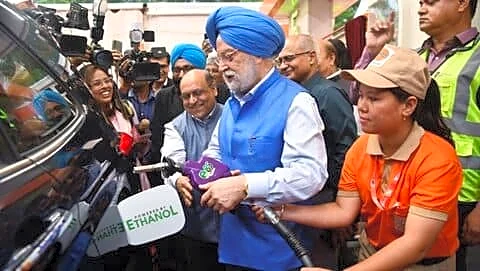
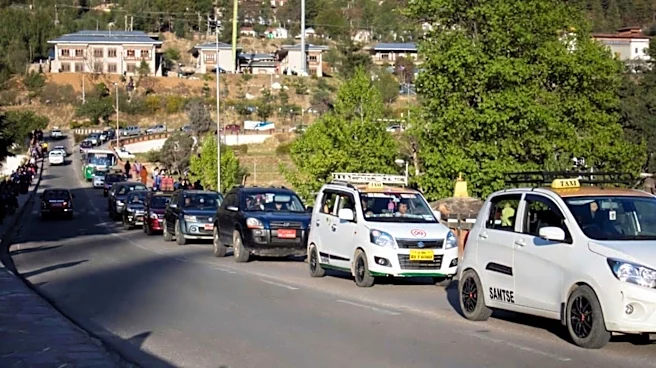
The Ministry of Petroleum and Natural Gas on Sunday fact-checked reports claiming that Bhutan had rejected imports of India's E20 petrol, stating that no such offer was ever made by India's Oil Marketing Companies (OMCs). The ministry added that there is "no such proposal" on exporting E20 petrol to the neighbouring country.The ministry said that the reports of Bhutan rejecting imports of India's E20 petrol are incorrect.Taking to X, the Ministry wrote, "Fact Check: Claims that Bhutan declined an offer to import E20 petrol from India are incorrect. No such offer has been made by the Oil Marketing Companies (OMCs), and there is no proposal for export of E20 petrol to Bhutan. Please rely only on official information from MoPNG and the Oil Marketing Companies."
The development came after Congress on Saturday alleged that Bhutan, Nepal, Bangladesh and Sri Lanka have refused India's fuel.The Opposition's claims came at a time when concerns were being raised about the performance and reliability of the newly introduced E20 blend fuel.
Centre Issues Clarification
Issuing clarification over the widely circulated claims, the Ministry of Information and Broadcasting said, "E20 fuel was introduced only after extensive laboratory, vehicle, and field testing by India's leading technical institutions. Science led the way, ensuring reliability, performance, and confidence on every journey."The government stated that the automobile industry has been aligning vehicles with prescribed ethanol-blending standards, news agency ANI reported. Use of approved E20 fuel does not automatically void the manufacturer's warranty merely because ethanol-blended petrol is used, as per the Ministry of Information and Broadcasting.The government reiterated that Ethanol blending is a scientifically designed, internationally accepted fuel formulation implemented under India's Ethanol Blended Petrol Programme. Extensive testing previously by ARAI, Indian Oil R&D and IIP has found no significant engine durability or performance issues with E20 in older vehicles. Millions of vehicles are already operating on E20 since April 1, 2025 (Pan rollout of E20) without any evidence of engine failure attributable to the fuel, the Ministry further said.
(With agency inputs)
/images/ppid_a911dc6a-image-178326726951027395.webp)


/images/ppid_a911dc6a-image-178309563908559875.webp)



/images/ppid_a911dc6a-image-178321522449248304.webp)