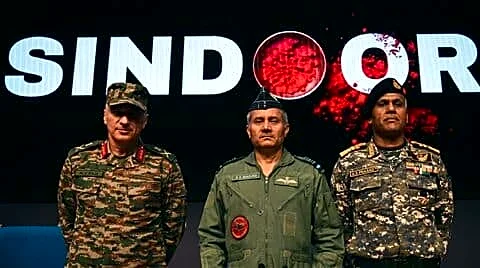
Sometimes, the sharpest articulation of institutional values does not come from doctrine—but from a moment on stage. Congress MP Shashi Tharoor on Thursday shared an anecdote drawn from military history, one that captures, with unusual clarity, the Indian Army’s long-held commitment to pluralism. Tharoor, in a post on X, referenced an extract from Fools and Infantrymen, a memoir by Lt Gen Vas, former Eastern Army Commander and Colonel of the 9th Gorkha Rifles. “I was born a human being, by tradition I’m a Hindu, by training I’m a Catholic, by temperament I’m a Muslim, morally I’m attracted to Buddhism, and every time I have to shave I wish I were a Sikh,” the post read. Tharoor described it as an “amusing statement” of the Army’s secular character.
What's the Background?
The story, originally recounted by Lieutenant General Eric Alexander Vas, is not about policy. It is about instinct. And perhaps that is what makes it endure. The extract references a routine—a first visit by a newly appointed Army Commander to a northeastern state. The reception, however, took an unexpected turn. According to Vas, the Chief Minister, addressing a public gathering, reassured the audience by pointing out that “the new army commander is a Christian.”What followed was not a correction. It was a reframing. Vas, in his reply, acknowledged the welcome but drew attention elsewhere—towards continuity, not identity. His predecessor, he noted, had been Jewish. His contribution to the state, he added, would be difficult to match.
A Soldier’s View Of A Diverse Nation
The statement, delivered in a public setting, carried a clarity that formal messaging often lacks. At its core was a simple assertion: military command is not shaped by personal identity. “Military commanders operate according to tasks laid down by the government,” Vas emphasised, adding that considerations of language, religion or caste do not factor into operational decision-making.It is a principle often cited—but rarely illustrated so plainly. Within the Indian Army, such positioning is not incidental. Lt Gen Vas’s memoir, spanning decades from pre-independence India through major conflicts including 1962, 1965, 1971 and beyond, offers what is often described as a “soldier’s-eye view” of history.This anecdote sits within that broader narrative. Not as an isolated remark—but as a reflection of a system that has, over time, absorbed diversity into discipline. In that sense, the story is less about one commander’s wit and more about an institutional culture that has made such statements possible.
/images/ppid_a911dc6a-image-177762269278254361.webp)


/images/ppid_a911dc6a-image-177735222870485680.webp)



/images/ppid_a911dc6a-image-177744587002022986.webp)


/images/ppid_a911dc6a-image-177752386190377803.webp)

/images/ppid_a911dc6a-image-17774614373916534.webp)