Over
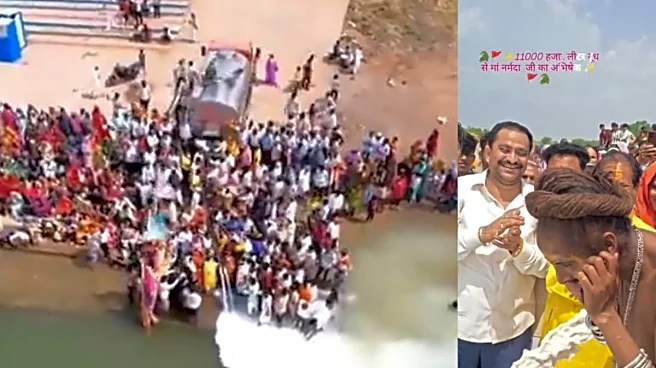
11,000 litres of milk — reportedly worth Rs 6 to 7 lakh — was poured into the Narmada River from a heavy tanker in an act of religious faith. The offering was made by religious guru Dada Ji Dhunivale Baba at the conclusion of a 21-day ritual at the Pataleshwar Mahadev Temple in Bherunda tehsil, Sehore district, Madhya Pradesh. Aerial drone shots captured the moment, and the same went viral on social media, with many questioning the act, saying that state where malnutrition is so high, could this milk have been used differently? A few also questioned that adding milk to a river is “not a natural thing” and it would also affect the ecosystem.
What Stats Say
According to National Family Health Survey-5 (2019-21), conducted by India's Ministry of Health and Family Welfare, 35.5 per cent of children under five in India are stunted, 19.3 per cent are wasted, and 32.1 per cent are underweight. And Madhya Pradesh consistently figures among the worst-performing states on stunting, wasting and underweight indicators, alongside Bihar, Jharkhand and Uttar Pradesh, according to NFHS-5 data published by the International Institute of Population Sciences under the Ministry of Health and Family Welfare. The state's malnutrition rate stands at 7.79 per cent against a national average of 5.40 per cent, according to Dainik Bhaskar — with 1.36 lakh children currently battling the condition.
A Mismatched Distribution – Big Q
The state's spending on its malnourished children has itself become a point of sharp public anger and topic of the state assembly debate. In 2025, Congress MLA Vikrant Bhuria raised a question in the Madhya Pradesh Assembly asking the Women and Child Development Department about the daily nutrition allocation for malnourished children. The state confirmed it allocates just Rs 8 per day for moderately malnourished children and Rs 12 for the severely malnourished.Bhuria hit back with a comparison, which drew significant outrage: "The government is spending Rs 8 to Rs 12 per day on malnourished children, but Rs 40 has been allocated for cow feed per day," he said. Health officials, civil society, and the Opposition called the allocation grossly insufficient, questioning how such meagre funding could possibly address a crisis of this scale.The crisis in Madhya Pradesh is not new and not unnoticed. The National Human Rights Commission in 2016 had issued a formal notice to the state government after taking suo motu cognizance of 116 children dying from malnutrition-related causes in Sheopur district of MP over five months, calling for a detailed report from the Chief Secretary within four weeks. The NHRC itself noted that Nutrition Rehabilitation Centres were overcrowded, understaffed and forcing children to sleep on the floor. Community paediatrician and public health expert Dr Vandana Prasad, who has presented at NHRC forums on malnutrition, visited afflicted villages and NRCs in Sheopur and Satna and wrote to the state government that what she found was "a disappointing lack of priority and urgency towards a predictable and recurrent tragedy," according to Hindustan Times. Sheopur keeps returning to the headlines.
About Narmada…
The Narmada, which is revered not just in Madhya Pradesh but beyond, has its own protections in law. The Madhya Pradesh High Court, in a case known as Narmada Mission, has ruled that no construction is permitted within 300 metres of the river. The NGT has separately passed orders against discharge of untreated material into its waters.Speaking to Times Now, lawyer and environment advocate Anshuman Singh said the act raises serious ecological concerns. "Every river has its own ecosystem. A single river running through hundreds of kilometres has multiple ecosystems within it. This is not just a small thing — it is something quite substantial."He added: "When you worship Narmada as your mother, by doing these things, you are harming your mother. There is a lack of awareness. People have to draw a line between being religious and being environmentally conscious. I have always been insistent upon remedial measures rather than punitive measures."Environmentalist Bhavna Menon echoed that position without attacking the intent behind the act. "It is not a natural thing to have milk in the river — so obviously, at some point, it will affect the ecosystem. The milk should have been used more judiciously. This is a time where there is so much climate change happening. We should refrain from polluting more of our natural resources. What will we keep for our future generations?"It is against this backdrop — of children carried into rehabilitation centres before they can walk, of Rs 12-a-day nutrition budgets, and of a river protected by a court order — that the images of 11,000 litres of milk flowing into the Narmada carry their full weight. The act was an offering made in faith, but the questions it has raised are ones that must be answered.
/images/ppid_a911dc6a-image-177583647256661822.webp)





/images/ppid_a911dc6a-image-177585207263091406.webp)





/images/ppid_a911dc6a-image-177579743691949677.webp)
/images/ppid_a911dc6a-image-177580003824922925.webp)