Tarique Rahman, the elder son of former Bangladesh President late Ziaur Rahman and Prime Minister late Khaleda Zia, has successfully steered the Bangladesh Nationalist Party (BNP) to a massive victory in the 13th parliamentary elections held on February 12, the first since the ouster of the Sheikh Hasina-led Awami League government. For over a decade, India’s Bangladesh policy was built around one constant: Sheikh Hasina. Her government delivered on security cooperation, curbed anti-India insurgent networks and anchored connectivity projects that tied Dhaka closer to New Delhi than ever before. For New Delhi, Tarique Rahman’s rise presents both a challenge and an opportunity. The ties between Delhi and Dhaka were not at their best when BNP was last
in power with Khaleda Zia at the helm; however, when compared to Jamaat-e-Islami, BNP happens to be the more liberal and democratic option to engage with. Experts suggest that the resurgence of the BNP under Tarique Rahman presents an opportunity for New Delhi to reset ties with Dhaka, which have been frosty lately over the demand for Sheikh Hasina's extradition by the interim government. Tarique Rahman's government will treat India as a priority, Dhananjay Tripathi, Senior Associate Professor at the Department of International Relations at the South Asian University (SAU), told Times Now. "It is important to recognise that this represents a potentially new phase for the BNP, which has successfully defeated Jamaat and appears to carry the aspirations of Bangladesh’s youth. Tarique Rahman has a long innings to play in Bangladesh politics, and strengthening ties with India is likely to be a priority for his leadership, just as stable relations with Bangladesh remain important for New Delhi," Professor Tripathi said. "This moment calls for fresh thinking in India’s approach to Bangladesh. The clear majority secured by the BNP in this election could serve as a new starting point for bilateral engagement," Tripathi said. "This appears to mark a new political beginning in Bangladesh. New Delhi has already congratulated the BNP leadership, and in return, the BNP has thanked India and expressed hope for improving bilateral ties," he said.
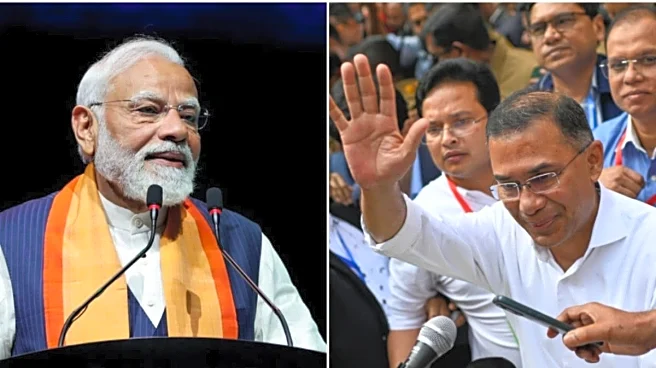
Prime Minister Narendra Modi was among the very few leaders to speak to Rahman congratulate him on the BNP's performance. "I congratulated him on the remarkable victory in the Bangladesh elections. I conveyed my best wishes and support in his endeavour to fulfil the aspirations of the people of Bangladesh," PM Modi said. The PM had earlier congratulated Rahman for the decisive win in a post on X (formerlyTwitter). The BNP was quick to thank India and PM Modi for recognising the verdict of Bangladesh's general elections and hoped that the relations between the two countries would be strengthened under the new government.
"I convey my warm congratulations to Mr Tarique Rahman on leading BNP to a decisive victory in the Parliamentary elections in Bangladesh. India will continue to stand in support of a democratic, progressive and inclusive Bangladesh. I look forward to working with you to strengthen our multifaceted relations and advance our common development goals," PM Modi posted on X.BNP standing committee member and chief coordinator for the 2026 election, Nazrul Islam Khan, said, "We thank Prime Minister Narendra Modi for congratulating our leader, Tarique Rahman." Khan said that it was great that a democratic country like India has recognised the "verdict of the people of the people." "We, also on behalf of our party, thank him, and we believe that under the leadership of our leader, Mr Tarique Rahman, the relation between these two countries and the people of these two countries will be strengthened," he added.
New Delhi had invested deeply in its partnership with Sheikh Hasina during her tenure, while BNP was seen as closer to Pakistan and China during Khaleda Zia's years. However, analysts suggest that the newly elected government would not shut ties with India. “Bangladesh needs both China and India, and you have to think of it in pragmatic terms,” Lailufar Yasmin of Dhaka University told Reuters. “While ties with China may improve, any party that comes to power will not be imprudent enough to ignore India.”Rahman's BNP has already declared that if voted to power, the party will work with a 'Bangladesh First' approach and will work towards building relations with neighbours for "collective progress". Rahman had signalled an independent foreign policy approach, with slogans like "Not Dilli, Not Pindi, Bangladesh before everything."
"Bangladesh is an important neighbour of India, and it is in India’s strategic interest to maintain cordial political relations. Beyond politics, the two countries share strong economic linkages, and Bangladesh is also crucial to India’s vision of an extended neighbourhood, particularly within the framework of the Act East Policy," Tripathi suggested.Former High Commissioner of India to Bangladesh Veena Sikri told ANI that the Bangladesh election result is a "direct setback to the Islamist forces." "I think that the victory of Tariq Rehman is a victory for democracy because Jamaat-e-Islami had been campaigning very strongly, using financial exhortation and using religious exhortation. They were really with the support of the Western powers and the support of Pakistan. They were really all set to form a government on their own," she explained.Bangladesh and Pakistan have been re-establishing relations since the fall of Hasina in 2024, and China has significantly expanded its footprints under Chief Advisor Muhammad Yunus. Calling Rahman’s return India’s “best-case scenario” does not imply political preference, but strategic realism. In a moment of transition, a stable, economically engaged Bangladesh woith a clear electoral mandate under a single leadership is better than an unstable country in the neighbourhood.
(Quotes are taken by Dhananjay Tripathi, Senior Associate Professor, SAU)
/images/ppid_a911dc6a-image-177098224616495837.webp)

/images/ppid_a911dc6a-image-177078725708786992.webp)
/images/ppid_59c68470-image-177080503405633434.webp)


/images/ppid_59c68470-image-17709675345444571.webp)


/images/ppid_59c68470-image-177096503953428764.webp)