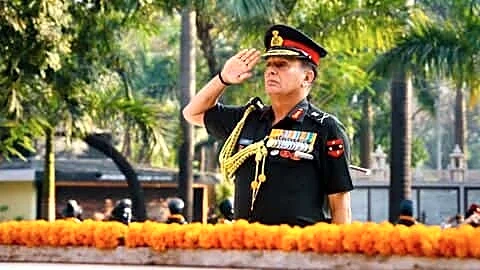
New Delhi: Outgoing Chief of Army Staff (COAS) General Upendra Dwivedi, in an exclusive interview with Times Now, outlined the Indian Army's assessment of the northern borders and its operational priorities. General Dwidevi said that the situation at the Line of Actual Control (LAC) is stable but sensitive. He further stated that both India and China are responsive to each other's concerns."The situation along the Northern Borders is stable but sensitive. Recent agreements have contributed to improving stability on the ground, and both sides are showing greater responsiveness towards each other’s concerns," the COAS told Times Now.General Dwivedi noted that established military communication channels continue to function effectively; that helps
in maintaining peace and avoiding misunderstandings in border areas. According to the Army Chief, mechanisms such as military-level talks, hotlines, flag meetings, and commander-level engagements are working well."Established mechanisms such as military-level talks, hotlines, flag meetings and commander-level engagements are working well. Regular ground-level interactions are taking place and help in routine border management besides preventing misunderstandings," the Army Chief said.Outlining the Indian Army's priorities along the LAC, General Dwivedi said the focus remains on three key objectives—maintaining peace and stability, resolving local issues through dilalogue and strong deployment."As regards our priorities are concerned, they are clear. First, to maintain peace and stability along the Line of Actual Control. Second, to resolve local issues through dialogue and established mechanisms. Third, to maintain a strong and credible deployment posture to meet any contingency," he said.
General Dwivedi on Atmanirbhar Initiative:
The Army Chief said Atmanirbharta is now a core requirement of national security and future warfighting. "In a crisis, the nation must be able to rely on its own systems, industrial base, and ability to sustain operations. Indigenous systems are becoming central to surveillance, communications, electronic warfare, precision engagement, information management, and operational decision-making. Indigenous capability is no longer peripheral to military preparedness; it is increasingly becoming an essential part of it," he added.
General Dwivedi also pointed to the rapidly evolving nature of warfare, saying armed forces must continuously adapt to emerging technologies and new battlefield challenges.He highlighted several key capability areas that will shape future military preparedness, including long-range precision strike systems, advanced munitions, drones and counter-unmanned aerial systems (counter-UAS)."Modern warfare is evolving rapidly. Capability requirements will continue to emerge in areas such as long-range precision fires, advanced munitions, drones and counter-UAS, electronic warfare, resilient communications, autonomous platforms and battlefield awareness," the Army Chief said.Asserting India's indigenous defence push, the Army Chief stressed that the objective is to develop solutions tailored to the country's unique security challenges rather than relying on imported systems."The effort is to develop Indian solutions for Indian challenges. Our terrain, threat matrix and operational requirements are unique and our engagement with DRDO, DPSUs, private industry, MSMEs, start-ups and academia is aimed at faster trials, better hand-holding and quicker induction," General Dwivedi said.General Dwivedi will step down as the Chief of Army Staff today (June 30). Lieutenant General Dhiraj Seth, currently Vice Chief of the Army Staff, will take over as the next COAS.
/images/ppid_a911dc6a-image-178279662219623516.webp)










/images/ppid_a911dc6a-image-178279924397740800.webp)
/images/ppid_a911dc6a-image-178283306182977634.webp)
/images/ppid_a911dc6a-image-178280451895771078.webp)
/images/ppid_a911dc6a-image-178280182999429013.webp)
/images/ppid_a911dc6a-image-178289805704566999.webp)