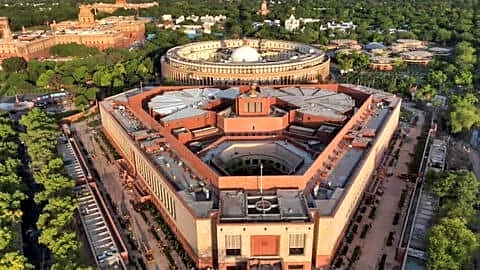
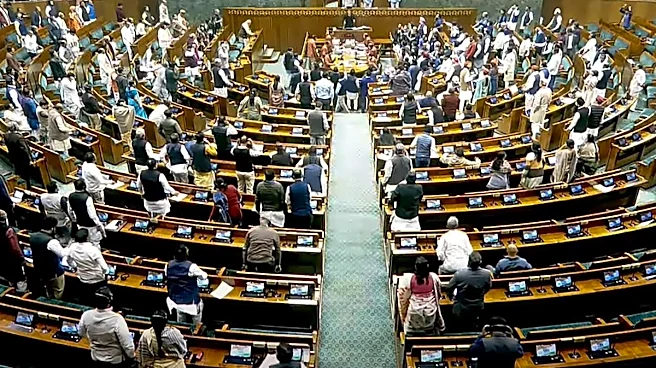
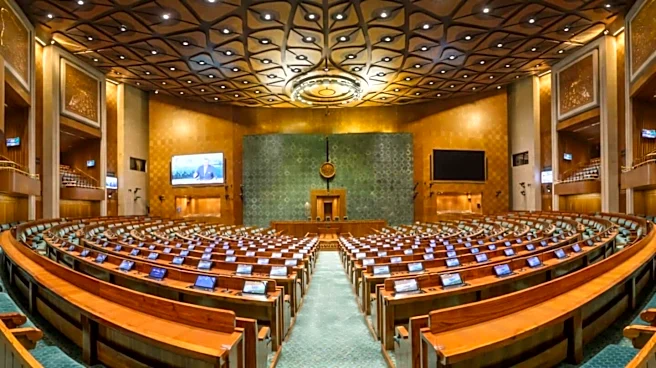
When the Monsoon Session of Parliament begins today, one number will be doing more political work than any speech: 362 — the one figure that explains almost every defection, merger and rebellion in the news right now. That is the two-thirds majority the BJP-led NDA needs in the Lok Sabha to amend the Constitution – the key that unlocks the Delimitation Bill and the linked 33% women's reservation. The government does not have that number. Which is why the real story of this monsoon isn't a bill so much as a countdown: how close can the NDA get to 362 before the session ends, and which broken Opposition party gets it there?Here is what the math actually looks like, and how each piece got there — stated plainly, with the numbers doing the talking.
The scoreboard
Two-thirds of the
543-member Lok Sabha is 362. That is the wall the government keeps running into. Its own alliance is 293 strong — so before a single defector is counted, the NDA starts 69 votes short.We know exactly how wide that gap was the last time the bill was actually put to a vote. On April 17, 2026, the Constitution (131st Amendment) Bill drew 298 ayes to 230 noes with 528 members present, 54 short of the majority it needed that day. That floor vote, not any projection, is the firm ground everything else is built on.
From 293, the climb to 362 is a ladder — and every rung above the first is an "if," each less certain than the one below it:The firmest step is the YSR Congress. Its four MPs are a stated yes. Ahead of the session, Jagan Mohan Reddy's party reiterated it will back both the Delimitation and Women's Reservation Bills, qualifying only that it will judge other legislation by Andhra Pradesh's interest. That takes the NDA to 297 — still 65 short.Add the 26 pending defectors — 20 Trinamool Congress (TMC) MPs and 6 from Shiv Sena (UBT) — and the tally reaches 323, still 39 short.Stack on the wish list — all 22 DMK MPs and the 8 from Sharad Pawar's NCP — and it reaches 353, still 9 short.That last figure is the honest ceiling. Even a best-case stack — the confirmed YSRCP votes, the defectors the Speaker has not yet ruled on, and two southern parties that have publicly said no such support is settled — leaves the NDA nine short of 362. On paper it is closing in. But the paper is full of ifs, and the ifs run out before the number does.The Rajya Sabha tells a similar story. There, the two-thirds mark is around 164. The BJP alone now holds 114 seats — its highest-ever count in the Upper House — and the wider NDA has climbed to roughly 150–155 after recent polls. Close, but still short of the supermajority.The Rajya Sabha tells a similar story. There, the two-thirds mark is around 164. The BJP alone now holds 114 seats, its highest-ever count in the
Upper House, and the wider NDA has climbed to roughly 150–155 after recent polls. Close, but still short of the supermajority.
Why parties are "breaking and merging", not just switching…
This is the part worth explaining simply, because it is the engine of everything else.Under the anti-defection law (the Tenth Schedule of the Constitution), an individual MP cannot simply cross the floor — do so and they risk losing their seat. But the law leaves one door open: if two-thirds of a party's legislators agree to merge with another party, that merger is protected. No disqualification.
That single rule is why the recent realignments have all taken the shape of group splits and mergers rather than lone crossings. Two-thirds is the magic fraction inside each party, just as it is inside Parliament. It has produced the biggest realignment of Opposition ranks since the Shiv Sena split of 2022 and the NCP split of 2023.
Party-by-party Arithmetic
YSR Congress (Andhra Pradesh). The clearest "yes" on the board. At a July 16 parliamentary party meeting chaired by Jagan Mohan Reddy in Tadepalle, the YSRCP reiterated it will support both the Delimitation and Women's Reservation Bills if they return this session, judging any other legislation by whether it serves Andhra Pradesh. The quiet irony: YSRCP is a southern party backing a delimitation that, on population, could dilute the South's weight, cutting against the grain of the DMK's opposition.
Trinamool Congress (West Bengal). Twenty of its 28 Lok Sabha MPs, above the two-thirds threshold, have broken away and, per reports, moved to merge into a new outfit, the Nationalist Citizens Party of India (NCPI); rebel leader Kakoli Ghosh Dastidar says the bloc will back the government. Three TMC Rajya Sabha members have also resigned, opening three Upper House seats the NDA is now placed to win.Shiv Sena (UBT) (Maharashtra). Six of its nine Lok Sabha MPs have moved toward Eknath Shinde's rival Sena, asking Speaker Om Birla to recognise them as a separate group. Six of nine is exactly the two-thirds line, which is why the Speaker's ruling matters so much.Aam Aadmi Party (Rajya Sabha). Already done. In April the Rajya Sabha Chairman accepted the merger of seven AAP MPs with the BJP under the Tenth Schedule, cutting AAP's Upper House strength from 10 to 3 – the clearest completed example of the merger route in action.DMK (Tamil Nadu). A firm no, and the loudest voice of the southern worry. Now the biggest unattached bloc in the Lok Sabha after walking out of the INDIA alliance, it wants one guarantee: that states which curbed their population won't lose seats for it. The government is quietly hoping for a few absences on voting day. In public, the DMK isn't budging.NCP (Sharadchandra Pawar). The hedge. Supriya Sule says the party would consider backing the bill only if it guarantees a flat 50% seat rise for every state – the Shah–Rijiju formula that would take Maharashtra from 48 to 72 seats – but has taken no official stand, will wait for the final draft, and will not join the NDA.
The National Conference: publicly out, privately strained
The National Conference is the clearest example of a party the NDA has not pulled in, but where the pressure is showing.Chief Minister Omar Abdullah has been categorical: the NC's two Lok Sabha and three Rajya Sabha MPs will not back the BJP-led government, and the party, in his words, will not "sell its morals" for power. On the delimitation debate itself, he has argued that the 2022 exercise in Jammu and Kashmir was designed to favour the BJP, a redistricting the NC accepted and contested anyway.But the party is not speaking with one voice. Its Srinagar MP, Aga Syed Ruhullah Mehdi, has openly turned on his own leadership. On July 15 he accused Abdullah of narrowing the party's agenda to statehood alone and, in a pointed line, said the Chief Minister "only wants his power back." Ruhullah is boycotting the NC's own July 20 statehood protest at Jantar Mantar, arguing the party should keep the restoration of Article 370 — not just statehood — at the centre of its politics.The nuance that keeps this from being a simple defection story: Ruhullah has also said the BJP's attempts to break the NC are "unfortunate," and that despite his differences, the Omar Abdullah government should be allowed to complete its full term. It is a rift, not yet a rupture but in a season of two-thirds mergers, an internal crack in any party is worth watching.Put the pieces together and the shape of the moment is clear. The Opposition's INDIA bloc has thinned — the DMK has walked out, seven AAP MPs are gone, the TMC has fractured, the Shiv Sena (UBT) is splitting, while the YSRCP has openly promised its votes. Each of those moves nudges the NDA up the ladder toward 362.
And yet, three facts sit underneath the momentum:
The Speaker hasn't ruled yet. Om Birla's decision on whether to formally recognise the TMC and Shiv Sena (UBT) defectors is still pending, and until he rules, those 26 votes are not banked.The best case is still short. Even the friendliest arithmetic, everyone the government hopes for, voting the way it hopes, lands at 353. Nine short of 362.
It may not even come up. As of now there is no official confirmation that the government will reintroduce the bill in the Monsoon Session at all.The government's pitch, made by Amit Shah in April, is that a bigger House protects everyone: the South, he argued, would climb from 129 seats to about 195 and hold roughly the same 24% share. The Opposition doesn't fight the maths but the meaning, a warning that real power still tilts north whatever the headline count. That is the true story behind 362: North versus South, population versus representation.The number is close. The consensus is not. Come July 20, we find out which one the government is willing to do without.
/images/ppid_a911dc6a-image-178451523439180980.webp)


/images/ppid_a911dc6a-image-178461405811445104.webp)


/images/ppid_a911dc6a-image-178445546525648666.webp)
/images/ppid_a911dc6a-image-178441383602056065.webp)