In April and May 2026, India held assembly elections across five states and one union territory simultaneously — the most sweeping state-level electoral exercise in years. West Bengal, Assam, Tamil Nadu, Kerala, and Puducherry all delivered their verdicts. Parties changed. Governments fell. One thing, however, remained almost entirely stable: the number of winning candidates walking into their new legislatures with criminal cases trailing behind them. In West Bengal, 190 of 292 winning candidates — 65 percent — declared criminal cases, up sharply from 49 percent in 2021. In Kerala, the figure was a staggering 84 percent — 114 of 135 newly elected MLAs had declared criminal cases, compared to 71 percent in 2021. Tamil Nadu returned 126 of 233
winning candidates — 54 percent — with declared cases. Assam, the relative outlier, saw 17 percent of winners declare criminal cases — a decline from 27 percent in 2021. The names below represent the most significant individual stories from each state — politicians who won big despite, or in some cases because of, the records they carry.
1. Suvendu Adhikari — 25 Cases, Two Constituencies, One Historic Upset
Party: BJP | State: West Bengal | Constituency: Bhabanipur & Nandigram The most watched battle of the 2026 season was not between two parties — it was between two individuals. BJP leader Suvendu Adhikari defeated Chief Minister Mamata Banerjee in her own bastion of Bhabanipur by over 15,000 votes, the biggest political upset of the entire 2026 election cycle. He simultaneously retained Nandigram — making him a double-constituency winner and the undisputed face of a new Bengal. Adhikari currently faces 25 criminal cases, most of them filed after his dramatic exit from the Trinamool Congress in December 2020. The charges span criminal intimidation, attempt to murder, rioting, promoting enmity between groups, and hurting religious sentiments, with his 2026 affidavit also listing charges of sexual harassment and theft. His name has also surfaced in connection with the Saradha chit fund scandal, with a petition by Saradha chief Sudipto Sen accusing him of extortion and using his influence to benefit the company. The Calcutta High Court at one stage stayed 26 FIRs against him and ruled that future complaints would require prior court approval. Later, 15 FIRs were quashed while five others were transferred to a Special Investigation Team. He dismisses every case as political persecution. Bhabanipur delivered its verdict on that argument in his favour.
2. Nisith Pramanik — 16 Cases, From Union Minister to MLA
Party: BJP | State: West Bengal | Constituency: Mathabhanga Former Union minister and BJP candidate Nisith Pramanik, who declared 16 criminal cases in his 2026 affidavit, won from the reserved seat of Mathabhanga in Cooch Behar by a commanding margin of over 43,000 votes. The cases against him range from attempt to murder and rioting to house trespass and unlawful assembly, with nine of the 14 cases on record in 2024 having been registered between 2018 and 2020 — the period immediately following his departure from the Trinamool Congress. Pramanik began his political career as a TMC youth wing leader and one of the party's key musclemen in Cooch Behar. He gained so much clout that he was able to corner most other TMC district leaders, and during the 2018 panchayat elections, fielded around 300 independent candidates against TMC nominees. He joined BJP in 2019 and has not looked back since — winning a Lok Sabha seat, serving as Union Minister of State for Home, and now returning as an MLA.
3. Himanta Biswa Sarma — Allegations Spanning Two Parties, Re-Elected CM
Party: BJP | State: Assam | Constituency: Jalukbari On May 10, 2026, Himanta Biswa Sarma was elected as the leader of the BJP-led NDA in Assam, paving the way for him to become Chief Minister for a second consecutive term. The BJP had bagged 82 seats, with allies AGP and BPF winning 10 each, giving the NDA a two-thirds majority. Before Sarma crossed the floor to join the BJP, the party itself accused him of being a "key suspect" in a scam linked to a Guwahati water supply project involving American multinational Louis Berger International. Executives of the company told a US court they had paid bribes of nearly $1 million to unnamed "officials" in the Assam government to secure water management contracts — during years when Sarma held the ministerial portfolio for the relevant department. Most recently in April 2026, documents released by Congress leader Pawan Khera alleged fresh financial irregularities — charges Sarma and his wife rejected as "malicious, fabricated and politically motivated," with Sarma calling the documents AI-generated. He declared zero pending criminal cases in his 2026 affidavit. The allegations against him are political and investigative rather than court-registered — a legal distinction that matters, and one his critics argue reflects access to power rather than absence of wrongdoing.
4. Akhil Gogoi — 21 Cases, Won From Jail Before, Won Again in 2026
Party: Raijor Dal | State: Assam | Constituency: Sibsagar The candidate with the highest number of declared cases in the entire 2026 Assam election, Akhil Gogoi declared 21 pending criminal cases in his affidavit, including serious charges such as criminal conspiracy, inciting violence, abetment of waging war, and defamation. Many of these cases are linked to his leadership of the 2019 anti-CAA protests. In the 2026 Assam election, Gogoi secured a comfortable victory from Sibsagar with 86,521 votes, maintaining a winning margin of 17,272 votes against BJP's Kushal Dowari. It was not close. He previously won Sibsagar in 2021 as an independent — while physically in detention under the UAPA — forming Raijor Dal afterwards to continue his politics. His cases are qualitatively different from many on this list: less a criminal past than a political biography of confrontation with state power. Voters in Sibsagar appear to have read the distinction clearly.
5. M.R. Vijayabhaskar — 31 Pending Cases, Reclaimed Karur
Party: AIADMK | State: Tamil Nadu | Constituency: Karur If one name from the Tamil Nadu 2026 results embodies the criminal-case paradox most starkly, it is M.R. Vijayabhaskar. The former Transport Minister in Jayalalithaa's cabinet carried 31 pending cases into the 2026 election, with eight serious IPC charges and two serious BNS charges, including kidnapping, forgery for cheating, and criminal intimidation. AIADMK successfully defended the Karur seat, with Vijayabhaskar winning with 71,542 votes. This was a redemption of sorts — he had lost Karur in 2021 to DMK's V. Senthil Balaji, who was himself later arrested in a money laundering case and dropped from the cabinet. The seat's history illustrates the interchangeability of legal trouble across Tamil Nadu's political spectrum. Across the 2026 Tamil Nadu results, 63 percent of AIADMK's winning candidates declared criminal cases — the highest share among major parties — followed closely by DMK at 63 percent and TVK at 38 percent.
6. Tamil Nadu's New Force: TVK's Tainted Debut
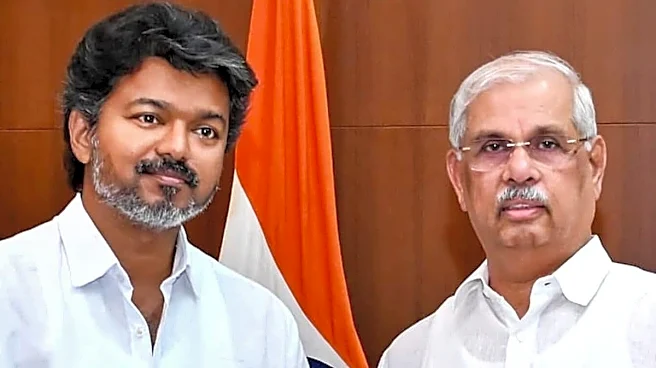
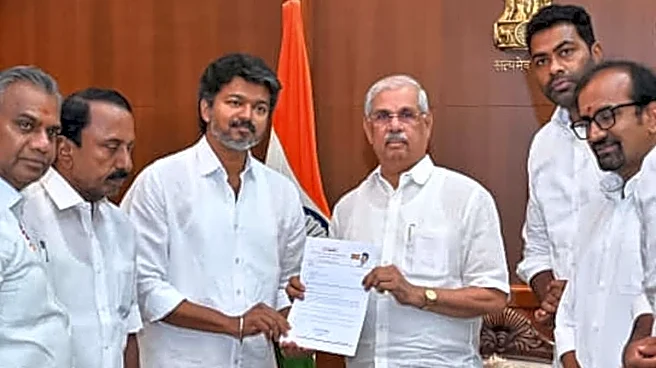
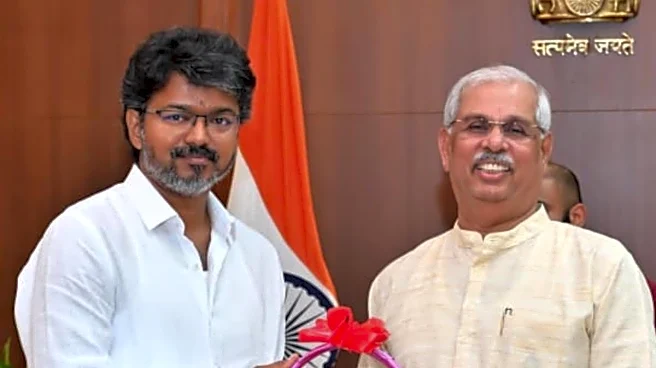
Party: TVK (Tamilaga Vettri Kazhagam) | State: Tamil Nadu Actor-turned-politician Vijay's party TVK made a stunning electoral debut in 2026, emerging as the single largest party in the assembly with 108 seats. Behind the political breakthrough, however, is a less flattering disclosure. Of the 89 TVK candidates who had declared serious criminal cases, 40 went on to win — meaning nearly 40 percent of TVK's victorious MLAs carried criminal cases into the legislature on their very first election.TVK had the highest number of members with pending cases among all major parties in the 2026 Tamil Nadu election, followed by DMK and AIADMK. Vijay built his campaign on a platform of clean governance and youth empowerment. His party's affidavit data told a more complicated story about candidate selection — one that echoed the pattern of every established party before it.
7. Rajeev Chandrasekhar — All Three BJP Kerala Winners Declared Cases
Party: BJP | State: Kerala | Constituency: Nemom The 2026 Kerala elections concluded with a historic landslide for the Congress-led United Democratic Front, which secured 102 seats — its most significant mandate since 1977 — effectively ending a decade of Left Democratic Front rule. Within this sweep, the BJP achieved a strategic breakthrough it had been chasing for years.Rajeev Chandrasekhar, who had lost the Thiruvananthapuram Lok Sabha seat to Congress's Shashi Tharoor in 2024, found victory in Nemom, while V. Muraleedharan won Kazhakoottam by just 428 votes and BB Gopakumar took Chathannoor. According to the ADR report, all three BJP winners had declared criminal cases in their affidavits. Chandrasekhar also emerged as the second-richest winner in Kerala, with declared assets exceeding Rs 111 crore and declared liabilities of over Rs 109 crore — the highest such figure among all winning candidates in the state. Kerala's overall numbers make the individual stories almost secondary. The ADR found that 114 of 135 winning candidates — 84 percent — had declared criminal cases, up from 71 percent in 2021, and 77 winning candidates, or 57 percent, declared serious criminal charges. This was the highest figure of any state in the 2026 election cycle — more than West Bengal, more than Tamil Nadu.
8. Jose Charles Martin — Cheating, Forgery, and a 10,000-Vote Win
Party: LJK (NDA) | State/UT: Puducherry | Constituency: Kamaraj Nagar The National Democratic Alliance, led by Chief Minister N. Rangaswamy's AINRC and the BJP, returned to power in Puducherry's 30-member assembly. The election's most striking individual story, however, belongs to a first-time MLA from a party that didn't exist a year ago. Jose Charles Martin, son of lottery baron Santiago Martin, won the Kamaraj Nagar seat on his electoral debut under his newly formed Latchiya Jananayaka Katchi (LJK), winning by a margin of over 10,000 votes. His affidavit, filed with the Election Commission, lists charges under IPC sections covering criminal breach of trust, cheating, criminal intimidation, and forgery of valuable security — four charges of criminal breach of trust and four of cheating alone. He declared assets worth around Rs 609 crore, with approximately Rs 210 crore in liabilities. The family context adds another layer. His father Santiago Martin, the "Lottery King," reportedly faces 32 cases in Kerala alone, all under CBI investigation. His company Future Gaming and Hotel Services contributed Rs 1,368 crore in electoral bonds — making it one of the largest donors to political parties in India's history. Jose Charles Martin ran on a platform of clean governance and urban development up to 2050. Puducherry gave him its mandate anyway.
The Pattern That Holds Across Every State
The 2026 elections were contested across wildly different political contexts — a historic BJP sweep in Bengal, a Congress resurgence in Kerala, a debut party winning in Tamil Nadu, and a familiar incumbent returning in Puducherry. The political outcomes couldn't have been more varied. The affidavit data, however, told one uniform story. The proportion of candidates with serious criminal cases in Tamil Nadu's 2026 elections nearly doubled compared to 2021, from 6 percent to 10 percent. In Puducherry, the number of candidates with criminal cases rose from 17 percent in 2021 to 23 percent in 2026. Across all five states, the Supreme Court's 2020 directive requiring parties to publicly justify why candidates with criminal records were chosen over cleaner alternatives has had near-zero practical impact. Parties continue to give hollow, boilerplate justifications: "cases are politically motivated", "does good social work", "popular person." The fundamental logic remains unchanged. A candidate with a criminal record has built a reputation — however earned — as someone who can navigate a system that rewards power over procedure. In constituencies where state institutions are absent, inaccessible, or themselves predatory, that reputation is often exactly what voters are looking for. Until the underlying system changes, the affidavit will remain, at best, a footnote.
/images/ppid_a911dc6a-image-177849103370441920.webp)








/images/ppid_a911dc6a-image-177842343338196211.webp)


/images/ppid_59c68470-image-177826007011868385.webp)
