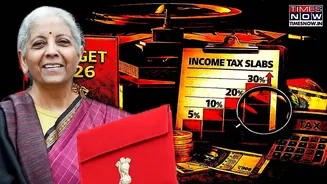

Every time the budget is presented, one hope is constant - will there be a change in income tax slabs? Will I be able to get a little extra back home?
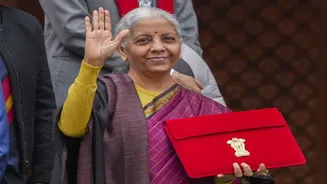
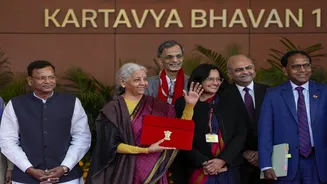
And this year was no different, with most people waiting eagerly for Finance Minister Nirmala Sitharaman to say a word - Income Tax.
But when she did, it ended up being a no show for middle class and salaried class. The Finance Minister has kept income tax slabs unchanged under both the old and new tax regimes in budget 2026.
Sorry to break the news for you, dear fellow salaried class but your take-home salary stays exactly where it was.
Beyond ‘No Income Tax Change’ Headline...
Beyond the headline decision to keep income tax slabs unchanged—a continuity Finance Minister Nirmala Sitharaman underlined in nearly one-and-a-half-hour Budget speech on Sunday, February 1 - the real action in Budget 2026 played out quietly in customs and trade rules.
The government rolled out a series of measures aimed squarely at making India easier to manufacture in and export from: non-residents supplying capital goods to toll manufacturers in bonded zones get a five-year income tax exemption; overseas firms warehousing components in bonded facilities are offered safe-harbour protection; and trusted manufacturers will be allowed to defer duty payments to ease cash-flow pressure.
Exporters, especially in seafood, footwear, leather and textiles, also saw relief—higher limits for duty-free input imports, longer timelines to ship final products, and expanded coverage to include shoe uppers.
In a clear push for high-value manufacturing, the Budget removed basic customs duty on key parts used in microwave ovens, aircraft manufacturing, and defence-related maintenance and overhaul work.
Regular importers with clean track records will now face fewer checks, while exporters using electronic sealing can move cargo straight from factory floors to ports.
Tying it all together is a one-time window allowing eligible SEZ units to sell into the domestic market at concessional duty—an unmistakable signal that while personal tax relief may have been skipped, the government is betting heavily on smoother trade, lower friction, and a quieter, more business-friendly tax architecture.
Under the new tax regime, the same structure continues - from zero tax up to Rs 4 lakh to a 30% rate beyond Rs 24 lakh.
The rebate for those earning up to Rs 12 lakh remains intact, keeping their effective tax at zero if conditions are met. So, all in all the disappointment is more for the next slab - Rs 15 Lakh to Rs 25 lakh that pays the most and takes the most (tax burden).
The rules of old tax regime also stay as is; no changes in slabs and rebates continuing only for incomes up to Rs 5 lakh. Notably, there were no new deductions, exemptions, or enhancements announced for those still clinging to the old system. No change here is possibly part of the government's plan to push for a new tax regime.
Either way, for a middle class and salaried class already juggling EMIs, school fees, rising healthcare costs, and stubborn inflation, this “status quo” doesn’t feel neutral - it feels heavy.
“What’s in it for us… we are technically earning for the government and the government giving benefits to corporate houses. Maximum tax goes from our pocket and nothing for us… for me, this budget is a waste,” says Suneet, a data architect at a multinational in Mumbai.
A similar concern was for a fellow journalist (strictly told not to name her). “The budget was industry-centric, there was nothing for the common man. There is relief for NRIs, tech companies but really nothing for the bracket that contributes the most - Rs 20 lakh plus,” she said, adding that “then this government wants people to move to new regime… and pay straight 30 per cent less.”
“Achhe din kaha hai?” She quipped.
But then there are people who feel that the government is doing the best they can in the current scenario.
“Is it fair for us to expect tax rebates in every budget… people who claim that the budget didn’t do enough should also be aware of the fact that the government is dealing with a lot of global pressure on trade,” said 51-year-old Aastha, a teacher at a government college in Indore.
“Rebates to Tech companies will help us become Aatmanirbhar (self-reliant), which is the need of the hour,” she said.
Experts, however, have given thumbs up to the budget.
"This is a budget with helpful tax proposals, achieved without any revenue giveaway, and with no change to the headline tax rates for corporates or individuals. There are nearly 100 tax amendments that mostly seek to help taxpayers with improved tax certainty as India migrates to a new direct tax law on April 1, 2026. The new law, as previously legislated, is designed to be simpler. Budget 2026, makes it also less rigorous on penalties with ease for small taxpayers,” said Gokul Chaudhri, President - Tax, Deloitte India.
“In a year marked by global trade volatility and aggressive US tariffs, the government’s adherence to fiscal consolidation — aiming for a deficit glide path near 4% — is the ‘stability premium’ foreign investors were looking for,” Vaibhav Mittal, a partner at Khaitan & Co said, as per the Bloomberg report.
He said that by avoiding populist excesses and focusing on “fiscal prudence and monetary stability,” the budget provides the predictability required to bolster the rupee.
Where the Budget Did Move the Needle
That said, Budget 2026 wasn’t entirely static on taxes. The changes just didn’t show up in monthly salary slips.
One big shift: share buybacks will now be taxed as capital gains. Earlier, buybacks followed a separate tax treatment that often confused investors and created planning loopholes. The new approach brings clarity and aligns buybacks with how equity gains are taxed—something market experts have long argued for.
There’s also a welcome relief for small taxpayers with foreign assets. Students studying abroad, tech professionals working overseas, and relocated NRIs who missed reporting minor foreign holdings will now get a six-month compliance window without harsh penalties. In a globalised workforce, this is a rare moment of empathy in tax policy.
Another practical fix affects NRIs selling property in India. The responsibility for TDS deduction will now rest with the resident buyer, tightening enforcement and simplifying compliance—something tax practitioners have repeatedly flagged as necessary.
And for everyday taxpayers, an underrated but important change: revised returns can now be filed up to March 31 by paying a nominal fee. More time, fewer panic errors, and a recognition that honest mistakes happen.
So how will we sum up the tax part for this budget? Cleaner rules. Better compliance. Less ambiguity. But also, no direct relief for the salaried middle class—the group that pays on time, files on time, and rarely escapes the tax net.
Sure the tax system may be smoother. The rules may be clearer. But for the middle class, Budget 2026 still reads like this: Sorry. Not this year either.