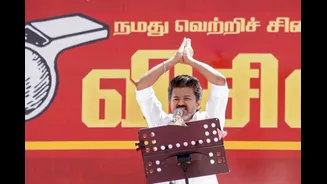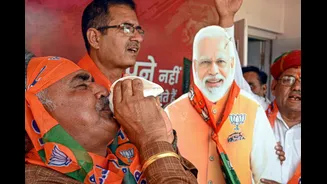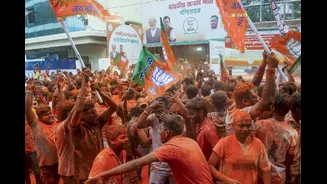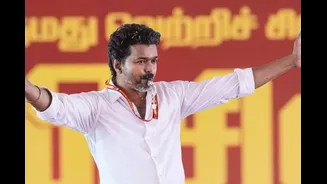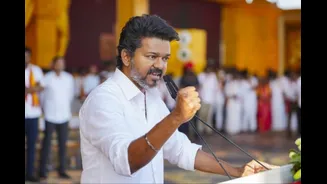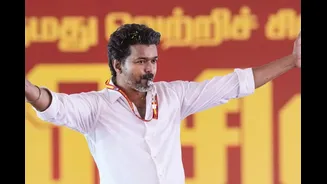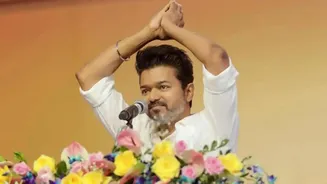






The emergence of Vijay and his party Tamilaga Vettri Kazhagam is not just a state-level development, it is reshaping the political equation in southern
India in ways that are not particularly favourable for the Bharatiya Janata Party. In a region where the BJP has historically struggled to expand beyond pockets of influence, Vijay’s rapid rise introduces a new, locally rooted challenger who is capturing exactly the voter segments the BJP has been trying to win over -- youth, urban voters and those seeking an alternative to entrenched parties. Early 2026 election trends suggest TVK has disrupted traditional alignments in Tamil Nadu, weakened existing alliances and consolidated a new anti-establishment vote, complicating the BJP’s long-term southern expansion strategy.
A new regional force cuts into BJP’s growth space
Vijay’s TVK has emerged as a “formidable force” in its debut election, directly challenging established players like the DMK and AIADMK.
For the BJP, this is a structural problem. Unlike North India, southern politics, especially in Tamil Nadu, has long been dominated by strong regional identities and parties.
TVK’s rise adds a third powerful regional pole, making it harder for the BJP to find political space. Instead of benefiting from anti-incumbency, the BJP now faces a new competitor that is culturally embedded and linguistically aligned with the state’s political ethos, areas where national parties traditionally struggle.
Disruption of BJP’s alliance pathways
The BJP’s strategy in Tamil Nadu has often relied on alliances, particularly with the All India Anna Dravida Munnetra Kazhagam. But Vijay’s surge has disrupted this ecosystem.
TVK’s strong performance has weakened the traditional BJP-AIADMK axis and reshaped the competitive landscape. If AIADMK recalibrates toward TVK or becomes politically weaker, the BJP risks losing its primary gateway into Tamil Nadu politics.
Vijay captures the “change vote”
Across multiple states in 2026, a clear voter trend has emerged: a desire for change and new leadership.
In Tamil Nadu, that sentiment has largely consolidated behind Vijay.
This is significant because the BJP has also positioned itself nationally as an agent of change. But in Tamil Nadu, Vijay has occupied that narrative space more effectively, particularly among:
First-time and young voters
Urban middle classes
Disillusioned voters tired of DMK vs AIADMK politics
This overlap directly cuts into the BJP’s potential growth base.
TVK’s positioning is also a factor. The party leans toward welfare-driven, socially inclusive and regional identity-based politics, drawing from Tamil cultural roots and texts like Thirukkural (as highlighted in campaign messaging).
This contrasts with the BJP’s broader ideological framework, which has historically had limited traction in Tamil Nadu’s Dravidian socio-political landscape. The result: Vijay offers a locally resonant alternative without the ideological baggage that often limits BJP’s appeal in the state.
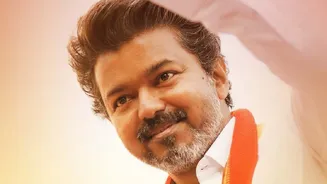
Perhaps the biggest challenge for the BJP is Vijay himself. Like earlier figures such as MGR, he combines cinema-driven mass popularity with political messaging, a powerful mix in Tamil Nadu politics.
Unlike the BJP, which often relies on central leadership campaigns in southern states, Vijay represents a homegrown, emotionally resonant figure. This makes him harder to counter politically.
Bigger picture: BJP’s southern push hits a new hurdle
Even as the BJP makes gains in states like West Bengal and Assam, Tamil Nadu presents a different challenge. Vijay’s rise signals that the path to southern expansion will not just be about defeating existing parties, but also about competing with new-age regional leaders who can mobilise identity, welfare and charisma simultaneously.
Vijay’s emergence is not just a disruption, it is a recalibration of Tamil Nadu politics. For the BJP, it means:
Reduced alliance leverage
Loss of anti-incumbency advantage
Competition for youth and urban voters
A stronger regional counterweight
In short, the BJP is no longer just battling legacy Dravidian parties in Tamil Nadu, it is now up against a fresh, fast-rising force that may be even harder to crack.