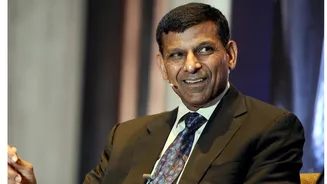







As the Union Budget 2026-27 is right around the corner, former RBI Governor Raghuram Rajan stressed the need for a forward-looking economic approach. He
stressed that India must adopt a strategy that strengthens resilience, reduces vulnerabilities, and sustains growth in a period he described as “extremely dangerous.”
Speaking to PTI Videos, Rajan argued that past budgets have rarely aligned with broader economic planning. “I think it (Union Budget for 2026-27) should be integrated with a longer-term vision. How do we become more resilient, more independent as an economy, but also fast growing, so that everybody else wants to be friends with India, that requires a fair amount of work, and I am hopeful that Finance Minister Nirmala Sitharaman's next budget will take us there,” he said.
The Finance Minister Nirmala Sitharaman is set to present the annual Budget on Sunday, February 1, with expectations high for reforms that can counter geopolitical risks and trade disruptions while encouraging domestic growth.
Preparing For Global Shifts
Rajan highlighted that technological innovations, particularly in artificial intelligence, offer opportunities but also raise risks. “But there is also a lot of danger from becoming too reliant on entities that can squeeze us and make us vulnerable because we do not have a natural market which is nearby, which is rich, that we can supply to other than our own,” he noted.
He stressed that integrating India into global supply chains will require difficult policy decisions, including tariff rationalisation, and stronger state-level policies to attract investment. “And of course, the states are also helping by creating policies that are friendly towards investment. But we need more of that,” he said.
Reviving Reform Momentum
Rajan stressed the importance of reigniting the reform spirit of the 1990s, which drove significant economic growth. “We had a whole range of very big reforms through the 1990s into the early 2000s, then for a while we did not have very much. I think it is time to start that process again,” he said, adding that the focus must now shift to measures that can lift India’s growth rate meaningfully.
He also suggested that India diversify its economic partnerships beyond its immediate neighbours, including with Europe, Australia, Canada, the Middle East, and East Asian countries. “It would be important for India going forward to diversify across the supply chains that it has access to, including with China, but also importantly, with Europe, with Australia, with Canada, with the Middle East, as also with the East Asian countries,” he said.
Prioritising Sustainable Development
Rajan cautioned against chasing short-term growth at the expense of sustainability. “Every city seems to want a metro, but not every city has the ability to put metro stations in the right place, and some of that investment may be hard to recover over time, and clearly, we should not build public infrastructure that people can not use,” he said.
He also stressed the importance of carefully planned housing initiatives. “It includes housing, as not all housing, even if we are a poor country with a lot of people without housing, can be utilised effectively, and so we have to be careful about helter-skelter growth,” he warned.