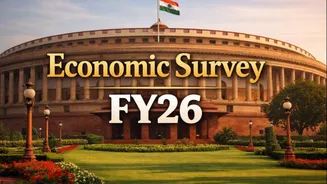








Union Finance Minister Nirmala Sitharaman tabled the Economic Survey for the Financial year 2026 in the Lok Sabha today, ahead of the budget 2026 scheduled
for Sunday. The survey revealed details around the short-term as well as long-term growth prospects. Comprehended as the report card of the Indian economy, it shed light on the key concerns.
The Economic Survey projects India’s real GDP growth in FY27 in the range of 6.8 to 7.2 per cent. At the same time, it anticipates weaker global tailwinds, particularly from exports; it also notes that sustained domestic reforms and public investment could lift the economy’s underlying growth capacity.
What Is Economic Survey?
The economic survey presents a detailed evaluation of the Indian economy, charting key macroeconomic indicators, growth trends, and sectoral performance. It also sets the context for policy debates and shapes expectations in the run-up to the following year’s Union Budget.
It is presented in both the Lok Sabha and Rajya Sabha by the Chief Economic Advisor (CEA), followed by a media briefing, during which the senior finance ministry officials highlight the document’s key findings and economic signals.
Usually, the economic survey focuses on the Real GDP growth outlook, inflation trends and price pressures, performance of key sectors, export strength, along with other key areas.
Who Prepares An Economic Survey?
It is drafted by the Economic Division of the Department of Economic Affairs under the Ministry of Finance. Authored under the guidance of the CEA, currently Dr V Anantha Nageswaran, it provides a comprehensive assessment of the macroeconomic conditions, fiscal trends, and forward-looking risk.
Also Read: Economic Survey 2026 Live Updates: Economic Survey Pegs India's GDP Growth Between 6.8-7.2% In FY27
Why Economic Survey Important?
The Economic Survey offers insights into the priorities that may influence the Union Budget for the following year, and is widely regarded as an indicator of the government’s policy stance.