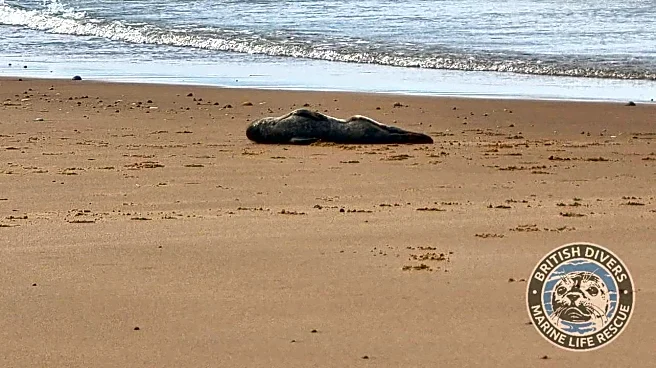








When rescuers found a tiny common seal pup alone on the coast of northern Scotland, he wasn’t moving or making a sound.
Instead, he lay silently on the shore, too weak to call for help.
"The pup was silent, likely conserving all remaining energy due to
being so underweight and weak," Emily Mayman, the national rescue coordinator for British Divers Marine Life Rescue, a UK-based group that rescues marine mammals found in distress, told The Dodo.
The group’s medics hurried to the pup after members of the public reported the animal to the organization’s hotline. When the medics arrived on the scene, they quickly realized just how sick the pup was.
The rescuers transported the young seal to a triage unit, where he spent 48 hours receiving fluids, nutrition, warmth from heat lamps and constant monitoring until he was stable enough to travel. He was then transferred to the Scottish SPCA's National Wildlife Rescue Centre, where staff started calling him Tardi.
While Tardi had made it this far, his future remained uncertain.
"Tardi was one that I was really concerned about when he first arrived," Chloe Burrell, communications officer for the Scottish SPCA, told The Dodo. "He had a guarded prognosis — his lungs were in a very poor condition, he was struggling to tolerate his feeds and he was having difficulty regulating his own body temperature."
"He was an incredibly poorly seal and, at that stage, I genuinely didn't know what the outcome was going to be,” Burrell added.
Tardi’s caregivers did everything they could to help him survive. The young seal received IV fluids to treat severe dehydration, medication prescribed by veterinarians, extra warmth to help regulate his body temperature and tiny meals every couple of hours. Staff closely monitored him and adjusted his care as his condition changed.
Little by little, Tardi started to get better.
"Once he began responding to treatment, we started seeing little improvements," Burrell said. "He became able to regulate his own temperature again, his breathing improved, his lungs started sounding better and he became much more comfortable taking his feeds."
Then, one day, the team noticed something that felt like a breakthrough.
"We came in and realised he'd started chewing on one of the fish we'd left for him," Burrell said. "That was a really exciting moment. For a seal to voluntarily show an interest in fish is a really positive indication that they’re feeling better.”
From that point on, Tardi’s recovery accelerated.
He began eating entirely on his own and eventually came off his medication and was moved into a pool with another rescued seal. Now he’s in one of the center's pre-release pools alongside two new companions, Bug and Mozzy. According to Burrell, he is “thoroughly enjoying” the company of his new friends.
“Tardi’s days are pretty simple — swimming, snoozing in the sun, interacting with the other seals, playing with enrichment and eating his meals,” Burrell said.
Tardi now weighs around 53 pounds, a remarkable jump from the 20 pounds he weighed when he was first rescued. Once he reaches around 77 pounds and shows other signs that he's ready for life back in the wild, he'll be released along the Scottish coast near an established seal colony.
For the people who cared for Tardi, watching him transform from a critically ill pup into a thriving young seal has been incredibly rewarding.
"I'll be honest," Burrell said, “his recovery absolutely surprised me."
For Mayman, Tardi's story is a reminder of why the work of the British Divers Marine Life Rescue is so important.
"We're always delighted when pups turn the corner and begin to thrive," Mayman said. "Our medics always love getting pups into care, as it means hope isn't lost."