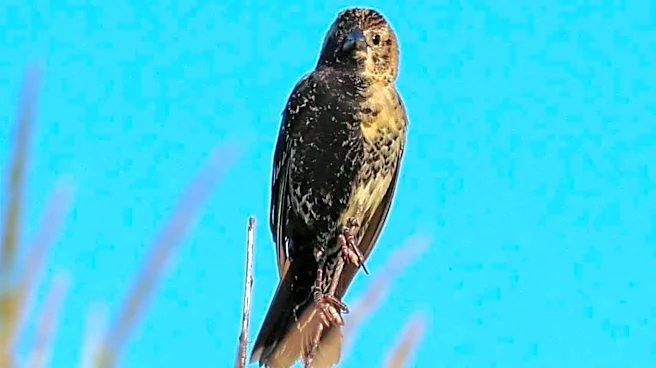









A few months ago, avid birdwatcher Luke Dahlberg was delighted to find a flock of bobolink birds at his workplace, a nature preserve near Illinois’ Barrington Hills. He snapped dozens of photos of the adorable birds, then continued his workday.
But as
he was going through his photos a few weeks later, one particular bobolink stood out to him. The bird’s coloring was split down the middle: the right side was black-and-white and the left side was yellow.
Dahlberg knew that male bobolinks have black-and-white feathers while female individuals have yellow feathers. As he studied the images, it started to seem like the bird he’d photographed was half male and half female. But how was that possible?
Dahlberg went back out to snap more photos of the bird and send them to staff members at the Field Museum of Natural History in Chicago. Sure enough, the experts confirmed that the bird was a perfect example of an extremely rare genetic anomaly called gynandromorphism.
In bilateral gynandromorphs like this bobolink, the male side and female side are evenly split down the middle. In species that have high levels of sexual dimorphism — meaning male and female individuals having noticeable physical differences — the gynandromorphic animals have a striking contrast between their male and female sides.
“Simply put, a bilateral gynandromorph is an organism that is half female (gyn-) and half male (andro-),” Cameron Rutt, a conservation ecologist at the Field Museum of Natural History wrote on Instagram.
To say that spotting a gynandromorphic bird in the wild is rare would be an understatement. Out of the 85 billion individual birds in the world, there have only been 100 individual gynandromorphic birds ever documented. In other words, the bird Dahlberg spotted is one in 850 million.
Gynandromorphic individuals have both male and female anatomy, so Dahlberg was curious about how the bird, whom he nicknamed Black and Tan, would behave. As he observed Black and Tan, he noticed that they seemed to behave more like a male than a female, even pairing up with a female bobolink and producing chicks.
As soon as Rutt heard about the rare bird, he knew he had to take a look for himself. As he observed Black and Tan flying in circles around him, the experience was disorienting. It almost felt like the bobolink was two separate animals, as the bird looked completely different from the left and the right.
Eventually, the bobolink moved on and left the area, but everyone who got the chance to observe such a unique bird feels incredibly lucky.
“I had a better chance of photographing a unicorn,” Dahlberg told WTTW.