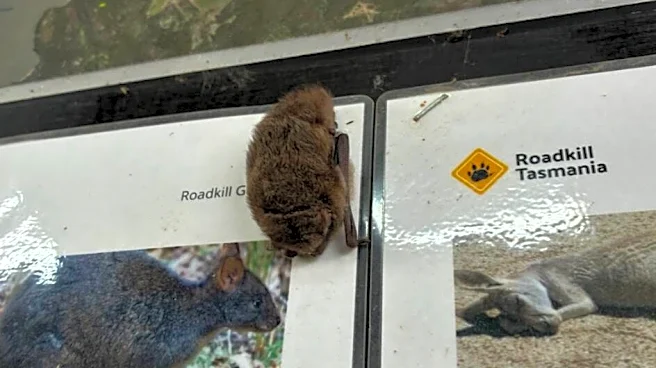

Recently, an employee at Northern Midlands Irrigation Scheme, a water infrastructure network in Tasmania, Australia, entered his site office and noticed a little ball of fuzz hanging from an informational
poster.
The worker, who’s also a wildlife volunteer, realized the animal was a forest bat. He didn’t want to disturb the bat, so he monitored him for three days, hoping he might fly away on his own. When the bat didn’t budge, the employee reached out to Bonorong Wildlife Sanctuary, who sent Tracey Bagger, of Tracey’s Micro Management, to the scene.
Bagger safely contained the bat, later named Bob, and took him back to a safe place for further assessment.
“When I retrieved it off the poster, it made a meager, sleepy attempt to bear its teeth and look scary, but it quickly resigned itself to the safety of my care,” Bagger told The Dodo.
The bat had been in torpor, a form of energy conservation similar to sleep that allows wild bats to survive with very little nourishment during colder months. Typically, bats enter torpor in the safety of their roost. But sometimes, as in this case, bats go into torpor too early, in less ideal locations. In these instances, wildlife rescuers must step in to make sure the bat is OK.
Bagger was glad that the worker had done the right thing by calling for assistance.
“Microbats are quite prolific, but rarely seen,” Bagger said. “If you find one grounded or out in the open in the daylight, it should come into care for assessment.”
Bagger checked the bat for physical injuries and treated him with fluid therapy for three days to ensure he was fully hydrated. Then she began flight training, watching carefully to see if he was ready to return to the wild.
Finally, Bagger released Bob back into the night sky, smiling as he soared off into the clouds.
“It always warms my heart when I do a release,” Bagger said. “For Bob to immediately start swooping and chasing insects in front of us when we released him was an absolute delight.”