








At the Richard Underwood Nature Refuge in southwest Queensland, Australia, a small group of northern hairy-nosed wombats make their homes in burrows throughout the wooded habitat.
These wombats are some of the world's rarest mammals, according to the Australian
Wildlife Conservancy (AWC), with an estimated population of just over 400.
Scientists at the refuge are trying to revitalize northern hairy-nosed wombats, and they often conduct surveys to see whether conservation efforts are working.
In 2024, researchers counted 18 northern hairy-nosed wombats at the refuge, though only three were male. Seeing so few males was a troubling sign, as it could negatively affect the group's long-term genetic diversity.
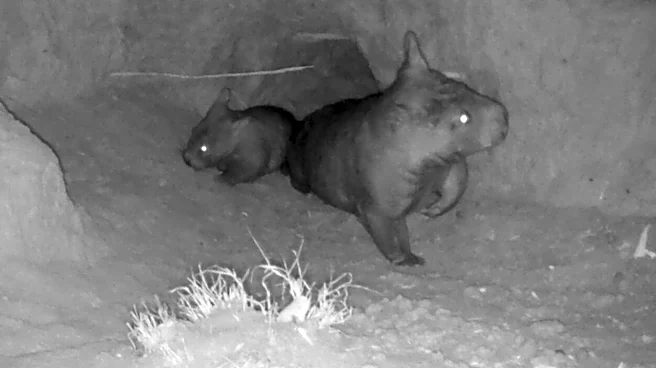
Recently, during a different survey, team members noticed a juvenile wombat outside her mother’s pouch — a brand new baby. Spotting this baby was exciting, and it raised a gripping question: Who was her father?
Now team members are waiting to test the newborn’s DNA, in hopes she may have been fathered by a new, undetected male wombat.
“It feels a bit like we’re in an episode of Jerry Springer,” Dr. Ben Stepkovitch, an AWC wildlife ecologist, said in a press release. “We’re excited to see the little wombat popping up on motion sensor cameras; it’s reassuring to see the population growing, but we also need to conduct a paternity test.”
According to AWC, scientists can’t collect the baby’s DNA until she’s old enough to leave solid scat samples. So they’re waiting it out, crossing their fingers for good news.
Once collected, the sample will be sent to Adelaide University, and scientists will have their answer.
Whatever the result, the team members aren’t giving up on these amazing animals.
“The juvenile’s DNA could tell us whether we have more breeding males in the population than we currently know,” Dr. Stepkovitch said. “Which would be very exciting, if that's the case.”