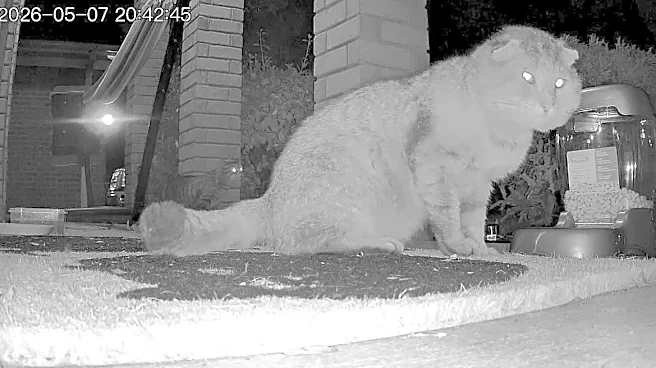









A few months ago, a stray cat showed up outside of Jaclyn Andersen’s home near Memphis, Tennessee. Andersen regularly feeds and cares for the feral cats in her neighborhood, but something about this kitty seemed different.
“[He] showed up in the middle
of the night,” Andersen told The Dodo. “The first thing I noticed was those ginormous tomcat cheeks. They were pretty hard to miss.”
Over the next few days, the tomcat, named Charles, consistently visited Andersen’s home. Like the other neighborhood cats, Charles scarfed down the food Andersen left out. But unlike the other kitties, Charles lingered even after finishing his meal.
“I noticed it seemed like he was sleeping on the doormat for an entire hour … it was just very odd behavior because most of the ferals are usually very skittish,” Andersen said.
Andersen has three indoor cats of her own, one of whom she rescued from the neighborhood last year. Her kitties took a strong interest in Charles and started staring at him through the window every day. She wondered if the former stray cat she’d rescued recognized Charles.
A few days after Charles first showed up at Andersen’s house, he started asking to come inside. It broke Andersen’s heart to see his condition — his ears were folded and infected, and he just looked exhausted.
“When he saw me through the window, he didn’t leave right away,” Andersen said. “He kind of just lingered and started slow blinking at me through the window. It looked like he was trying to tell me something.”
At that point, Andersen knew she had to rescue Charles. She trapped him and brought him to a vet, where he was diagnosed with FIV, a virus that compromises cats’ immune systems. When FIV cats are kept indoors, they tend to live long, healthy lives. So by bringing Charles inside, Andersen saved his life.
For Andersen, making Charles a permanent member of her family was a no-brainer. She wanted to give the kitty a safe place to rest after everything he’d been through.
“I think he’s just so ready to retire and saw a nice senior living center in my household with all my cats that were safe,” Andersen said.
For the past seven weeks, Charles has been decompressing in Andersen’s home. While living a fully indoor life has been a bit of an adjustment, he’s been doing great and opening up more and more every day. He has even been letting Andersen pet him.
“I honestly expected him to hiss at it, and he was totally calm,” Andersen said. “He let me do it, and he really enjoyed it. So I’ve already done it a few times now, and he really likes it.”
Andersen is excited to see how Charles continues coming out of his shell and fully letting himself enjoy his new peaceful life. Before long, he will become a fully integrated member of the household and enjoy the company of his new family.