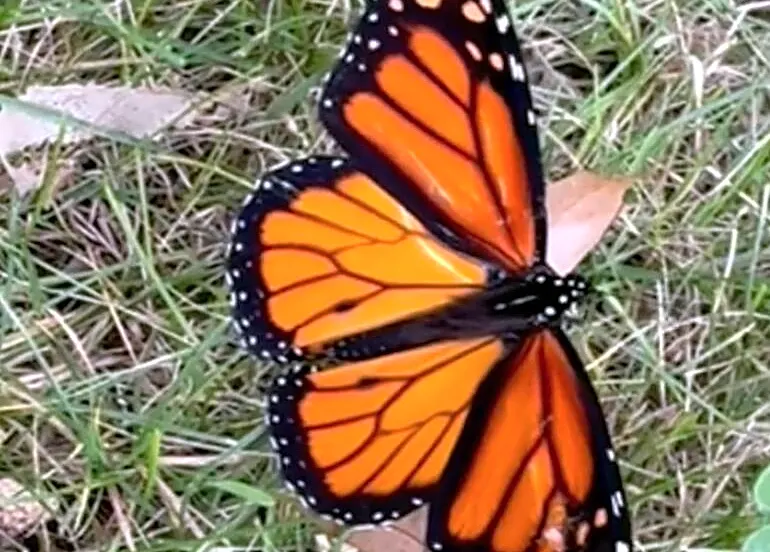






Colleen Attara was getting ready to leave her art studio the other day when she spotted a lone monarch butterfly in the grass. The butterfly was nearly still — only moving one wing and refusing to budge, no matter how close she got.
“I could see that the
left wing was broken near the bottom, close to his body,” Attara said. “The feathers were intact, but the structure of the left wing itself was broken.”
Attara, a mixed media artist, felt compelled to help the butterfly, especially since she had an entire studio filled with different materials that could possibly be used to mend his broken wing.
“[M]y work has always been focused on reusing and repairing, so he landed in the perfect place,” Attara said.
Without skipping a beat, Attara Googled how to help a butterfly with a broken wing and immediately sprang into action. Following the advice she found online, Attara carried the butterfly inside her studio and placed him in a refrigerator for a few minutes to help calm him down.
While the butterfly waited in the fridge, she gathered the materials she’d need to save him: tissue paper and a solid glue stick.
“They suggested tissue paper, no liquid glue and that the trick was to balance the wings,” Attara said.
After six minutes in the fridge, Attara scooped the butterfly up again, gave him some sugar water and began making her first round of repairs. She added tissue paper to his broken wing at first and was pleased to see him finally move it, but he still couldn’t fly very far, as “there was no flutter.”
So, Attara carried the butterfly back to her work station and began improvising a second round of repairs. This time, she grabbed a stack of colorful feathers she’d purchased from an artist and began attaching them to the butterfly’s wings.
“I added a blue and red feather to the broken wing, using the same glue,” Attara said. “I added the gray one to the other wing to balance out the weight.”
You can watch footage of the repairs here:
The butterfly remained calm as Attara cut the feathers down around his wings and carried him outside again. Despite the repairs, the poor butterfly still didn’t make it very far, but Attara refused to give up on him.
“A plane would go overhead and I would say, ‘You don’t have to go that high … but I think you have at least one more flight in you,” Attara said. “There was a part of me that deeply needed to see him take flight.”
That’s when Attara noticed a small gap between the feathers and the butterfly’s actual wings.
“I then put the hinging tape over the top of both of his wings, closing that space,” Attara said.
After nearly two hours of repairs, Attara was eager to see the butterfly finally fly. She brought him to her car, where she sat in the driver’s seat with her arm stretched out the window and the butterfly on her palm.
“I unrolled the window and stuck my hand out with him on it. He started to truly flutter,” Attara said. “I encouraged him to fly. And he did!”
Attara was thrilled to see the butterfly finally take off from her hand and soar into the sky. Shortly after he took off, the butterfly swooped down in front of Attara’s car. And when she went to check on him, she couldn’t find him anywhere.
“I got out expecting him to be on the ground, but he was nowhere to be found,” Attara said. “And an orange monarch with blue, red and gray feathers with hinging tape is very easy to spot.”
Attara kept her eyes peeled for the colorful butterfly. But after a day or so without any sign of him, she came to the conclusion that the repairs worked, and he actually flew away.
The artist later learned that the butterfly was a male with a lifespan of about nine months, who was migrating south. She hoped that her repairs would help him reach his goal and live the best possible life.
As part of her profession, Attara is used to repairing things with miscellaneous materials. She even has a tattoo on her arm that says, “There is such beauty in the small repairs.” But this moment with the butterfly was her most fulfilling project yet.
“I consider this one of my greatest repairs. It was an honor to help him along,” Attara said. “I don’t know where or how far he got, but I know he flew. I like to think of someone far away spotting him and wondering how he looks like this.”