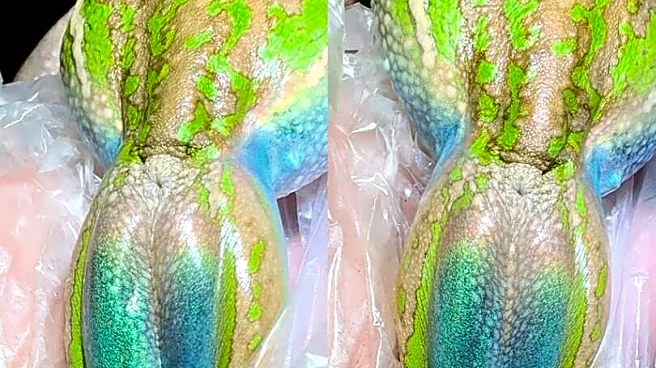







John Gould, a conservation biologist at the University of Newcastle, specializes in monitoring green and golden bell frogs in Australia. Recently, when Gould was photographing one of the frogs, he noticed that the amphibian’s inner thighs appeared to be iridescent.
“Iridescence is an optical effect where an object shifts in color based on viewing angle,” Gould told The Dodo. “This means one viewer may see one color but another viewer at a different location may see an entirely different color at the exact same time.”
As Gould was observing the frog, he wasn’t sure whether the animal was displaying true iridescence or just skin that looked shiny and colorful. Iridescence has mostly been documented in insects and birds, so Gould studied the amphibians carefully to make sure he was correct.
“At first, I thought it was a trick of the light, as iridescence isn’t really something you hear about in the frog world,” Gould said. “But I kept seeing it in all the individuals I processed, both male and female.”
As Gould continued his research, he was pleased to learn that the green and golden bell frogs’ inner thighs were, in fact, truly iridescent. His discovery marks one of the clearest examples of iridescence ever documented in any amphibian species.
“It was incredible to know there was a feature of this frog species I hadn’t really noticed for such a long time,” Gould said.
Skin iridescence is a complex biological phenomenon that involves specialized tissues arranged in a specific order. Gould’s next step in his research is to study the frogs’ skin under a microscope to understand more about the arrangement of the tissues.
“Amphibians have these crystal platelets in their skin that can produce an array of structural colors … Iridescence can only emerge when these platelets have some degree of order to their arrangement, which is solid visual evidence that the platelets are not just randomly ordered,” Gould said.
Gould and his fellow researchers are still trying to understand the specific function of the iridescence, but they suspect it has something to do with protecting themselves against predators.
“[A] frog that’s about to be eaten can flash their brightly colored thighs to signal to a predator that they would be bad to eat,” Gould said.
Unfortunately, green and golden bell frog populations are declining due to introduced species and fungal infections. Gould is hoping that his research will inspire further efforts to protect this unique, vulnerable species.
“It means quite a lot to be able to push our understanding of structural color production among frogs just a little bit forward,” Gould said. “I’m hoping it will show the public that frogs are just as mesmerizing as metallic blue butterflies and color-shifting hummingbirds.”