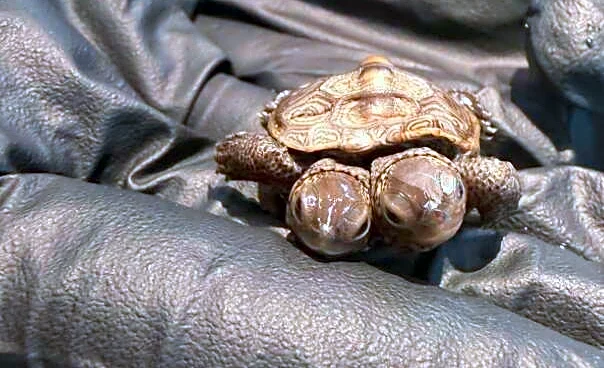




Recently, staff members at Mass Audubon Wellfleet Bay Wildlife Sanctuary were checking on a protected diamondback terrapin turtle nest when they noticed something unusual about one of the babies. The little turtle had two heads — the result of a rare
anomaly called bicephaly.
While the turtle seemed to be in good shape, the sanctuary staff scooped them up and transported them to New England Wildlife Centers' Cape Cod branch. It’s not every day that a two-headed animal shows up at the center, so the staff members were excited.
“In total, this is the third bicephalic terrapin that we’ve seen,” Dr. Priya Patel, wildlife medical director of New England Wildlife Centers, told The Dodo. “[W]e see hundreds of turtles each year. So it is still a pretty rare finding.”
Patel immediately got to work examining the unusual turtle. She noticed that the baby had some of their yolk sac present, which meant they were still very young. Because the terrapin is still absorbing nutrients from their yolk sac, the staff members still have a little time before they need to start introducing food.
“It’s an anomaly, but fortunately, since we’ve seen it before, we kind of know how to proceed,” Patel said.
For now, Patel is focusing on making sure the turtle is as comfortable as possible while she works on slowly introducing them to swimming. Diamondback terrapins are semi-aquatic turtles, so they typically only eat when they’re in a water environment, but the staff aren’t sure how the turtle’s condition will affect their swimming ability.
“Our first priority is just to make sure they’re bright and alert and active,” Patel said.
The turtle having two heads naturally raises a question: Should the patient be considered one individual or two? Because bicephaly is a complex condition that varies on a case-by-case basis, there’s no simple answer.
“For now, we’ve given them one case number, but that’s always a debate with conjoined twins,” Patel said. “Some say if they have two brains, they’re two people. So I don’t think we know enough to know whether we can consider them singular or plural at this time.”
When the baby grows a little bit and stabilizes, the center is planning on running more tests, including an X-ray and CT scan, to learn more about the terrapin’s internal anatomy. With more information, they’ll know how to better care for the turtle (or turtles).
“We’d love to see what parts of their body are combined, what they have separately — do they have separate hearts or a combined heart?” Patel said.
Patel and the rest of the New England Wildlife Centers' staff are looking forward to seeing how this unique turtle continues to develop. Thanks to the rescuers who found the baby and the vets who’ve been caring for this unique animal, this little terrapin has a safe place to grow.