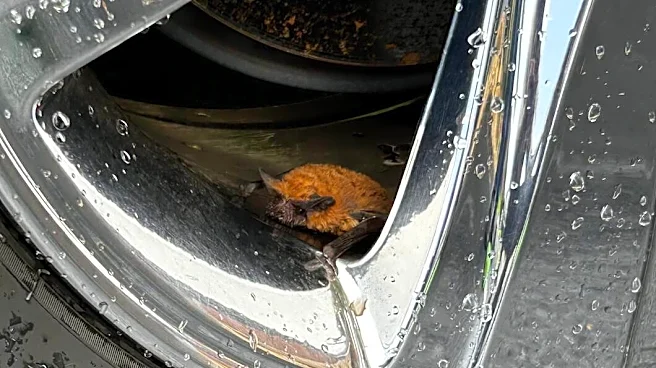

Earlier this month, a resident of Davie, Florida, was washing her car when she noticed a tiny clump of fur peeking out from her tire. As the owner of the car looked closer, she realized there was a bat
stuck in the wheel well.
The bat stayed still in the wheel well and didn’t attempt to fly away, which concerned the woman who’d found her. She called South Florida Wildlife Center (SFWC) for help, and the rescue admitted the little mammal right away.
“Although she was understandably feisty during her examination, she was alert, responsive, and showed no evidence of injury or illness,” Haillie Mesics, SFWC’s development associate and marketing specialist, told The Dodo.
The SFWC staff identified the animal as a Brazilian free-tailed bat. Tens of millions of these bats call North America home, making them some of the continent’s most abundant mammals.
“Brazilian free-tailed bats are among the fastest flying mammals, capable of reaching speeds of over 90 miles per hour during flight, and they travel long distances each night while hunting moths, beetles, mosquitoes and other flying insects,” Mesics told The Dodo.
Although the bat initially seemed relatively healthy, the SFWC staff decided to continue monitoring her at the center. Bats can reach life-threatening levels of dehydration quickly, and the rescuers wanted to make sure she was healthy before releasing her.
“She received subcutaneous fluids to correct her dehydration and was admitted to the hospital overnight for observation,” Mesics said.
Brazilian free-tailed bats, like all bats, play a crucial role in keeping their ecological communities balanced. As insectivores, they help maintain insect population numbers at healthy levels.
“Bats are some of the most misunderstood yet ecologically important mammals in the world,” Mesics said. “As the only mammals capable of true power flight, they play a critical role in maintaining healthy ecosystems by consuming vast numbers of insects each night.”
As for this particular Brazilian free-tailed bat, after a short stay at SFWC, she was already feeling much better. The staff transported her to an outdoor area near where she was initially found and let her fly free.
“I didn’t even have to help her out of the soft carrier; it was like she knew she was back home,” SFWC’s release coordinator, Melanie Lemieux, told The Dodo. “She took off across the water, and I stayed to watch her fly.”
As the little bat flew off into the distance, Lemieux saw other bats emerge from a palm frond and join her in the sky. It warmed her heart to see that the little winged mammal the center had rescued was back with her friends.
“Seeing this bat successfully reunite with her roost after just a day of monitoring was an excellent reminder of how important timely rehabilitation and release can be for these highly social mammals,” SFWC’s director of operations, Carolina Montano, told The Dodo.