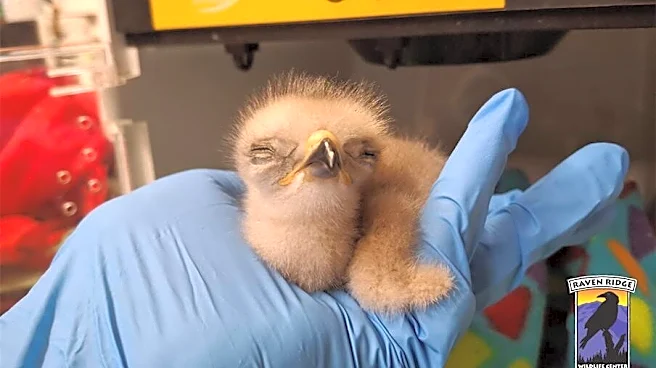






Last month, the folks at Raven Ridge Wildlife Center (RRWC) received a worrying call from a local resident named Angie. Angie’s dog had found a “white ball of fuzz” in their yard, whom RRWC’s staff identified as a baby Cooper’s hawk, and he was in desperate need of help.
“[W]e quickly realized that this Cooper's hawk chick was far too small to be on the ground and away from its nest,” RRWC wrote on Facebook.
The vulnerable hatchling likely fell from his nest. But when RRWC’s rescue team got there, they had no way of knowing which nest he’d come from. There were many Cooper’s hawks in the area, and they didn’t want to place the baby somewhere he didn’t belong. Plus, he was already very fragile.
“[T]he baby Cooper's hawk was very weak and cold,”
RRWC wrote. “These hawks cannot thermoregulate their body temperature, especially at just a day or so old. Given the circumstances, it was clear that if this hawk were to survive, it would need to be admitted for care."
So, the rescue team transported the baby back to their wildlife hospital, where they officially confirmed his age thanks to a unique bump on his beak called an “egg tooth.”
“[It’s] a temporary, sharp, horn-like bump on its beak used to pierce the internal membrane and crack the eggshell during hatching … before falling off a few days after hatching,” RRWC wrote.
In addition to his egg tooth, the rescue team could tell that the Cooper’s hawk was only a few days old because he fit perfectly into their palms that first day. So, they put the baby hawk on a strict feeding schedule and placed him in an incubator to stay warm.
And to ensure he wouldn’t imprint on humans during his recovery, they put a mirror and photos of adult hawks in the baby’s incubator.
“It will be with us for some time until it is strong enough to stand, eat on its own, and develop its flight feathers,” RRWC wrote.
In the weeks following his rescue, the baby hawk began to thrive. He started eating more consistently, and his caregivers could tell he was well-nourished just by looking at the bulge he’d developed on his chest, known as a “crop.”
“How can we tell when a hawk is full from eating? Look at the size of its crop,” RRWC wrote on Facebook. “Generally, food travels from the mouth down the esophagus and into the crop, a pouch that serves as a temporary storage area before entering the two-part stomach …”
You can see the baby hawk’s crop here:
While the baby hawk still has ways to go in his recovery journey, he’s getting stronger every day thanks to RRWC’s care team. Once he’s able to fly and eat independently, he’ll be ready to return to the wild — and his team of caregivers can’t wait to witness that moment.
Until then, they’ll keep showering the baby hawk with love and care, still in awe that a day-old baby could be such a resilient little fighter.
“This is a fortunate hatching!” RRWC wrote.