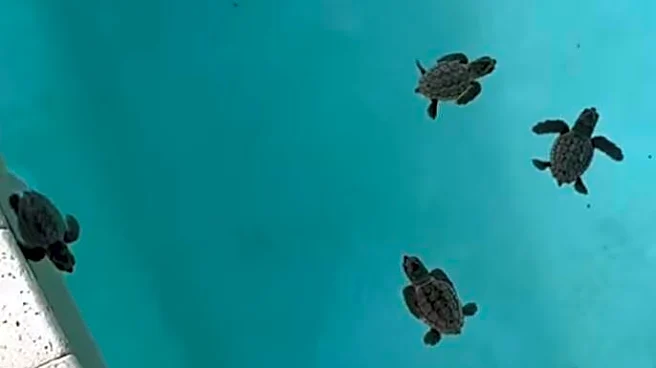







Last week, a homeowner in Islamorada, Florida, noticed dozens of tiny animals swimming around in their backyard swimming pool. As the owner looked more closely, they were shocked to discover that their pool had been taken over by baby sea turtles.
Knowing
the sea turtles wouldn’t survive in the small, chlorinated pool, the owners called The Turtle Hospital for help. Unfortunately, during turtle nesting season, the hospital gets calls about stranded hatchlings almost daily. Baby sea turtles rely on natural light patterns to guide them into the ocean after they hatch, and when those patterns get disrupted by light pollution, it can confuse them.
In the Florida Keys and many other sea turtle habitats around the world, hatchlings have been having a tougher and tougher time with each passing year. The Turtle Hospital frequently responds to calls about babies stuck inside storm drains or even caught on busy, dangerous roads.
“[I]t does seem to be an increasing problem as we develop our coastlines and we have more artificial light with resorts and vacation rentals and homes along our coastlines,” Bette Zirkelbach, general manager at The Turtle Hospital, told The Dodo. “That artificial light disorients those babies, so they come out of the nest and they see a bright light and they go towards the light.”
Although The Turtle Hospital finds baby sea turtles stuck in all kinds of circumstances, the sheer number of babies inside the homeowner’s pool was still shocking. The rescuers ended up counting 64 total hatchlings.
“It’s the most I’ve seen in a swimming pool, for sure,” Zirkelbach said.
The rescuers transported all 64 babies back to the hospital facility, then cleaned them off and administered fluids to help them get their strength back up. Then they gave all the hatchlings swim tests, which they passed with flying colors, having already been paddling around in the pool.
Just a few days after the turtles were rescued from the pool, they were ready to be released into the ocean. Zirkelbach placed them directly into the Gulf Stream, where they seemed perfectly content and at ease right away.
Zirkelbach was thrilled to have given the 64 little sea turtles second chances at life. But what would make her even happier is reducing the number of babies who get harmed by light pollution. If you live in or are visiting an area with sea turtle hatchlings, the best thing you can do to help is turning off your lights at night or looking into turtle-safe lights that are at specific wavelengths which don’t interfere with their vision.
“[C]ompassion is contagious,” Zirkelbach said. “I think the most important thing we can all do to help sea turtles is to fall in love with them.”