/images/ppid_59c68470-image-178789252591688203.webp)


What is the story about?
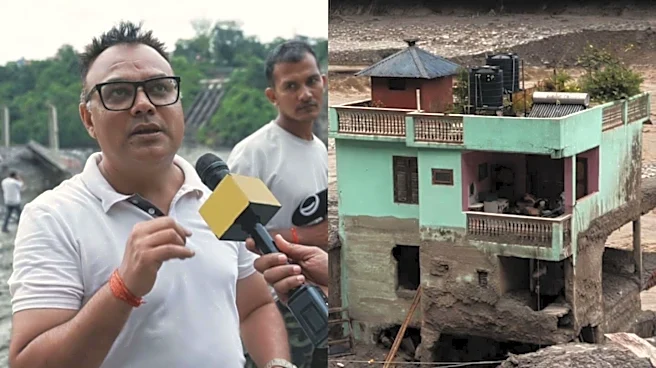
Even as scientists are collating data and building a broader picture of the reasons behind the Nepal catastrophe, the collapse of a large section of glacier has emerged as the likely trigger.
Experts say rising temperatures are reshaping high-mountain environments by accelerating glacier melt, altering meltwater pathways and, in some locations, destabilising the ice.
Why does a glacier collapse
A glacier collapse occurs when a large and weak section of glacier breaks away or fails, sending ice, rock and water down the mountain slope. While in some cases it can happen naturally, scientists feel that climate change can create conditions that can destabilise the high-altitude ice.
Warming can accelerate surface melting and change the meltwater pathways. Water entering the crevasses and cracks can reach the glacier bed, where it may reduce friction between ice and rock. This can increase the instability.
“This is an unprecedented event, one that we had not previously imagined at this scale. We are relatively familiar with glacial lake outburst floods (GLOFs), but such a large-scale glacier collapse was not anticipated. It's hard to believe a water-level rise of more than 70 m at some river cross-sections. The volume of water released after the glacier collapse remains a mystery, and we do not yet know its source,” says Dibas Shreshta , Assistant Professor, Central Department of Hydrology and Meteorology , Tribhuvan University, Kirtipur, Kathmandu, Nepal.
Shreshta maintains that the flash flood was triggered by the collapse of a huge hanging section of the glacier on the northern slope of the famous Lirung Peak in the Langtang Valley.
“My rough estimate is that approximately 350,000 m² of glacier area collapsed, releasing an estimated 7–10 million m³ of water equivalent from the failed ice mass,” he says.
Mohan Chand, Assistant Professor, Department of Environmental Science, Kathmandu University, says: “A preliminary assessment indicated that a large avalanche blocked the Lhende River, trapping a large volume of water, and the sudden breaching of the dam caused the floods. And now it has been proved with several satellite images and footage from the nearby locations.”
Is climate change responsible?
Scientists say climate change is increasing the likelihood of several types of high-mountain hazards, although linking any individual disaster directly to warming requires detailed analysis.
“Warming destabilises these landscapes - more snow and glacier meltwater, more warming and thaw of permafrost - so you get more floods, landslides, debris flows. But it is too early to say for this event because we're still crunching through data, and new videos, images, etc., are coming to light all the time. It's hard to attribute any one event to climate change,” says Simon Cook, a glaciologist and geoscientist at the University of Dundee in Scotland.
Are such disasters becoming more common?
Alton Byers, a glacier-hazards and community-preparedness expert at the Institute of Arctic and Alpine Research (INSTAAR), University of Colorado Boulder, says these events are increasing in frequency, magnitude and destructive force.
“The Himalayas have witnessed a growing frequency of glacier- and mountain-related disasters in recent years. Those similar to the Nepal tragedy include the Seti Khola disaster in Nepal (2012), the Chamoli rock-and-ice avalanche in India (2021), the South Lhonak GLOF in Sikkim (2023), and the Thame flood in Nepal (2024), among others. “
These events illustrate how the range of cryospheric hazards emerging from an increasingly unstable high-mountain environment, in addition to glacial lake outburst floods (GLOF), are becoming a permanent feature of the high-altitude mountain world.
Ashim Sattar, GLOF expert and Assistant Prof, IIT Bhubaneswar, however, maintains that glacier collapse is very unpredictable and not as common as regular avalanches. "Unless we have a broad set of data, we cannot say the frequency is increasing. We also need to know the magnitude of the event."
Glacier collapse vs GLOF: What’s the difference
Experts say the difference is only in the origin and source.
"Typical glacier lake outburst floods (GLOF) involve breaching of glacial lake dams due to various triggers, including avalanches, rockfalls, debris flows, and seismic events, while glacier collapse is a type of ice avalanche, the breaking off of a large chunk of ice from the glacier, says Chand. This could be due to natural glacier velocity on high slopes, hanging-type glaciers, or bedrock failure where glacier ice lies.
Shreshta says the glacier collapse is completely different from the GLOF. “This is the phenomenon of breaking down a large part of the glacier because of the increased velocity of a certain section of the glacier. That could be because of warming of the glacier bed, substantial accumulation of fresh snow in the upper part, or the percolation of surface meltwater. At this stage, we cannot identify the exact mechanism responsible for the collapse.”
“GLOF involves a lake, impounded by ice, bedrock or moraine or a combination of all. These lakes can burst for various reasons, the most common being a landslide into the lake and generating a damaging flood, “ says Cook, adding, “A glacier collapse, on the other hand, does not involve a lake; a chunk of ice or a whole tongue falls off the side of the mountain. The ice becomes pulverised and generates a debris flow or flood.”
Glaciers and climate change
According to a review published in January 2026 in Nature, the cryosphere of the Himalayan-Karakoram is rapidly retreating under climate change, leading to widespread formation and expansion of glacial lakes and increasing the risk of glacial lake outburst floods(GLOFs).
The review titled—Glacial lakes and GLOFs in a warming Himalaya-Karakoram region: current understanding, challenges and the way forward mentions that growing exposure of settlements and infrastructure amplifies impacts, highlighting the need to integrate physical science with social vulnerability, preparedness, and adaptation strategies.
Another study published in Nature published in February 2025 and titled –Community estimate of global glacier mass changes from 2000 to 2023—mentions that glaciers are indicators of ongoing anthropogenic climate change. “Their melting leads to increased local geohazards, and impacts marine and terrestrial ecosystems, regional freshwater resources, and both global water and energy cycles,” the study notes
“We can attribute it to the rapid melting of the glaciers and accelerated warming, which is making the high mountain environment more sensitive and unstable, along with fragile geology. However, we need more verification to directly connect this particular event to climate change,” Chand maintains.
Can these events be predicted?
Scientists feel that it is difficult to predict when similar events can happen.
Sattar says these events cannot be predicted, but certainly there could be ways to detect the precursors, like abnormal behaviour of the glaciers. “The problem is that since there are thousands of glaciers, where should you put the sensors? It is therefore important to have some kind of regional-scale monitoring.”
Scientifically, there are potential early warning signs, but detecting them in the remote Himalaya remains extremely challenging, says Shreshta. “Scientists can monitor rapid changes in glacier velocity, increasing crevassing and surface deformation, thinning or retreat of unstable glacier sections, changes in supraglacial ponds and meltwater pathways, unusual accumulation of snow or ice, and seismic signals associated with glacier movement or collapse. “
High-resolution satellite imagery, InSAR, optical feature tracking, time-lapse cameras, seismic networks, GNSS and automated weather and hydrological stations can all contribute. However, monitoring and prediction can be extremely difficult across the vast, rugged, and remote Himalayan terrain.
Byers says that regions of high risk, like overhanging ice susceptible to breakage, can be identified using regularly monitored satellite imagery.
"A more pragmatic solution to avoiding similar catastrophes in the future is to enforce restrictions on unregulated building and construction in floodplains.”
Can they be mitigated?
Byers says one of the most pragmatic ways to reduce casualties is to restrict construction in floodplains exposed to historical and ongoing monsoon or glacier-related flooding.
Nepal has experienced a surge in unplanned and unregulated urbanisation starting about 15 years ago that extended into the historically flooded regions of major rivers. Other structural interventions include construction of gabions (rock-filled wire cages) along river channels to divert flood flow, building higher bridges, and building on higher ground (I’ve seen all three of these in active use in the Nepal highlands.
Researchers should identify potentially dangerous glacial lakes and high-risk overhanging ice, develop models on the impacts under low/medium/high flood volumes, create hazard maps and share them with local communities.
Chamoli: An Indian precedent
Chamoli offers a striking Indian precedent. The Chamoli disaster in February 2021 showed that the Himalayas have already witnessed how a sudden failure of ice and rock at high altitude can cascade into a devastating flood far downstream.
On February 7, 2021, a huge mass of rock and glacier ice broke away from Ronti Peak in Uttarakhand's Chamoli district, plunging into the Rishiganga valley and transforming into a highly destructive debris flow that swept downstream, killing hundreds of people and damaging two hydropower projects.
Experts say rising temperatures are reshaping high-mountain environments by accelerating glacier melt, altering meltwater pathways and, in some locations, destabilising the ice.
Why does a glacier collapse
A glacier collapse occurs when a large and weak section of glacier breaks away or fails, sending ice, rock and water down the mountain slope. While in some cases it can happen naturally, scientists feel that climate change can create conditions that can destabilise the high-altitude ice.
Warming can accelerate surface melting and change the meltwater pathways. Water entering the crevasses and cracks can reach the glacier bed, where it may reduce friction between ice and rock. This can increase the instability.
“This is an unprecedented event, one that we had not previously imagined at this scale. We are relatively familiar with glacial lake outburst floods (GLOFs), but such a large-scale glacier collapse was not anticipated. It's hard to believe a water-level rise of more than 70 m at some river cross-sections. The volume of water released after the glacier collapse remains a mystery, and we do not yet know its source,” says Dibas Shreshta , Assistant Professor, Central Department of Hydrology and Meteorology , Tribhuvan University, Kirtipur, Kathmandu, Nepal.
Shreshta maintains that the flash flood was triggered by the collapse of a huge hanging section of the glacier on the northern slope of the famous Lirung Peak in the Langtang Valley.
“My rough estimate is that approximately 350,000 m² of glacier area collapsed, releasing an estimated 7–10 million m³ of water equivalent from the failed ice mass,” he says.
Mohan Chand, Assistant Professor, Department of Environmental Science, Kathmandu University, says: “A preliminary assessment indicated that a large avalanche blocked the Lhende River, trapping a large volume of water, and the sudden breaching of the dam caused the floods. And now it has been proved with several satellite images and footage from the nearby locations.”
Is climate change responsible?
Scientists say climate change is increasing the likelihood of several types of high-mountain hazards, although linking any individual disaster directly to warming requires detailed analysis.
“Warming destabilises these landscapes - more snow and glacier meltwater, more warming and thaw of permafrost - so you get more floods, landslides, debris flows. But it is too early to say for this event because we're still crunching through data, and new videos, images, etc., are coming to light all the time. It's hard to attribute any one event to climate change,” says Simon Cook, a glaciologist and geoscientist at the University of Dundee in Scotland.
Are such disasters becoming more common?
Alton Byers, a glacier-hazards and community-preparedness expert at the Institute of Arctic and Alpine Research (INSTAAR), University of Colorado Boulder, says these events are increasing in frequency, magnitude and destructive force.
“The Himalayas have witnessed a growing frequency of glacier- and mountain-related disasters in recent years. Those similar to the Nepal tragedy include the Seti Khola disaster in Nepal (2012), the Chamoli rock-and-ice avalanche in India (2021), the South Lhonak GLOF in Sikkim (2023), and the Thame flood in Nepal (2024), among others. “
These events illustrate how the range of cryospheric hazards emerging from an increasingly unstable high-mountain environment, in addition to glacial lake outburst floods (GLOF), are becoming a permanent feature of the high-altitude mountain world.
Ashim Sattar, GLOF expert and Assistant Prof, IIT Bhubaneswar, however, maintains that glacier collapse is very unpredictable and not as common as regular avalanches. "Unless we have a broad set of data, we cannot say the frequency is increasing. We also need to know the magnitude of the event."
Glacier collapse vs GLOF: What’s the difference
Experts say the difference is only in the origin and source.
"Typical glacier lake outburst floods (GLOF) involve breaching of glacial lake dams due to various triggers, including avalanches, rockfalls, debris flows, and seismic events, while glacier collapse is a type of ice avalanche, the breaking off of a large chunk of ice from the glacier, says Chand. This could be due to natural glacier velocity on high slopes, hanging-type glaciers, or bedrock failure where glacier ice lies.
Shreshta says the glacier collapse is completely different from the GLOF. “This is the phenomenon of breaking down a large part of the glacier because of the increased velocity of a certain section of the glacier. That could be because of warming of the glacier bed, substantial accumulation of fresh snow in the upper part, or the percolation of surface meltwater. At this stage, we cannot identify the exact mechanism responsible for the collapse.”
“GLOF involves a lake, impounded by ice, bedrock or moraine or a combination of all. These lakes can burst for various reasons, the most common being a landslide into the lake and generating a damaging flood, “ says Cook, adding, “A glacier collapse, on the other hand, does not involve a lake; a chunk of ice or a whole tongue falls off the side of the mountain. The ice becomes pulverised and generates a debris flow or flood.”
Glaciers and climate change
According to a review published in January 2026 in Nature, the cryosphere of the Himalayan-Karakoram is rapidly retreating under climate change, leading to widespread formation and expansion of glacial lakes and increasing the risk of glacial lake outburst floods(GLOFs).
The review titled—Glacial lakes and GLOFs in a warming Himalaya-Karakoram region: current understanding, challenges and the way forward mentions that growing exposure of settlements and infrastructure amplifies impacts, highlighting the need to integrate physical science with social vulnerability, preparedness, and adaptation strategies.
Another study published in Nature published in February 2025 and titled –Community estimate of global glacier mass changes from 2000 to 2023—mentions that glaciers are indicators of ongoing anthropogenic climate change. “Their melting leads to increased local geohazards, and impacts marine and terrestrial ecosystems, regional freshwater resources, and both global water and energy cycles,” the study notes
“We can attribute it to the rapid melting of the glaciers and accelerated warming, which is making the high mountain environment more sensitive and unstable, along with fragile geology. However, we need more verification to directly connect this particular event to climate change,” Chand maintains.
Can these events be predicted?
Scientists feel that it is difficult to predict when similar events can happen.
Sattar says these events cannot be predicted, but certainly there could be ways to detect the precursors, like abnormal behaviour of the glaciers. “The problem is that since there are thousands of glaciers, where should you put the sensors? It is therefore important to have some kind of regional-scale monitoring.”
Scientifically, there are potential early warning signs, but detecting them in the remote Himalaya remains extremely challenging, says Shreshta. “Scientists can monitor rapid changes in glacier velocity, increasing crevassing and surface deformation, thinning or retreat of unstable glacier sections, changes in supraglacial ponds and meltwater pathways, unusual accumulation of snow or ice, and seismic signals associated with glacier movement or collapse. “
High-resolution satellite imagery, InSAR, optical feature tracking, time-lapse cameras, seismic networks, GNSS and automated weather and hydrological stations can all contribute. However, monitoring and prediction can be extremely difficult across the vast, rugged, and remote Himalayan terrain.
Byers says that regions of high risk, like overhanging ice susceptible to breakage, can be identified using regularly monitored satellite imagery.
"A more pragmatic solution to avoiding similar catastrophes in the future is to enforce restrictions on unregulated building and construction in floodplains.”
Can they be mitigated?
Byers says one of the most pragmatic ways to reduce casualties is to restrict construction in floodplains exposed to historical and ongoing monsoon or glacier-related flooding.
Nepal has experienced a surge in unplanned and unregulated urbanisation starting about 15 years ago that extended into the historically flooded regions of major rivers. Other structural interventions include construction of gabions (rock-filled wire cages) along river channels to divert flood flow, building higher bridges, and building on higher ground (I’ve seen all three of these in active use in the Nepal highlands.
Researchers should identify potentially dangerous glacial lakes and high-risk overhanging ice, develop models on the impacts under low/medium/high flood volumes, create hazard maps and share them with local communities.
Chamoli: An Indian precedent
Chamoli offers a striking Indian precedent. The Chamoli disaster in February 2021 showed that the Himalayas have already witnessed how a sudden failure of ice and rock at high altitude can cascade into a devastating flood far downstream.
On February 7, 2021, a huge mass of rock and glacier ice broke away from Ronti Peak in Uttarakhand's Chamoli district, plunging into the Rishiganga valley and transforming into a highly destructive debris flow that swept downstream, killing hundreds of people and damaging two hydropower projects.