/images/ppid_59c68470-image-178791502724961802.webp)

/images/ppid_59c68470-image-178783504461633544.webp)
/images/ppid_59c68470-image-178794255329731267.webp)
What is the story about?
Every year around August 28, financial markets turn their attention to Jackson Hole, Wyoming, where economists and central bankers gather for one of the most closely watched policy events on the calendar.
The annual event has often been more than an academic gathering. Over the years, Fed chiefs have used their Jackson Hole speeches to signal important shifts in monetary policy, giving markets an early indication of what could come next.
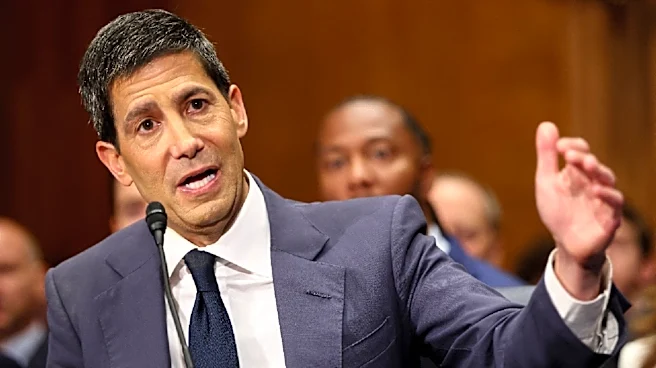
This year, all eyes are on US Federal Reserve Chair Kevin Warsh, who is making his first appearance at the symposium in his current role. Investors will look for clues on how he plans to deal with inflation and where interest rates could go from here.
Here are some of the moments that stood out:
So, what could Kevin Warsh signal this time?
Warsh’s approach to communicating policy has already marked a departure from his predecessor Jerome Powell. Warsh has repeatedly argued against rigid ‘forward guidance’ and what he describes as excessive "handholding" of financial markets. That makes it less likely that investors will get a clear answer from him on whether the Fed will raise rates at its September 15-16 meeting.
The US economy is facing a mix of a weakening labour market and inflation that remains above the Fed's 2% target, making the next policy move difficult to predict. Traders are now pricing in a 33.7% chance of a rate hike at the September meeting, down from 39.9% a week earlier, according to CME FedWatch.
That leaves Wall Street with an unusual Jackson Hole setup. After years of markets hanging on every word from the Fed chair, Warsh's first major speech could offer more questions than answers.
“I think we will continue to see less forward communication coming from the Fed chair, and I do think to some extent that makes sense. He might look at some big-picture focus in terms of the overall policy, but I don't really expect a lot in terms of forward guidance here. So, there will be some disappointment for the markets expecting to get more clarity on the policy path from here,” Neeraj Seth, Founder and CIO of 3R Investment Management, told CNBC-TV18.
For markets hoping for a clear signal on rates, Jackson Hole this year could turn out to be a non-event.
The annual event has often been more than an academic gathering. Over the years, Fed chiefs have used their Jackson Hole speeches to signal important shifts in monetary policy, giving markets an early indication of what could come next.
This year, all eyes are on US Federal Reserve Chair Kevin Warsh, who is making his first appearance at the symposium in his current role. Investors will look for clues on how he plans to deal with inflation and where interest rates could go from here.
Here are some of the moments that stood out:
| Year | Fed chief | What happened at Jackson Hole |
| 2010 | Ben Bernanke | Signalled the launch of a second round of quantitative easing – which means buy US bonds and provide plentiful cash to the market at low rates. |
| 2012 | Ben Bernanke | At Jackson Hole, Bernanke defended his unconventional policy of QE setting the ground for more quantitative easing, leading to a further rally in bonds. |
| 2019 | Jerome Powell | Shifted towards proactive rate cuts to help growth. Wall street cheered and dollar fell. |
| 2020 | Jerome Powell | Powell unveiled his theory of average inflation targeting i.e. Fed won’t worry if inflation went above its 2% target, provided over a few years inflation averages 2%. Bond yields shot up as the market prepared for higher inflation. |
| 2022 | Jerome Powell | In a short 8 minute speech Powell bluntly warned the economy that taming inflation will require aggressive rate hikes. |
| 2024 | Jerome Powell | Powell u-turned and said time has come for policy to adjust thus signalling a flood of rate cuts. |
So, what could Kevin Warsh signal this time?
Warsh’s approach to communicating policy has already marked a departure from his predecessor Jerome Powell. Warsh has repeatedly argued against rigid ‘forward guidance’ and what he describes as excessive "handholding" of financial markets. That makes it less likely that investors will get a clear answer from him on whether the Fed will raise rates at its September 15-16 meeting.
The US economy is facing a mix of a weakening labour market and inflation that remains above the Fed's 2% target, making the next policy move difficult to predict. Traders are now pricing in a 33.7% chance of a rate hike at the September meeting, down from 39.9% a week earlier, according to CME FedWatch.
That leaves Wall Street with an unusual Jackson Hole setup. After years of markets hanging on every word from the Fed chair, Warsh's first major speech could offer more questions than answers.
“I think we will continue to see less forward communication coming from the Fed chair, and I do think to some extent that makes sense. He might look at some big-picture focus in terms of the overall policy, but I don't really expect a lot in terms of forward guidance here. So, there will be some disappointment for the markets expecting to get more clarity on the policy path from here,” Neeraj Seth, Founder and CIO of 3R Investment Management, told CNBC-TV18.
For markets hoping for a clear signal on rates, Jackson Hole this year could turn out to be a non-event.
/images/ppid_59c68470-image-17879300552039616.webp)

/images/ppid_59c68470-image-178791258203443165.webp)
/images/ppid_59c68470-image-178792252579528644.webp)
/images/ppid_59c68470-image-178789006817448231.webp)
/images/ppid_59c68470-image-178788257003867076.webp)
/images/ppid_59c68470-image-178792756565216158.webp)