/images/ppid_59c68470-image-178923004156814685.webp)

/images/ppid_59c68470-image-178920506833255302.webp)

/images/ppid_59c68470-image-178904752453844935.webp)
What is the story about?
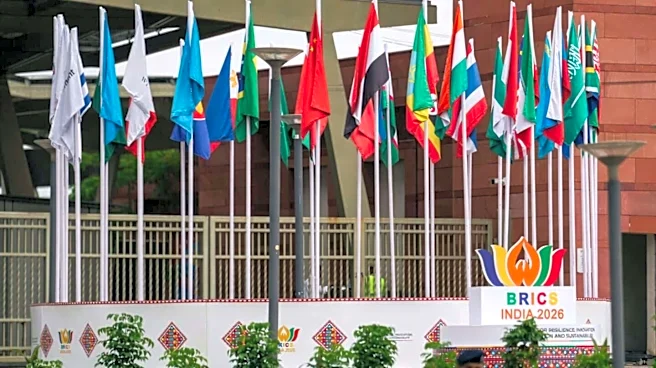
India's role in BRICS could become increasingly important for trade, technology and economic cooperation as the grouping looks to strengthen the voice of the Global South.
Experts discussing the New Delhi Declaration said the next phase will depend on how effectively member countries turn their commitments into practical initiatives.
Speaking on a business news channel, economist and trade expert Deepak Singhal said India should look beyond traditional commodity trade and focus on areas such as digital infrastructure, artificial intelligence and sustainable development. He pointed to India's progress in digital public infrastructure as an opportunity to develop solutions that could be shared with other BRICS members.
Singhal also stressed the need to move from declarations to execution so that the benefits of economic cooperation reach people and businesses across member countries. For India, this could create opportunities to expand its digital technology capabilities and strengthen its position in emerging international markets.
Former Indian ambassador to Latin America Deepak Bhojwani highlighted the growing discussion around cross-border payment systems and the use of national currencies. He said the declaration reflects efforts to reduce dependence on the unilateral use of the US dollar as an economic tool.
Read Here | Amitabh Kant backs deeper China ties to boost manufacturing, expand Global South trade
However, Sarang Shidore, Director of the Global South Program at the Quincy Institute for Responsible Statecraft, offered a more measured assessment of the pace of change. He said BRICS is making progress on local currency transactions, but the dollar remains firmly established in global trade and finance.
For Indian businesses, the development of alternative payment arrangements could eventually support trade diversification, although the experts did not suggest that a major shift away from the dollar is imminent.
Shidore said the grouping should neither be dismissed as irrelevant nor treated as a threat to the existing global order. In his view, BRICS continues to bring together countries with different interests, including India, which seeks constructive relations with major powers while pursuing its own development goals.
Hamed Mousavi, an adjunct professor at Carleton University, said BRICS could contribute to a more multipolar global economy if it gradually develops financial mechanisms that are less dependent on the dollar.
The broad message from the discussion was that the declaration provides a platform for deeper economic engagement, but its impact will depend on implementation. For India, progress in digital technology, sustainable development, trade and payment systems could be key areas to watch in the coming months and years.
For the entire discussion, watch the accompanying video
Catch all the live updates from the BRICS Summit 2026
Experts discussing the New Delhi Declaration said the next phase will depend on how effectively member countries turn their commitments into practical initiatives.
Speaking on a business news channel, economist and trade expert Deepak Singhal said India should look beyond traditional commodity trade and focus on areas such as digital infrastructure, artificial intelligence and sustainable development. He pointed to India's progress in digital public infrastructure as an opportunity to develop solutions that could be shared with other BRICS members.
Singhal also stressed the need to move from declarations to execution so that the benefits of economic cooperation reach people and businesses across member countries. For India, this could create opportunities to expand its digital technology capabilities and strengthen its position in emerging international markets.
Former Indian ambassador to Latin America Deepak Bhojwani highlighted the growing discussion around cross-border payment systems and the use of national currencies. He said the declaration reflects efforts to reduce dependence on the unilateral use of the US dollar as an economic tool.
Read Here | Amitabh Kant backs deeper China ties to boost manufacturing, expand Global South trade
However, Sarang Shidore, Director of the Global South Program at the Quincy Institute for Responsible Statecraft, offered a more measured assessment of the pace of change. He said BRICS is making progress on local currency transactions, but the dollar remains firmly established in global trade and finance.
For Indian businesses, the development of alternative payment arrangements could eventually support trade diversification, although the experts did not suggest that a major shift away from the dollar is imminent.
Shidore said the grouping should neither be dismissed as irrelevant nor treated as a threat to the existing global order. In his view, BRICS continues to bring together countries with different interests, including India, which seeks constructive relations with major powers while pursuing its own development goals.
Hamed Mousavi, an adjunct professor at Carleton University, said BRICS could contribute to a more multipolar global economy if it gradually develops financial mechanisms that are less dependent on the dollar.
The broad message from the discussion was that the declaration provides a platform for deeper economic engagement, but its impact will depend on implementation. For India, progress in digital technology, sustainable development, trade and payment systems could be key areas to watch in the coming months and years.
For the entire discussion, watch the accompanying video
Catch all the live updates from the BRICS Summit 2026


/images/ppid_59c68470-image-17892100345427432.webp)






/images/ppid_59c68470-image-178912253683146610.webp)