/images/ppid_59c68470-image-179065752357750905.webp)

/images/ppid_59c68470-image-179060502893062799.webp)
/images/ppid_59c68470-image-179061508641963239.webp)

What is the story about?
Drew Pettit, Chief Investment Strategist at Roundhill Investments, says US equities can withstand a 10-year Treasury yield of around 5.3%, but investors are getting close to that level. He says strong earnings growth in the S&P 500 and Nasdaq is helping keep investors in equities even as higher bond yields make fixed income more attractive.
Pettit says the next phase will require investors to become more selective, particularly as higher rates put pressure on cyclicals and small caps. On AI, he remains in the “early innings”, pointing to strong demand for compute and infrastructure, although he expects the investment theme to become more volatile and prefers buying AI-related plays on pullbacks.
This is an edited transcript of the interview.
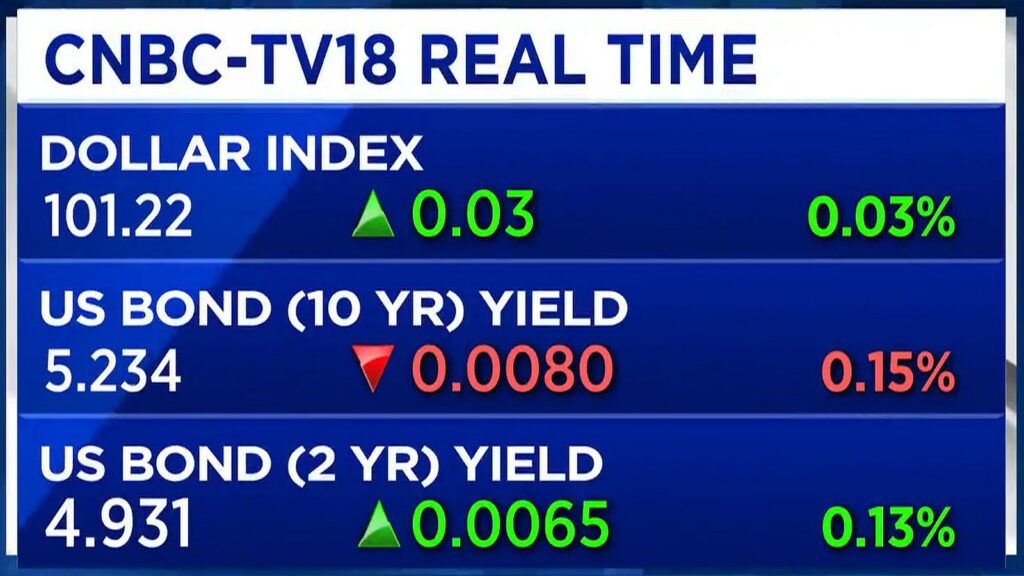
Q: Let's talk about the bond yields to begin with. The 10-year at 5.23%, the highest since 2007. The 10-year has moved up 50 to 60 basis points in two months. Expand the horizon. We're talking about a 70-80 basis points increase in bond yields in the US 10-year in a span of three months, 30-year highest since 2004. Now you've been bullish when we spoke to you, and while you were at Citi, you've been bullish on the US equity market. At what point does it start hurting? And now that you're at Roundhill, what is the investment thesis that you're working with?
A: It's funny when we think about interest rates in the United States. We focus on the 10-year. I think that's where the US market is most sensitive, not necessarily the front end of the curve, but on the 10-year, and we are testing our thesis right now for the S&P 500 and the Nasdaq.
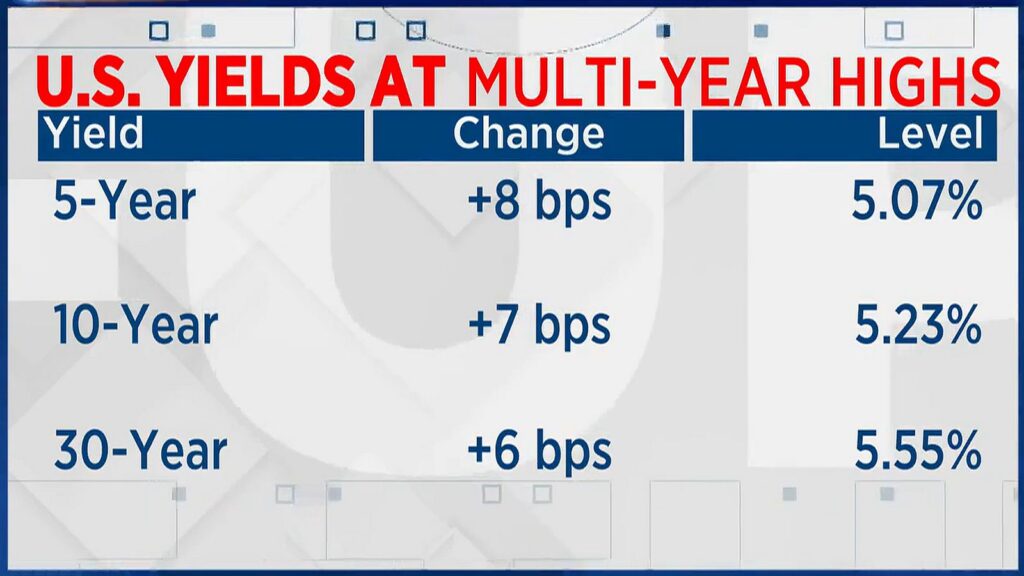
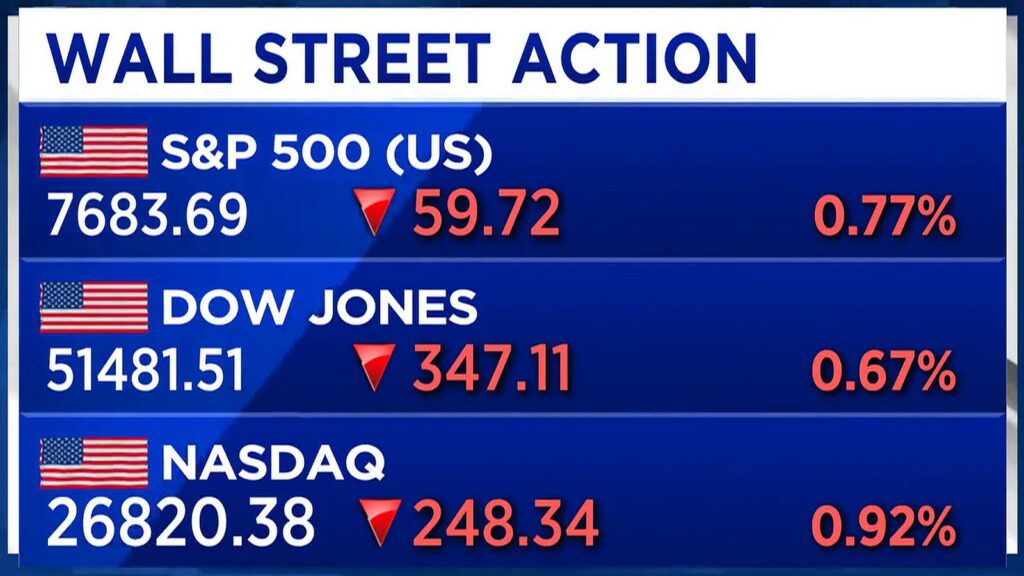
We think it can survive a 10-year of about 5.3%. So, we're getting dangerously close to that level right now. And to us, when rates are higher, it just means growth in equities has to be even better to keep investors in those markets rather than rotating out to other asset classes, where the returns, especially for bonds in the United States, are starting to look better and better.
So again, 5.3% on the 10-year, we're hovering near that level. But earnings growth is delivering, which is keeping investors in the S&P and in the Nasdaq.
Q: So, suppose we get to 5.3%. How would you change your view on US equities?
A: We would start to get even more selective. When we get to higher rates, I keep stressing this enough: not all else is equal.
The one thing where equities, where things change, is growth expectations can move higher, and they have very aggressively for the Nasdaq and the S&P. The difference is when we look down cap and into cyclicals in the United States, that's where earnings growth expectations actually haven't gone up.
Earnings on the quarters have been good, but the expectations for the next few years have not been. So, when you're seeing the rate pressure come up, and people concerned that the Fed is going to continue to raise interest rates, which puts more upward pressure on bond yields and downward pressure on cyclical growth, you get to that point where you really can't leg into small caps.
You've got to get really, really selective into the growth areas of the market where you have conviction.
Q: Till about three weeks back, there was all that worry about US debt and fiscal spending, and Scott Bessent, United States Secretary of the Treasury, saying, "I'm the house" and all that. Now, all that is forgotten? And this is about the yields jumping the way they are — is all about strong growth and inflation, or how much of it is government spending?
A: Government spending is definitely playing a part here. I would say a lot of this talk about the $5,000 dividend tariff, dividend checks don’t really help.
I just think, in general, the US investors might actually like a stalemate when it comes to government, when we think about the midterm elections.
What I think is happening, to be honest with you, it's a little bit of debt, and I think it's a little bit of Fed. Because when we look at what has actually driven the last 50 or 60 basis points of that 10-year moving higher, it's not inflation expectations out 10 years; it's actually just the real rate.
And that is even more concerning for the cyclicals because every time you get good inflation and good demand, again, stronger demand, inflation goes up. That should be good for stocks and earnings.
You have this reaction function that the Fed might be more aggressive and really stamp that out. So, the concern to us is that real rate moves puts pressure on cyclicals more than the inflation move does, and that's what's driven this last leg higher in US interest rates.
Q: What's interesting is that every time the expectations of inflation are higher and you have geopolitical uncertainty, we see a spike in gold prices. But this time around, gold prices aren't moving. In fact, the correlation is plus one as against minus one.
A: It's been a bit of a messy macro environment. And look, gold had big moves and big flows at the beginning of the year. You saw people buying it and Bitcoin. So, there's kind of these other alternatives that are out there, if you're worried about dollar debasement in US debt.
So, it's not just a clean inflation story. And honestly, on the inflation side, I heard it in prior segments on your show. If artificial intelligence (AI) and growth are driving it, gold might not be the hedge.
If you're worried about energy prices and energy demand, and where diesel goes in the United States, again, gold might not be the perfect hedge.
So, to us, I can see why the gold breakdown exists right now because there's other commodities and other plays to manage that inflation risk.
Q: Is anyone talking about India when they're looking at the emerging market basket?
A: This has been, to be honest with you, a little bit of a pain point because outside of South Korea, Taiwan, and then parts of China, you're still looking at India as more of a cyclical economy, a price taker on oil.
It hasn't come up in a lot of our thematic discussions as of late. People are still really focused on where they can buy strong AI-related earnings growth, and that's been a major focus that we've seen in the past month.
Q: How much more upside do you think is still there in the AI-related plays? Because a lot of the capex is done. People believe that maybe the next round of capital expenditure on artificial intelligence would come at a higher cost as well, and the returns would not be as much as the earlier rounds. And at the same time, cost of money is increasing. All these factors, with the discounting factor because of higher rates coming in, put a bit of a lid. Where do you think we are there?
A: So, still surprisingly early innings. It was funny just listening to that report on Anthropic again earlier in your programming. They're spending so much on compute. There's just not enough infrastructure there. Demand is so high.
And then what we've seen, the Federal Reserve in the United States has actually just released AI adoption surveys, and those are still quite low and growing really quickly, both at the personal level, and we saw agentic AI come out from Facebook recently, and at the business level.
So again, early innings. I understand the return on interest (ROIs) might come down, but that end demand is so strong that we still think we're early innings.
Stuff like dynamic random-access memory (DRAM) on the memory side, the Magnificent Seven, the Mags (Nvidia, Apple, Alphabet, Microsoft, Amazon, Meta Platforms, and Tesla), and the hyperscalers. Early innings, but again, you're into a more volatile phase. We like kind of buying these on pullbacks.
Watch the full conversation here
Q: Have you thought about the profound question of whether AI will end humanity?
A: All I can say is AI can't win any arguments against my three- and four-year-old. And I would say, as a user of it, it's given me, I would say, a lot more time and a lot more efficiency, and I'm excited to use it.
But I do honestly, reading the essays, I do see the risk, especially on the cyber side. So again, bit of a double-edged sword. There's good — people use it, you get good outcomes. Bad people use it, you get bad outcomes.
Catch all the latest updates from the stock market here
Pettit says the next phase will require investors to become more selective, particularly as higher rates put pressure on cyclicals and small caps. On AI, he remains in the “early innings”, pointing to strong demand for compute and infrastructure, although he expects the investment theme to become more volatile and prefers buying AI-related plays on pullbacks.
This is an edited transcript of the interview.
Q: Let's talk about the bond yields to begin with. The 10-year at 5.23%, the highest since 2007. The 10-year has moved up 50 to 60 basis points in two months. Expand the horizon. We're talking about a 70-80 basis points increase in bond yields in the US 10-year in a span of three months, 30-year highest since 2004. Now you've been bullish when we spoke to you, and while you were at Citi, you've been bullish on the US equity market. At what point does it start hurting? And now that you're at Roundhill, what is the investment thesis that you're working with?
A: It's funny when we think about interest rates in the United States. We focus on the 10-year. I think that's where the US market is most sensitive, not necessarily the front end of the curve, but on the 10-year, and we are testing our thesis right now for the S&P 500 and the Nasdaq.
We think it can survive a 10-year of about 5.3%. So, we're getting dangerously close to that level right now. And to us, when rates are higher, it just means growth in equities has to be even better to keep investors in those markets rather than rotating out to other asset classes, where the returns, especially for bonds in the United States, are starting to look better and better.
So again, 5.3% on the 10-year, we're hovering near that level. But earnings growth is delivering, which is keeping investors in the S&P and in the Nasdaq.
Q: So, suppose we get to 5.3%. How would you change your view on US equities?
A: We would start to get even more selective. When we get to higher rates, I keep stressing this enough: not all else is equal.
The one thing where equities, where things change, is growth expectations can move higher, and they have very aggressively for the Nasdaq and the S&P. The difference is when we look down cap and into cyclicals in the United States, that's where earnings growth expectations actually haven't gone up.
Earnings on the quarters have been good, but the expectations for the next few years have not been. So, when you're seeing the rate pressure come up, and people concerned that the Fed is going to continue to raise interest rates, which puts more upward pressure on bond yields and downward pressure on cyclical growth, you get to that point where you really can't leg into small caps.
You've got to get really, really selective into the growth areas of the market where you have conviction.
Q: Till about three weeks back, there was all that worry about US debt and fiscal spending, and Scott Bessent, United States Secretary of the Treasury, saying, "I'm the house" and all that. Now, all that is forgotten? And this is about the yields jumping the way they are — is all about strong growth and inflation, or how much of it is government spending?
A: Government spending is definitely playing a part here. I would say a lot of this talk about the $5,000 dividend tariff, dividend checks don’t really help.
I just think, in general, the US investors might actually like a stalemate when it comes to government, when we think about the midterm elections.
What I think is happening, to be honest with you, it's a little bit of debt, and I think it's a little bit of Fed. Because when we look at what has actually driven the last 50 or 60 basis points of that 10-year moving higher, it's not inflation expectations out 10 years; it's actually just the real rate.
And that is even more concerning for the cyclicals because every time you get good inflation and good demand, again, stronger demand, inflation goes up. That should be good for stocks and earnings.
You have this reaction function that the Fed might be more aggressive and really stamp that out. So, the concern to us is that real rate moves puts pressure on cyclicals more than the inflation move does, and that's what's driven this last leg higher in US interest rates.
Q: What's interesting is that every time the expectations of inflation are higher and you have geopolitical uncertainty, we see a spike in gold prices. But this time around, gold prices aren't moving. In fact, the correlation is plus one as against minus one.
A: It's been a bit of a messy macro environment. And look, gold had big moves and big flows at the beginning of the year. You saw people buying it and Bitcoin. So, there's kind of these other alternatives that are out there, if you're worried about dollar debasement in US debt.
So, it's not just a clean inflation story. And honestly, on the inflation side, I heard it in prior segments on your show. If artificial intelligence (AI) and growth are driving it, gold might not be the hedge.
If you're worried about energy prices and energy demand, and where diesel goes in the United States, again, gold might not be the perfect hedge.
So, to us, I can see why the gold breakdown exists right now because there's other commodities and other plays to manage that inflation risk.
Q: Is anyone talking about India when they're looking at the emerging market basket?
A: This has been, to be honest with you, a little bit of a pain point because outside of South Korea, Taiwan, and then parts of China, you're still looking at India as more of a cyclical economy, a price taker on oil.
It hasn't come up in a lot of our thematic discussions as of late. People are still really focused on where they can buy strong AI-related earnings growth, and that's been a major focus that we've seen in the past month.
Q: How much more upside do you think is still there in the AI-related plays? Because a lot of the capex is done. People believe that maybe the next round of capital expenditure on artificial intelligence would come at a higher cost as well, and the returns would not be as much as the earlier rounds. And at the same time, cost of money is increasing. All these factors, with the discounting factor because of higher rates coming in, put a bit of a lid. Where do you think we are there?
A: So, still surprisingly early innings. It was funny just listening to that report on Anthropic again earlier in your programming. They're spending so much on compute. There's just not enough infrastructure there. Demand is so high.
And then what we've seen, the Federal Reserve in the United States has actually just released AI adoption surveys, and those are still quite low and growing really quickly, both at the personal level, and we saw agentic AI come out from Facebook recently, and at the business level.
So again, early innings. I understand the return on interest (ROIs) might come down, but that end demand is so strong that we still think we're early innings.
Stuff like dynamic random-access memory (DRAM) on the memory side, the Magnificent Seven, the Mags (Nvidia, Apple, Alphabet, Microsoft, Amazon, Meta Platforms, and Tesla), and the hyperscalers. Early innings, but again, you're into a more volatile phase. We like kind of buying these on pullbacks.
Watch the full conversation here
Q: Have you thought about the profound question of whether AI will end humanity?
A: All I can say is AI can't win any arguments against my three- and four-year-old. And I would say, as a user of it, it's given me, I would say, a lot more time and a lot more efficiency, and I'm excited to use it.
But I do honestly, reading the essays, I do see the risk, especially on the cyber side. So again, bit of a double-edged sword. There's good — people use it, you get good outcomes. Bad people use it, you get bad outcomes.
Catch all the latest updates from the stock market here
/images/ppid_59c68470-image-179078006248429276.webp)
/images/ppid_59c68470-image-179077256828958478.webp)



/images/ppid_59c68470-image-179072502810491557.webp)
/images/ppid_59c68470-image-179064762591759094.webp)

/images/ppid_59c68470-image-179057262453748266.webp)
/images/ppid_59c68470-image-179069262743248111.webp)