/images/ppid_59c68470-image-179068752844997341.webp)

/images/ppid_59c68470-image-179065752357750905.webp)
/images/ppid_59c68470-image-179059518732876454.webp)
/images/ppid_59c68470-image-179067763795296992.webp)
What is the story about?
On a dating app, signing up usually means getting straight to a search: build a rudimentary profile and start swiping. Hinge is taking a different approach in India. Some new users will now have to wait before they can start matching, and the wait may not be just a few hours or days.
This is Hinge's new waitlist feature. It's part of a new safety and privacy push the company is making. Hinge says the move is a testament to India having become an increasingly important market for it. "India is Hinge’s second-largest country by downloads/registrations, after the US, and it's the third-largest by monthly active users, after the US and UK," CEO Jackie Jantos told CNBC-TV18.
The dating app has been in India since 2015 and says it has seen strong organic growth in a market that has numerous dating and matrimonial platforms catering to an increasingly tech-savvy and internet-adept population.
“There’s been a real evolution in young Indian singles wanting to have some agency over finding partners, finding long-term partners, and finding love,” Jantos said.
Globally, Hinge has 15 million monthly active users, though the company does not disclose India-specific user or revenue numbers.
A more controlled entry into dating
The waitlist is one of the biggest changes Hinge is introducing as part of its new India experience.
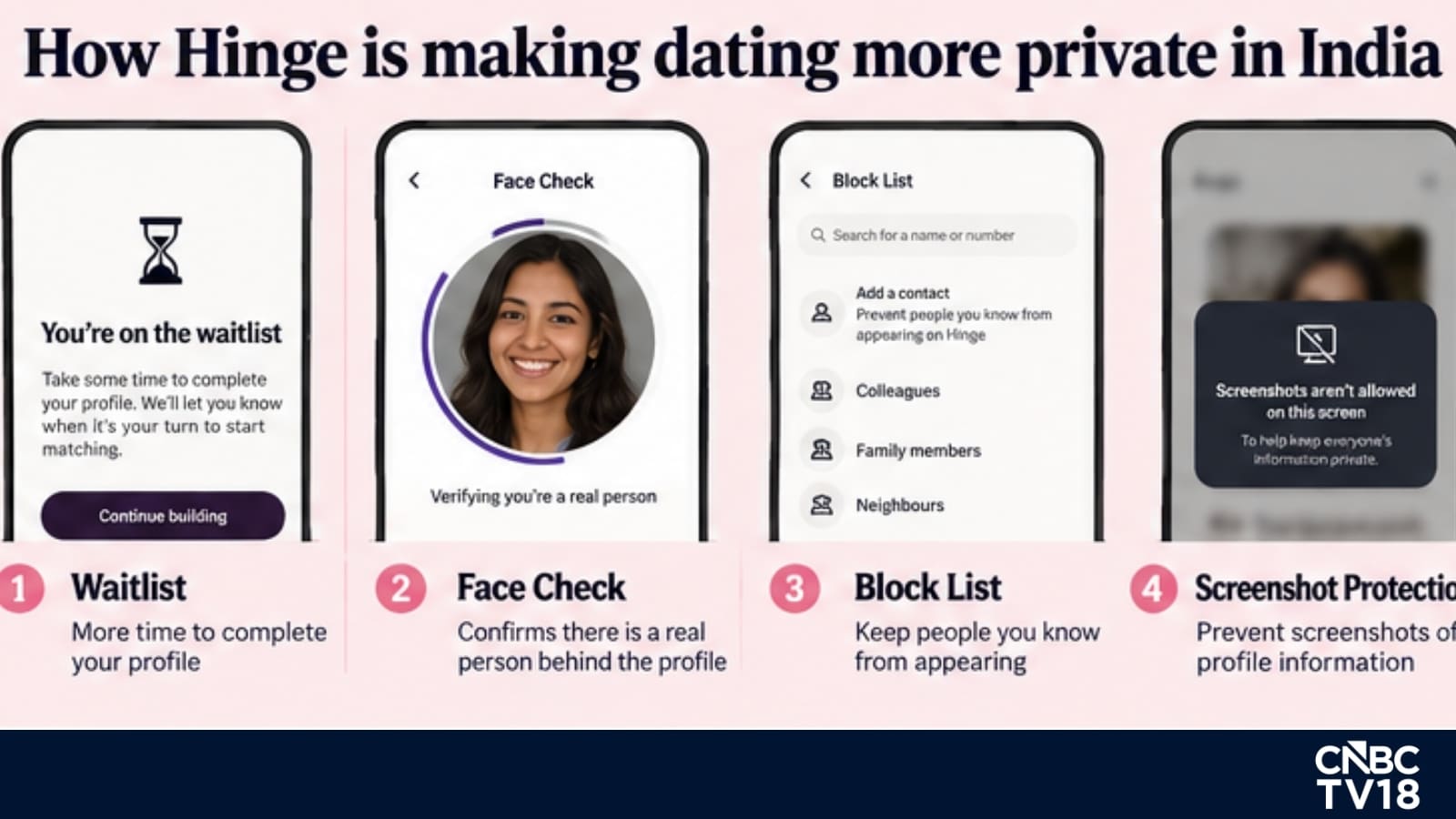
Some new users will be placed on a waitlist after creating their profile. During that time, they can add photographs, answer Hinge’s prompts and verify their profile before they begin matching and liking other users. The waitlist itself is a global feature, but Hinge is using this broader product push to introduce several features specifically for users in India.
That includes Face Check, which is designed to confirm that there is a real person behind an account. Face Check is being introduced specifically for Hinge users in India, alongside two other India-specific privacy features: Block List and Screenshot Protection.
The Block List lets users avoid seeing, or having their profile seen by, people they already know, such as an ex, colleague or family member. Screenshot Protection blocks screenshots on profile surfaces containing personally identifiable information, including profiles shown in Discover, Likes You and Standouts. Users can still take screenshots of conversations if they need to report a concern.
Together, these features give Hinge users more control over who can find them, what can be shared from their profile and whether the person behind an account is who they say they are.
Jantos said Hinge's detailed onboarding is intentional. Around one in five people who start the onboarding process do not complete it, a drop-off the company says it is comfortable with because users are asked to provide photographs, answer prompts and give more information about themselves.
For Hinge, the India-specific push comes as safety and privacy become a bigger consideration as its user base grows. Jantos said the company has seen a particular need among women and LGBTQI+ communities. “There is a need for more safety and privacy,” she said.
The company's Trust & Safety team monitors activity, user reports, and potential policy violations to identify and remove bad actors.
Fewer endless chats, more meaningful interactions
Hinge is also trying to put more structure around what happens after a match.
Its Signals feature gives users a profile badge based on care and consistency on the platform. A Comment Filter lets users filter unwanted words, emojis or phrases from comments, while Match Note allows people to privately share information about a value, boundary, faith, or communication style with a match before a conversation begins. The company says these tools are being brought to India as part of its broader effort to give users more control during interactions.
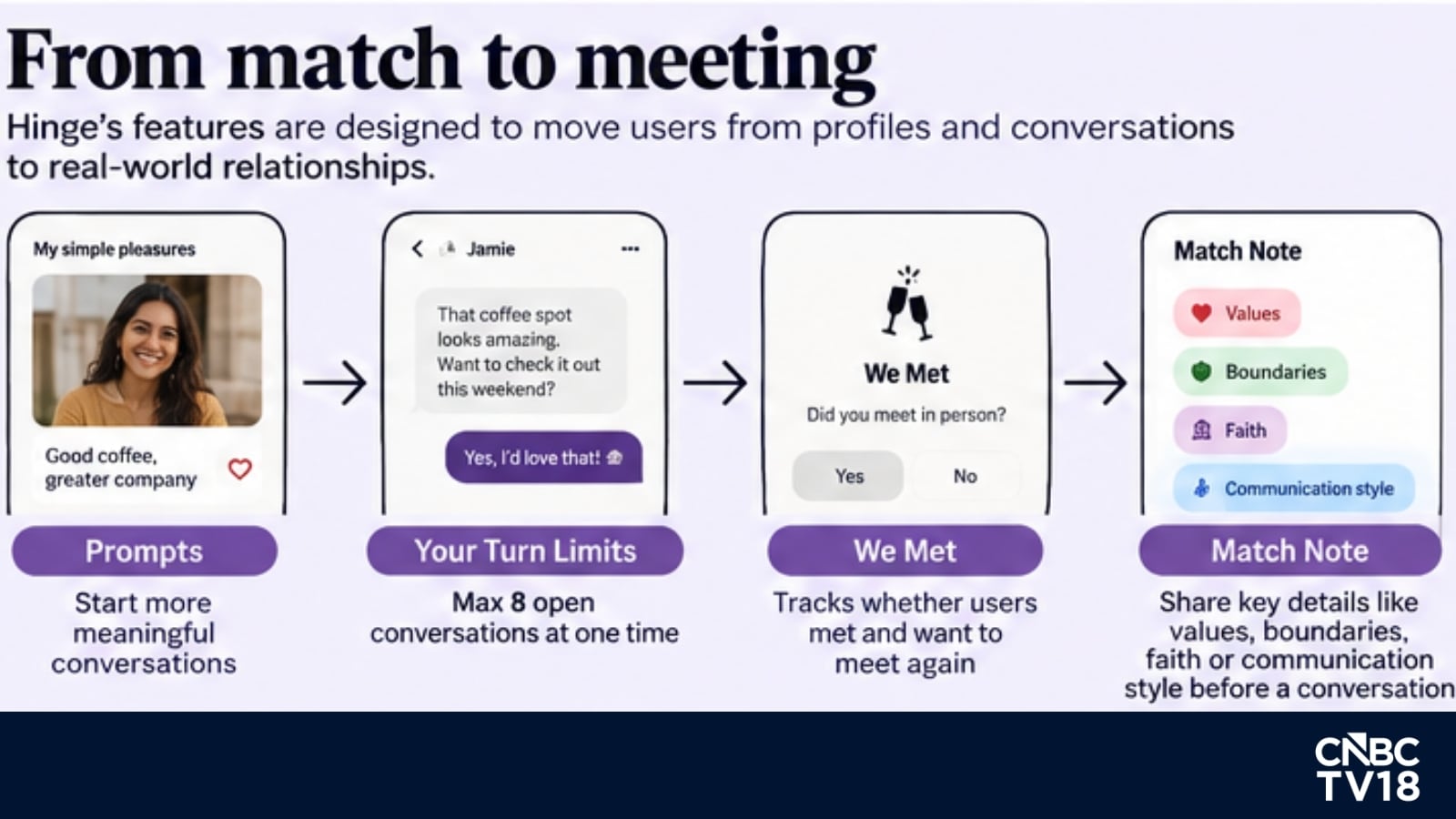
The company has also built constraints into the product. Your Turn Limits allows users to have up to eight conversations open at one time. Once they reach that limit, they cannot like anyone else until they free up a conversation.
The idea is to move users away from endlessly accumulating matches and push them towards actually meeting people. Hinge also uses its We Met survey to find out whether users met a match and whether they want to meet again. Jantos said meeting in person and wanting a second date are important indicators for the company.
That feeds directly into Hinge's broader philosophy.
Hinge has long described itself as “designed to be deleted”, with the company saying its success is tied to helping users find relationships rather than keeping them on the platform indefinitely.
That sounds counterintuitive for a consumer internet business, but Jantos argues that successful users can become a source of new users when they share their relationships and experiences.
“We are a bit of an anomaly in the global dating category right now because we are so focused on getting people off the app and into relationships,” Jantos said. “If you deliver on that promise, you open up and unlock a world of potential new users who want to try your app.”
Hinge has seen double-digit user growth and double-digit revenue growth globally year-on-year, according to Jantos. She said the company remains on track to meet its $1 billion revenue target for 2027.
How does Hinge make money while trying to get people to leave?
Less than 15% of Hinge users pay for the premium subscriptions of the app, according to Jantos.
“We believe the free product is sacred,” Jantos said, arguing that “dating apps work when they have scaled audience bases of people looking for love.”
For the users who do pay, Hinge has two main revenue streams: subscriptions and à la carte products. “We only make money off of subscriptions and a la carte products that individuals can buy,” Jantos said. “There’s no other revenue made. There’s no advertising on our platform.”
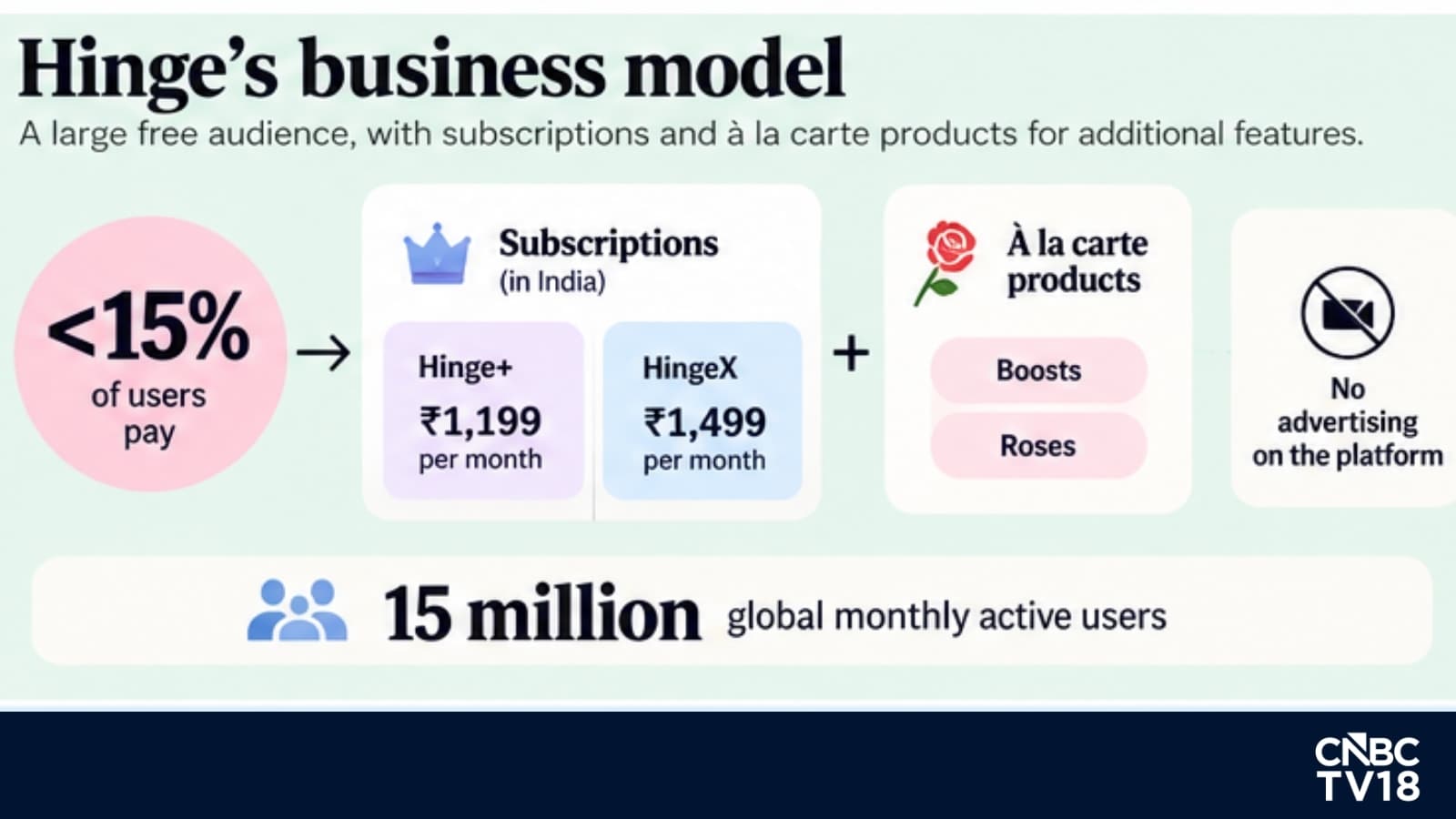
In India, Hinge has two subscription tiers: Hinge+ at ₹1,199 per month and HingeX at ₹1,499 per month. Jantos described Hinge+ as a way to focus the dating experience through filters, while HingeX is aimed at getting a user's profile in front of more people.
The other part of the business comes from à la carte purchases, where users can pay for individual products rather than taking a subscription. Jantos cited Boost and Rose as examples. A Boost can help a user's profile get more visibility, while a Rose is a way to signal stronger interest in another profile.
That creates a model in which the majority of users can continue using Hinge without paying, while those looking for more ways to filter, accelerate or increase the visibility of their experience can spend on the platform.
Jantos said Hinge is comfortable with that model because “the addressable market is massive, and it is far more than the 15 million users.”
“If we can do that successfully... and continue to do that successfully for every next generation... We are perfectly comfortable with the revenue that comes in from subscriptions and from a la carte products,” she said.
Hinge and AI
AI is another part of Hinge’s effort to improve the experience, although Jantos is clear that the company does not see AI replacing the human element of dating.
“AI plays no role in replacing a human in a relationship that’s about love,” she said. Hinge uses AI to help power its recommendation system, which is built around compatibility, and in Trust & Safety to identify potentially harmful users.
AI also works at the conversation level. Hinge’s Are You Sure? prompt can intervene before a potentially offensive message is sent, while Did This Bother You? gives recipients a way to flag something that made them uncomfortable. Jantos said this feedback also helps Hinge's models learn how to protect users from unintended harm.
Hinge is also using AI to help users improve their profile prompts. Rather than writing for them, Hinge’s system asks questions that encourage users to provide more specific information about themselves.
“We’ll never give you the words,” Jantos said. “The human experience has to be the human experience.”
That approach also reflects how Hinge sees its product differentiation: features such as prompts, Your Turn Limits, We Met, and Match Note are designed around moving users from profiles and conversations towards meeting in person.
Also read: Fake AI, real fraud: Inside China’s 20-app dating scam network built on Anthropic's Claude
This is Hinge's new waitlist feature. It's part of a new safety and privacy push the company is making. Hinge says the move is a testament to India having become an increasingly important market for it. "India is Hinge’s second-largest country by downloads/registrations, after the US, and it's the third-largest by monthly active users, after the US and UK," CEO Jackie Jantos told CNBC-TV18.
The dating app has been in India since 2015 and says it has seen strong organic growth in a market that has numerous dating and matrimonial platforms catering to an increasingly tech-savvy and internet-adept population.
“There’s been a real evolution in young Indian singles wanting to have some agency over finding partners, finding long-term partners, and finding love,” Jantos said.
Globally, Hinge has 15 million monthly active users, though the company does not disclose India-specific user or revenue numbers.
A more controlled entry into dating
The waitlist is one of the biggest changes Hinge is introducing as part of its new India experience.
Some new users will be placed on a waitlist after creating their profile. During that time, they can add photographs, answer Hinge’s prompts and verify their profile before they begin matching and liking other users. The waitlist itself is a global feature, but Hinge is using this broader product push to introduce several features specifically for users in India.
That includes Face Check, which is designed to confirm that there is a real person behind an account. Face Check is being introduced specifically for Hinge users in India, alongside two other India-specific privacy features: Block List and Screenshot Protection.
The Block List lets users avoid seeing, or having their profile seen by, people they already know, such as an ex, colleague or family member. Screenshot Protection blocks screenshots on profile surfaces containing personally identifiable information, including profiles shown in Discover, Likes You and Standouts. Users can still take screenshots of conversations if they need to report a concern.
Together, these features give Hinge users more control over who can find them, what can be shared from their profile and whether the person behind an account is who they say they are.
Jantos said Hinge's detailed onboarding is intentional. Around one in five people who start the onboarding process do not complete it, a drop-off the company says it is comfortable with because users are asked to provide photographs, answer prompts and give more information about themselves.
For Hinge, the India-specific push comes as safety and privacy become a bigger consideration as its user base grows. Jantos said the company has seen a particular need among women and LGBTQI+ communities. “There is a need for more safety and privacy,” she said.
The company's Trust & Safety team monitors activity, user reports, and potential policy violations to identify and remove bad actors.
Fewer endless chats, more meaningful interactions
Hinge is also trying to put more structure around what happens after a match.
Its Signals feature gives users a profile badge based on care and consistency on the platform. A Comment Filter lets users filter unwanted words, emojis or phrases from comments, while Match Note allows people to privately share information about a value, boundary, faith, or communication style with a match before a conversation begins. The company says these tools are being brought to India as part of its broader effort to give users more control during interactions.
The company has also built constraints into the product. Your Turn Limits allows users to have up to eight conversations open at one time. Once they reach that limit, they cannot like anyone else until they free up a conversation.
The idea is to move users away from endlessly accumulating matches and push them towards actually meeting people. Hinge also uses its We Met survey to find out whether users met a match and whether they want to meet again. Jantos said meeting in person and wanting a second date are important indicators for the company.
That feeds directly into Hinge's broader philosophy.
Hinge's business of getting people off the app
Hinge has long described itself as “designed to be deleted”, with the company saying its success is tied to helping users find relationships rather than keeping them on the platform indefinitely.
That sounds counterintuitive for a consumer internet business, but Jantos argues that successful users can become a source of new users when they share their relationships and experiences.
“We are a bit of an anomaly in the global dating category right now because we are so focused on getting people off the app and into relationships,” Jantos said. “If you deliver on that promise, you open up and unlock a world of potential new users who want to try your app.”
Hinge has seen double-digit user growth and double-digit revenue growth globally year-on-year, according to Jantos. She said the company remains on track to meet its $1 billion revenue target for 2027.
How does Hinge make money while trying to get people to leave?
Less than 15% of Hinge users pay for the premium subscriptions of the app, according to Jantos.
“We believe the free product is sacred,” Jantos said, arguing that “dating apps work when they have scaled audience bases of people looking for love.”
For the users who do pay, Hinge has two main revenue streams: subscriptions and à la carte products. “We only make money off of subscriptions and a la carte products that individuals can buy,” Jantos said. “There’s no other revenue made. There’s no advertising on our platform.”
In India, Hinge has two subscription tiers: Hinge+ at ₹1,199 per month and HingeX at ₹1,499 per month. Jantos described Hinge+ as a way to focus the dating experience through filters, while HingeX is aimed at getting a user's profile in front of more people.
The other part of the business comes from à la carte purchases, where users can pay for individual products rather than taking a subscription. Jantos cited Boost and Rose as examples. A Boost can help a user's profile get more visibility, while a Rose is a way to signal stronger interest in another profile.
That creates a model in which the majority of users can continue using Hinge without paying, while those looking for more ways to filter, accelerate or increase the visibility of their experience can spend on the platform.
Jantos said Hinge is comfortable with that model because “the addressable market is massive, and it is far more than the 15 million users.”
“If we can do that successfully... and continue to do that successfully for every next generation... We are perfectly comfortable with the revenue that comes in from subscriptions and from a la carte products,” she said.
Hinge and AI
AI is another part of Hinge’s effort to improve the experience, although Jantos is clear that the company does not see AI replacing the human element of dating.
“AI plays no role in replacing a human in a relationship that’s about love,” she said. Hinge uses AI to help power its recommendation system, which is built around compatibility, and in Trust & Safety to identify potentially harmful users.
AI also works at the conversation level. Hinge’s Are You Sure? prompt can intervene before a potentially offensive message is sent, while Did This Bother You? gives recipients a way to flag something that made them uncomfortable. Jantos said this feedback also helps Hinge's models learn how to protect users from unintended harm.
Hinge is also using AI to help users improve their profile prompts. Rather than writing for them, Hinge’s system asks questions that encourage users to provide more specific information about themselves.
“We’ll never give you the words,” Jantos said. “The human experience has to be the human experience.”
That approach also reflects how Hinge sees its product differentiation: features such as prompts, Your Turn Limits, We Met, and Match Note are designed around moving users from profiles and conversations towards meeting in person.
Also read: Fake AI, real fraud: Inside China’s 20-app dating scam network built on Anthropic's Claude
/images/ppid_59c68470-image-179086013534281790.webp)
/images/ppid_59c68470-image-179085272404450683.webp)
/images/ppid_59c68470-image-179084002349597495.webp)
/images/ppid_59c68470-image-179086265656412705.webp)
/images/ppid_59c68470-image-179074753036220922.webp)
/images/ppid_59c68470-image-179085252893999040.webp)
/images/ppid_59c68470-image-179059252159748728.webp)
/images/ppid_59c68470-image-179065507118292073.webp)