/images/ppid_59c68470-image-178790755915260093.webp)

/images/ppid_59c68470-image-178782005677361209.webp)
/images/ppid_59c68470-image-178780752642257928.webp)

What is the story about?
India and Canada are moving to rebuild an economic relationship that was badly damaged by their diplomatic fallout in 2023.
The latest push goes beyond a conventional free-trade agreement: the two countries are working towards a Comprehensive Economic Partnership Agreement (CEPA) by the end of 2026, while India has also signalled readiness to begin negotiations on a Bilateral Investment Treaty (BIT).
The renewed momentum comes as Canada tries to reduce its heavy dependence on the US market, especially as it faces a heated trade war and territorial threats under the Trump administration. More than 70% of Canadian exports still go to the US.
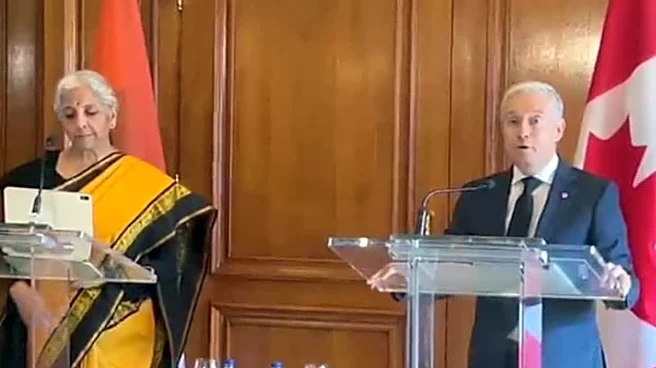
Speaking of ties to India, Canada's Finance Minister François-Philippe Champagne recently said, "When I think about India, I think about possibilities. When I think about India, I think about opportunities. When I think about India, I think about talent and scale.
What is India-Canada CEPA?
CEPA would broadly reduce or eliminate tariffs on goods, while also creating greater market access for services and investment. The ongoing negotiations cover areas including goods, services, intellectual property, rules of origin, sanitary standards and technical barriers to trade.
The opportunity is significant, but so is the gap. Bilateral trade was only around $9 billion in 2024-25, and Modi and Canadian Prime Minister Mark Carney have set an ambitious target of $50 billion by 2030.
The bigger opportunity is complementing each other, which analysts point out as an area of failure in the many attempts made to forge an agreement in the last decade and a half.
"India and Canada have spent nearly fifteen years trying to translate economic complementarity into a formal trade arrangement. Efforts have repeatedly fallen short, even though the underlying case for closer economic engagement has remained strong," Sanjay Kumar Verma, a former Indian high commissioner to Canada, wrote on Observer Research Foundation.
"The principal reason for the underperformance of the bilateral economic relationship has not been the absence of commercial logic. It has been the absence of a negotiating approach capable of managing political sensitivity without letting it derail the wider enterprise," he added.
Canada brings natural resources, technology and long-term institutional capital; India brings a large consumer market, manufacturing capacity and a growing services economy.
Verma has also argued that the relationship has strong underlying economic logic, with Canada offering “patient capital, technology, natural resources” and India offering scale and long-term demand.
What could make or break the deal?
The headline trade target is ambitious.
India has signed or advanced trade agreements with several major economies, meaning Canadian exporters risk losing ground in India if Ottawa cannot secure competitive market access. Canada's Export Development agency has warned that India's other trade agreements are already widening the tariff disadvantage for Canadian exporters.
That makes the negotiations about more than simply cutting tariffs. The challenge, as Verma has argued, is whether both sides can manage politically sensitive issues without allowing them to derail the broader economic relationship.
For Canada, that means securing greater access to India's large and growing market while bringing more of its natural resources and capital into the relationship. For India, it means gaining more reliable access to critical minerals, energy and investment while expanding its exports to Canada.
Whether the two countries can turn that economic complementarity into a workable agreement will determine whether this latest push succeeds where previous attempts have failed.
The latest push goes beyond a conventional free-trade agreement: the two countries are working towards a Comprehensive Economic Partnership Agreement (CEPA) by the end of 2026, while India has also signalled readiness to begin negotiations on a Bilateral Investment Treaty (BIT).
The renewed momentum comes as Canada tries to reduce its heavy dependence on the US market, especially as it faces a heated trade war and territorial threats under the Trump administration. More than 70% of Canadian exports still go to the US.
Speaking of ties to India, Canada's Finance Minister François-Philippe Champagne recently said, "When I think about India, I think about possibilities. When I think about India, I think about opportunities. When I think about India, I think about talent and scale.
What is India-Canada CEPA?
CEPA would broadly reduce or eliminate tariffs on goods, while also creating greater market access for services and investment. The ongoing negotiations cover areas including goods, services, intellectual property, rules of origin, sanitary standards and technical barriers to trade.
The opportunity is significant, but so is the gap. Bilateral trade was only around $9 billion in 2024-25, and Modi and Canadian Prime Minister Mark Carney have set an ambitious target of $50 billion by 2030.
The bigger opportunity is complementing each other, which analysts point out as an area of failure in the many attempts made to forge an agreement in the last decade and a half.
"India and Canada have spent nearly fifteen years trying to translate economic complementarity into a formal trade arrangement. Efforts have repeatedly fallen short, even though the underlying case for closer economic engagement has remained strong," Sanjay Kumar Verma, a former Indian high commissioner to Canada, wrote on Observer Research Foundation.
"The principal reason for the underperformance of the bilateral economic relationship has not been the absence of commercial logic. It has been the absence of a negotiating approach capable of managing political sensitivity without letting it derail the wider enterprise," he added.
Canada brings natural resources, technology and long-term institutional capital; India brings a large consumer market, manufacturing capacity and a growing services economy.
Verma has also argued that the relationship has strong underlying economic logic, with Canada offering “patient capital, technology, natural resources” and India offering scale and long-term demand.
What could make or break the deal?
The headline trade target is ambitious.
India has signed or advanced trade agreements with several major economies, meaning Canadian exporters risk losing ground in India if Ottawa cannot secure competitive market access. Canada's Export Development agency has warned that India's other trade agreements are already widening the tariff disadvantage for Canadian exporters.
That makes the negotiations about more than simply cutting tariffs. The challenge, as Verma has argued, is whether both sides can manage politically sensitive issues without allowing them to derail the broader economic relationship.
For Canada, that means securing greater access to India's large and growing market while bringing more of its natural resources and capital into the relationship. For India, it means gaining more reliable access to critical minerals, energy and investment while expanding its exports to Canada.
Whether the two countries can turn that economic complementarity into a workable agreement will determine whether this latest push succeeds where previous attempts have failed.

/images/ppid_59c68470-image-178788253762940852.webp)
/images/ppid_59c68470-image-178785752891960278.webp)

/images/ppid_59c68470-image-178789752815388883.webp)

/images/ppid_59c68470-image-17878375587048780.webp)