





New Delhi, Feb 1 (PTI) The government on Sunday announced the setting up of Mega Textile Parks in challenge mode with a focus on integrated infrastructure and value addition, among a raft of reforms, including
a five-pronged integrated policy framework, to provide a shot in the arm to India's employment-intensive textile sector.
The proposed establishment of new Mega Textile Parks will attract investments, improve compliance and traceability, and create integrated hubs for scale, quality control and exports.
It will also support growth in technical textiles, a high-potential segment critical for industrial, medical, defence and infrastructure applications.
To strengthen khadi, handloom and handicrafts, the Mahatma Gandhi Gram Swaraj Initiative will be launched. The initiative will focus on global market linkage, branding, streamlined training, skilling, quality improvement and process modernisation. It will benefit weavers, village industries, rural youth and support the One District One Product (ODOP) initiative.
In a major boost to exports of textiles, leather and marine products, the Budget announced the Extension of the export obligation period from 6 months to 12 months for exporters of textile garments, leather garments, leather or synthetic footwear and other leather products manufactured using duty-free imported inputs.
This measure will provide greater operational flexibility, ease of compliance and improved working capital management for textile exporters, currently grappling with 50 per cent tariffs on Indian goods imposed by the US, India's largest export market.
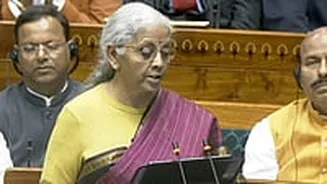
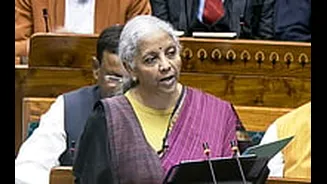
In her budget speech, Union Finance Minister Nirmala Sitharaman said, "For the labour-intensive Textile Sector, I propose an Integrated Programme with 5 sub-parts". Under these five sub-parts, she announced a 'National Fibre Scheme' for self-reliance in natural fibres such as silk, wool and jute, man-made fibres, and new-age fibres.
The Finance Minister announced the Textile Expansion and Employment Scheme to modernise traditional clusters with capital support for machinery, technology upgradation and common testing and certification centres; a National Handloom and Handicraft programme to integrate and strengthen existing schemes and ensure targeted support for weavers and artisans; and the Tex-Eco Initiative to promote globally competitive and sustainable textiles and apparels.
She also unveiled the SAMARTH 2.0 skill development scheme to help local manufacturers become more efficient, innovative and sustainable, and expand their presence in global markets.
Sitharaman also proposed a dedicated initiative for sports goods that will promote manufacturing, research and innovation in equipment design as well as material sciences.
"This is a holistic and comprehensive Budget as PM Modi has positioned textiles as the second-largest employment sector after agriculture," Textile Minister Giriraj Singh told reporters after the Budget announcements.
The textile and apparel industry bodies cheered the thrust placed on the sector.
Confederation of Indian Textile Industry (CITI) Chairman Ashwin Chandran said, "The Budget is a strong manifestation of the Government's commitment to future-proof the textile and apparel sector, make it more resilient to global headwinds, and comes as a huge shot in the arm for the industry".
Apparel Export Promotion Council (AEPC) Chairman A Sakthivel said, "The Budget is forward-looking, growth-oriented and balanced, reflecting the Government's strong commitment to building a competitive, resilient and globally integrated textile and apparel sector. It provides a road-map for strengthening India's textile and apparel ecosystem, with a strong focus on self-reliance, sustainability, employment generation and global competitiveness".
Santosh Katariya, President, Clothing Manufacturers Association of India (CMAI), said: "We welcome the Finance Minister's Budget 2026-27 and the comprehensive measures announced for India's textile value chain. The package signals a clear, outcomes-oriented intent to modernise the sector, strengthen livelihoods across the value chain, and accelerate India’s competitiveness in domestic and global markets". PTI RSN RSN MR