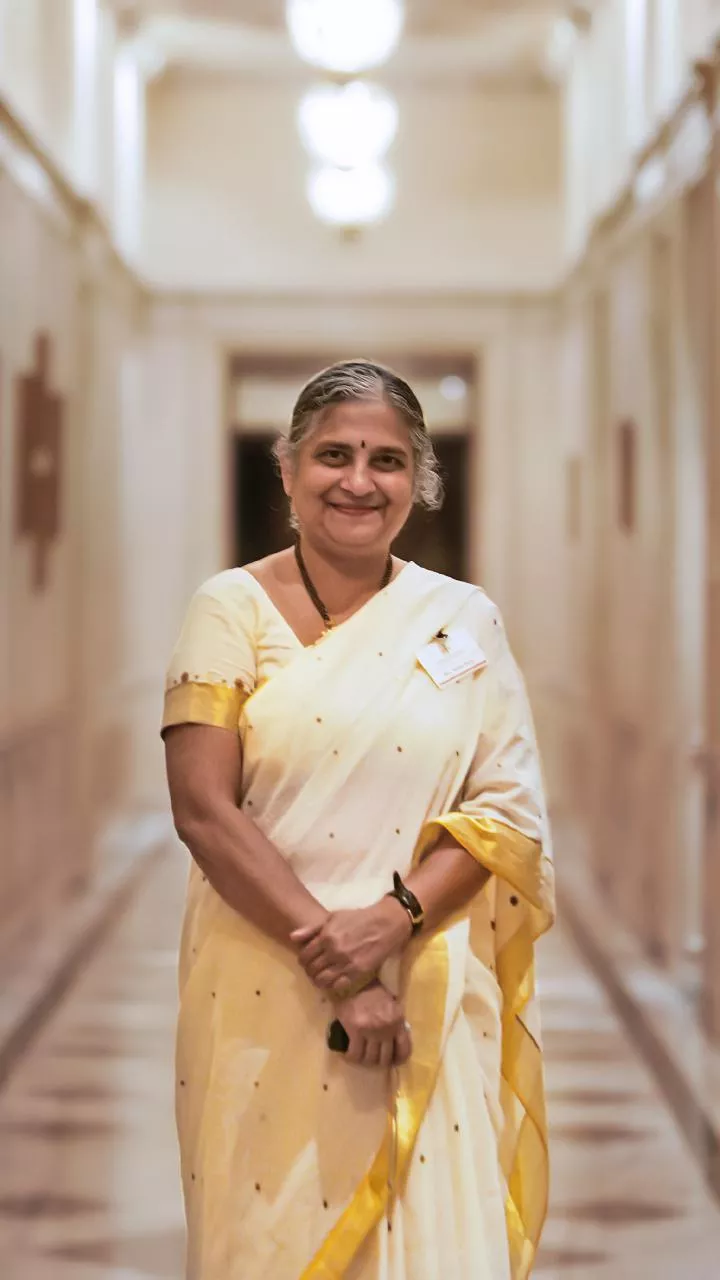

Jaipur, Jan 17 (PTI) The story of India’s past, particularly Partition, is essential for children to understand, said celebrated author Sudha Murty, adding that she consciously addresses the sensitive
topic in her latest book, "The Magic of the Lost Earrings", to help young readers realise it was a “mistake” that must never be repeated.
Speaking at the ongoing 19th edition of the Jaipur Literature Festival (JLF), Murty, who drew a packed audience cutting across age groups, said the impulse to explore this painful chapter of history in her new novel was rooted in a desire to explain it to her own granddaughter, Anoushka Sunak, on whom the book’s central character, Nooni, is based.
“If you don’t know history, you won’t understand your future... When I look at the Partition, I always feel that I should tell children: this happened. What happened was wrong and should not be repeated. I felt very sorry for the people who emigrated from what is today called Pakistan and Bangladesh.
“Just because a person who knew nothing about India -- its culture or its languages -- took a pencil and drew a line, and said that from that moment onwards this land no longer belonged to them and had become a foreign land. How heartbreaking that is,” said the philanthropist, Rajya Sabha MP and author.
Drawing from personal experience, Murty referred to the family history of her son-in-law, former British prime minister Rishi Sunak, whose family was uprooted twice -- first during Partition and later in Africa.
The 75-year-old noted that Sunak’s grandparents were originally from regions that are now in Pakistan and were forced to leave everything behind during Partition. After rebuilding their lives in Nairobi, they were uprooted again and eventually migrated to London when Sunak’s father was ten years old.
“They lost their homes, businesses and savings, rebuilt their lives in Africa, and were uprooted again before finally settling in London,” Murty said, pointing out that losing one’s home repeatedly is a hardship few truly comprehend.
This, she added, is what she wanted her granddaughter to understand that how much effort and sacrifice lie behind the stability people enjoy today.
“I wanted to tell her that land and freedom are not easily earned. Our ancestors worked very hard, losing their homes more than once, and still rebuilt their lives with resilience,” she explained.
Reflecting on the Partition, Murty described the trauma of people becoming refugees in their own land overnight.
She expressed particular concern for the Sindhi community, which she said suffered an irreversible cultural loss.
"At least in Punjab, after the division, Punjabis were able to find another land called Punjab, where their language was spoken. Same is the case for Bengal. But for Sindhis, the loss was far deeper. They not only lost their land, they did not get any land of their own.
"They lost their land, their language and their culture. Over generations, the next generation switched to Hindi, and within three generations, Sindhi became one of the forgotten languages," she said.
Though she has no personal experience of migration and has lived in Karnataka all her life, Murty said the consequences of Partition’s trauma struck her deeply during her visit to Pakistan nearly two decades ago -- one at the Taxila Museum and another when she accompanied a friend to her pre-Partition home.
Murty recalled being charged a higher entry fee at a museum because she was a foreigner.
“It hurt me deeply that I shared the same history, food and traditions, yet became a foreigner simply because a border was drawn,” she said.
Another moment that stayed with her was visiting a friend’s ancestral home in Lahore, where personal memories -- from a mango tree to footprints preserved in old cement -- were still intact.
“Seeing her grief made me realise how one wrong decision can affect generations of children,” Murty said.
Her latest novel -- third in her bestselling 'Magic Series' -- begins with Nooni planning a vacation with her grandparents and on the first leg of the journey finds a pair of earrings that accidentally landed in her luggage.
And soon what starts as a search for the rightful owner of the earrings brings forth the sensitive issues of India’s Partition, immigration and more.
Murty has authored 50 books -- over 300 titles including the translations into 23 Indian languages.
The five-day literary festival is hosting more than 350 celebrated authors and scholars, including Booker Prize winner Banu Mushtaq, chess legend Viswanathan Anand, British actor and author Stephen Fry, Sahitya Akademi Award winner Anuradha Roy, veteran film critic Bhawana Somaaya, and authors Manu Joseph, Ruchir Joshi, and KR Meera.
The festival will conclude on January 19. PTI MG MAH
MAH