



Kolkata, Apr 9 (PTI) Concerns over job opportunities and issues related to infrastructure development seem to be dominating the voters’ mindset in the Khardaha assembly constituency, a seat represented
by successive finance ministers of West Bengal, as the countdown for the 2026 state elections has officially begun.
The assembly segment, on the outskirts of Kolkata, in North 24 Parganas district, is perceived to be headed for a face-off between the TMC and the BJP, amid worries over the law and order situation.
Not so long ago, Khardaha served as the home segment to the longest serving finance minister of the erstwhile Left Front government, Asim Dasgupta, who won the seat five times in a row from 1987 to 2006.
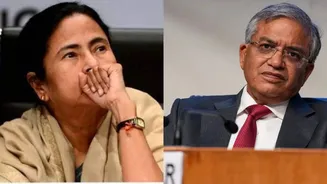
The Marxist leader was dislodged by TMC’s Amit Mitra, who was a key office-bearer of FICCI before joining politics and then going on to shoulder the state’s finance portfolio in Mamata Banerjee’s cabinet for two successive terms in 2011 and 2016, before hanging up his boots on health grounds.
He currently serves as Special Advisor on finance to Chief Minister Mamata Banerjee.
Following Mitra’s exit from the poll fray, the TMC managed to hold on to Khardaha in the 2021 state polls and its subsequent by-election when senior party leader Sovandeb Chattopadhyay, the MLA from Bhabanipur, was shifted to the seat to make way for Chief Minister Mamata Banerjee in the south Kolkata constituency.
Banerjee won the bypoll from Bhabanipur after her defeat in Nandigram in 2021.
While Chattopadhyay won the seat by a comfortable margin of more than 93,000 votes over his nearest BJP rival, the 2021 bypoll results marked a new phase for Khardaha with different political actors stepping into the turf and reflecting a broader churn in Bengal’s electoral dynamics.
Once a significant constituency held by the state’s finance ministers for about three decades, Khardaha is now ironically plagued by the decline of the traditional jute industry, economic stagnation, infrastructure issues such as dilapidated drainage resulting in severe waterlogging, and worsening law and order compounded by alleged syndicate raj extortions.
Part of the Dum Dum Lok Sabha seat, Khardaha grew around jute mills and heavy engineering units, most of which have shut down operations. It also houses small-scale and medium manufacturing units, allegedly also struggling for survival.
The constituency, falling under the Barrackpore industrial belt, has witnessed several armed attacks in the recent past, including the murder of BJP youth leader Manish Shukla in 2021, the gunning down of a TMC activist in a slum bordering Titagarh in 2023, in the wake of the BJP's emergence as a strong political force since the 2019 Lok Sabha polls.
“Law and order situation here has sharply deteriorated, women are not safe at night, and incidents of molestation and eve-teasing are on the rise. Employment opportunities for our children have dipped sharply,” Mili Saha, a school teacher from Rahara, complained.
Echoing similar sentiments, businessman Satadru Saha said, “A change of government could usher in real development on the ground.”
Among the main contenders in the upcoming polls are journalist-turned-TMC’s greenhorn nominee Devadeep Purohit, BJP’s Kalyan Chakraborti and the CPI(M)’s Debojyoti Das (Subho).
Purohit, a Delhi School of Economics alumnus and a graduate of IIM, Calcutta, highlighted his local roots and hit out at his opponents for attempting to label him an outsider.
“Though my parents are from outside the state, we had been living here for generations. I was born and brought up here. I studied in the Rahara Ramakrishna Mission, played in local grounds and grew up among the people," the TMC nominee said.
Purohit said he moved out during his higher studies and work, but retained contacts and used to regularly visit his roots.
"I have my residence here, and my near ones live in Khardaha,” he said.
He accused the BJP of spreading misinformation and attempting to polarise voters by means of divisive politics.
“Khardaha reflects Bengal’s inclusive and cosmopolitan character. Vote-bank politics has never worked here. People across communities -- Bengali and non-Bengali, Hindus and Muslims -- have largely supported the TMC,” he said, adding that around 20 per cent of the electorate belonged to minority communities.
Asked if he eyed the state’s finance department in the event of TMC returning to power, Purohit, who briefly served the Mamata Banerjee government as its media advisor after quitting journalism, said he had no such ambition.
“I have no inkling about that and will leave it to the party leaders to use me in whichever position they deem appropriate,” he said.
BJP’s Kalyan Chakraborti claimed public resentment against the TMC was widespread.
“People are unhappy with the overall situation, from law and order and unemployment to syndicate raj. There are concerns over demographic changes in certain pockets of the seat and a strong desire for change,” he said.
The BJP, observers say, is harping on consolidating Hindu voters with the segment housing around 30 per cent of the migrant Hindi-speaking population from Bihar and UP.
CPI(M) candidate Debojyoti Das criticised both the TMC and the BJP, alleging industrial decline in the region accelerated under the current regime.
“The once-prosperous industrial belt has witnessed major closures with factory land getting converted into real estate projects. Both the TMC and the BJP have contributed to the rise of communal politics in the region. Also, the RG Kar rape-murder incident will impact people’s choice since Khardaha reacted sharply to the institutional crime,” he said.
Subho Chakraborty, an executive with a private telecom firm, said he was happy at the TMC’s choice of candidate.
“Devadeep represents the new generation of politicians who can clean up the system. I would not have wanted anyone else in the fray.” PTI SUS SMY BDC