







New Delhi, Feb 13 (PTI) As India looks to grab a position at the high table of global tech innovations, its farmlands have been a testimony to an intelligent revolution taking place that cements its technology
prowess.
Artificial Intelligence (AI), once confined to high-tech corridors and labs, is now being deployed to solve one of the oldest challenges in agriculture: predicting the unpredictable.
From analysing soil moisture to tracking local wind patterns, AI models are providing Indian farmers with a high-tech early warning system, modernising agriculture, improving resilience to climate challenges, and making farming more data-driven and inclusive.
A case in point is Microsoft's project with ADT Baramati, which is transforming sugarcane farming in Maharashtra by bringing high-tech AI to the fields.
Through Microsoft's AI technologies, including Azure Data Manager for Agriculture, FarmVibes.AI, and the Agripilot.ai app, ADT Baramati's 'Farm of the Future' project empowered many farmers to boost sugarcane yields with heavier stalks, use less water and fertilisers.
These AI-driven insights, delivered in local languages via a mobile app, are helping bridge the digital divide, promote sustainable farming, and attract a new generation to agriculture.
"...if you talk about agriculture, the first thing that comes to mind is the unpredictability that farmers have to deal with, and different crops are sensitive to different weather patterns, pest attacks, etc. There's a lot of information that's available, whether it is the satellite data or the soil health data, weather patterns, etc, but it is complex information and not available to farmers, which is really micro relevant to their farms," Himani Agrawal, COO of Microsoft India and South Asia, said.
Agrawal added, "So, we have actually worked with ADT Baramati to bring it all live for sugarcane farmers there and it's Microsoft Azure Data Manager for Agriculture, FarmVibes.AI, and Azure open AI models, all of that came together to synthesise this complex information that's available, get the patterns out of it and provide that information very simply to the farmers in a mobile application or on WhatsApp in local language that they are used to."
In all, the AI shift is transforming farming from a reactive struggle into a predictive science, allowing for targeted interventions that save crops, increase output and reduce costs.
AI is also being leveraged to combat pest attacks in fields. At the core of this transformation is the ability of AI to process vast amounts of real-time data.
By integrating information from IoT-based soil sensors and climate monitors, AI models can identify the exact conditions -- such as specific humidity levels or wind directions -- that precede a pest outbreak.
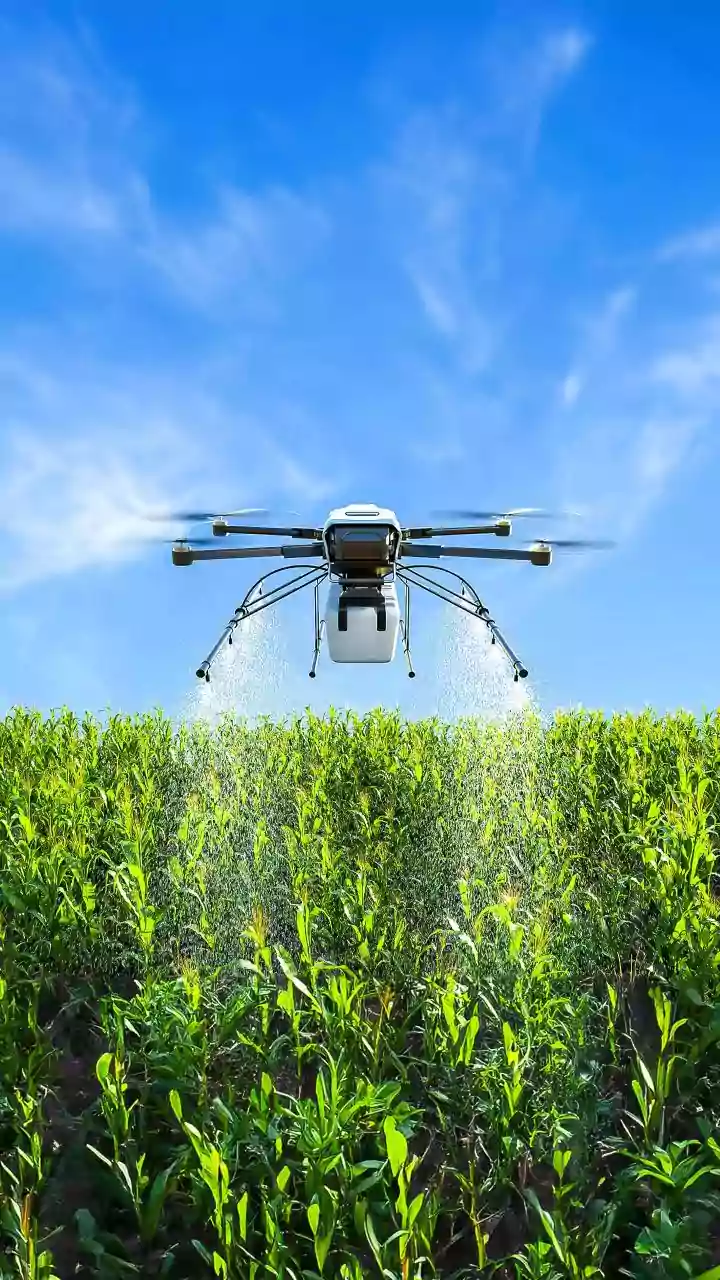
That means, instead of the traditional blanket spraying of pesticides, which is both expensive and environmentally damaging, farmers can now opt for targeted interventions.
This is particularly crucial at a time when, according to Niti Aayog, the cost of cultivation, including labour and inputs, has surged 20-40 per cent since 2021.
The impact of these technologies is already visible on the ground. The Saagu Baagu (agriculture advancement) project, an initiative of the Government of Telangana and the World Economic Forum (WEF), substantially improved the value chain for more than 7,000 chilli farmers.
Farmers participating in the programme saw a 21 per cent increase in chilli yields per acre, a 9 per cent reduction in pesticide use, a 5 per cent decrease in fertiliser usage, and an 8 per cent improvement in unit prices due to quality enhancements.
Contrary to the general perception that technology intervention would raise costs, AI actually offers the promise of pruning overheads and operating costs.
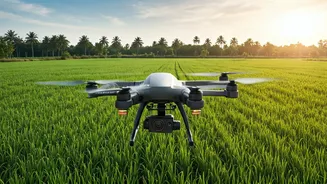
"Think of a situation where, by using micro sensors in the soil, understanding what the soil content is, the level of moisture, and nutrients, correlating that with weather… what is going to happen in the next 3-4 days, what's the right time to sow the seeds, what's the right time to harvest and integrate maybe the ability to spray your fields with drones… all of that can now be done at a fraction of the cost," said S Anjani Kumar, Partner, Deloitte India.
Earlier, yield improvement entailed expensive machinery and overheads, but small-scale farmers lacked the scale needed to make such high capital investments efficient on limited rural acreage.
AI makes it possible to do it on a per-hectare basis, he said.
AI also helps with post-harvest functions, assisting farmers to select markets where they can get the best price for their produce by studying trends and patterns, Kumar noted.
"...it takes out this entire 'what if' and 'should I do this or should I do that'? Because now he (farmer) has data-driven information on where he will get (access to) the biggest mandi," he said.
The AI-led transformation extends far beyond the planting season. With India losing about 15-20 per cent of produce (as per Niti Aayog) to post-harvest losses due to poor storage and transport, AI is stepping in to optimise the value chain.
Innovations include AI-driven machines that automatically sort and grade produce by size, shape, and colour, and digital twins, the virtual replicas of fields and crops that allow farmers to simulate different scenarios and outcomes before they even get into sowing.
As the India AI Impact Summit nears, and the nation gears up to showcase applications that bridge the gap between digital experimentation and real-world utility, these use cases serve as a powerful reminder that the 'Intelligent Revolution' is no longer a distant dream -- it is already helping Indian farmers secure their livelihoods and the nation's food security. PTI ANK MBI TRB