






New Delhi, Jan 27 (PTI) Researchers have created a high resolution map of dark matter, often described as the "invisible scaffolding of the Universe", showing how gravity exerted by dark matter influenced
the formation of stars, galaxies and planets.
Unlike ordinary matter, 'dark matter' is said to have peculiar properties, including being invisible as it does not interact with light. About 85 per cent of the Universe's total matter created at the time of the Big Bang is said to be dark matter.
However, dark matter does exert gravity, just like ordinary matter, and can hold together galaxies, which the map, published in the journal Nature Astronomy, reaffirms with a new level of clarity, researchers said.
Co-lead author Gavin Leroy, from Durham University's department of physics, said, "By revealing dark matter with unprecedented precision, our map shows how an invisible component of the Universe has structured visible matter to the point of enabling the emergence of galaxies, stars, and ultimately life itself."
"This map reveals the invisible but essential role of dark matter, the true architect of the Universe, which gradually organises the structures we observe through our telescopes," Leroy said.
Evidence for dark matter's interaction with the Universe through gravity lies in the degree of overlap between maps of dark matter and normal matter, the researchers said.
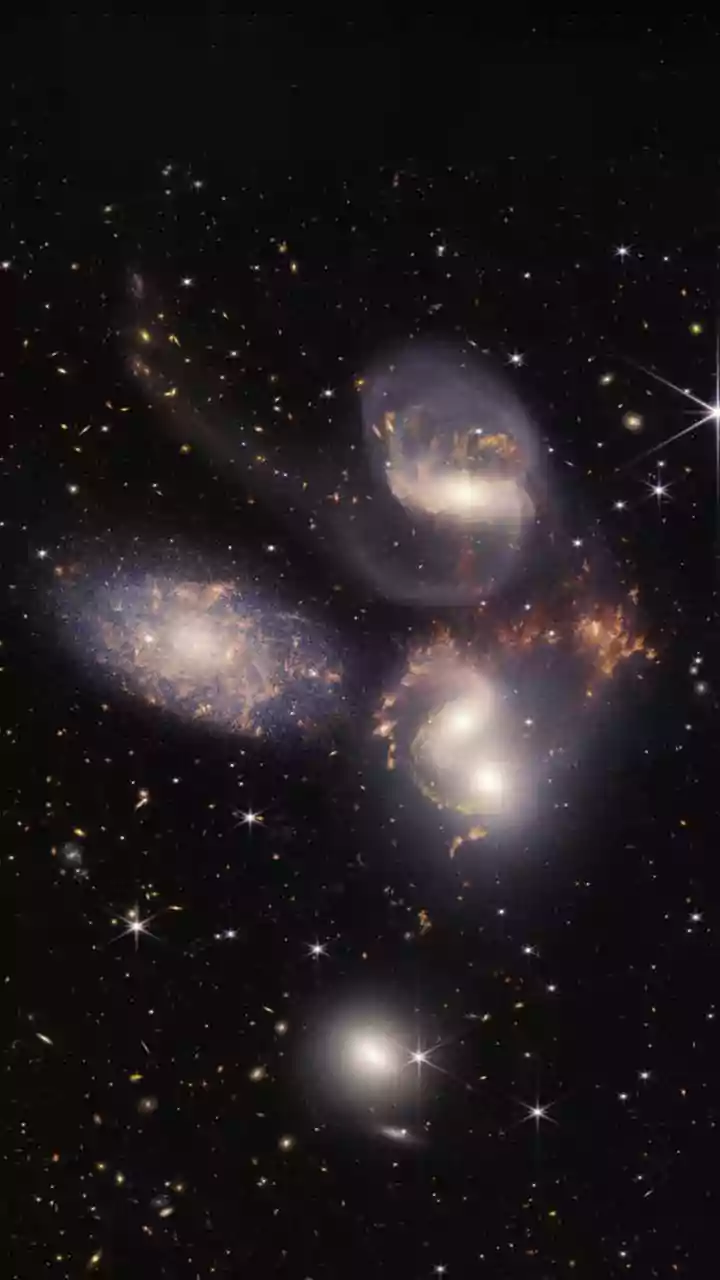
Observations from the the US space agency NASA's James Webb Space Telescope confirm that this close alignment cannot be a coincidence -- instead, the astronomers said it is due to dark matter's gravity pulling normal matter towards it throughout cosmic history.
Co-author Richard Massey, professor in the department of physics, Durham University, said, "Wherever you find normal matter in the Universe today, you also find dark matter."
"Billions of dark matter particles pass through your body every second. There's no harm, they don't notice us and just keep going," Massey said.
"But the whole swirling cloud of dark matter around the Milky Way has enough gravity to hold our entire galaxy together. Without dark matter, the Milky Way would spin itself apart," the co-author said.
The map tells us more about how this invisible substance (dark matter) helped pull ordinary matter into galaxies like our Milky Way and planets like Earth, the researchers said.
The map looks at a section of sky about 2.5 times larger than the full Moon, in the constellation Sextans -- named in the 1600s and said to appear highest in the evening sky in the months around February.
The James Webb Space Telescope peered at the section of sky for a total of about 255 hours and identified nearly 800,000 galaxies, with many detected for the first time, the researchers said.
The map also confirms findings from previous research and provides new details about the relationship between dark matter and the normal matter from which we -- and everything we can touch or see -- are made, they added.
Dark matter is thought to have clumped together first and then pull in normal matter, thereby creating regions where stars and galaxies began to form.
The team also said that by prompting galaxy and star formation to begin earlier than they would have otherwise, dark matter also played a role in creating the conditions for planets to eventually form.
Without dark matter, we might not have the elements in our galaxy that allowed life to appear, they said. PTI KRS
KRS MAH
MAH