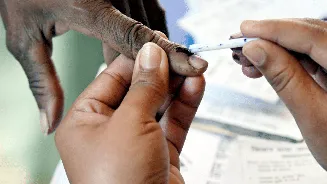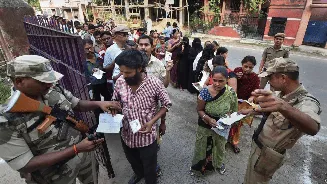







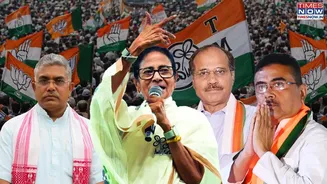
Kolkata, Apr 23 (PTI) The first phase of the West Bengal assembly elections on Thursday set a high-decibel tone for a tightly fought contest with an exceptionally heavy turnout as voters across 152 constituencies
had their say after months of rancour over deletion of names from electoral rolls and a vituperative political campaign.
Sporadic incidents of violence failed to deter the electorate as the turnout exceeded 92 per cent, a figure that led both the rival parties, the BJP and the TMC, to express hopes of a decisive verdict in their favour. While the former chose to construe it as a strong anti-incumbency sentiment, the ruling party felt people voted in larger numbers to avoid losing their rights.
Prime Minister Narendra Modi, addressing a rally in Nadia, described the turnout as an "overwhelming mandate for change" and asserted that poll-related violence was at its lowest in five decades, a claim sharply contested by the ruling party.
Chief Minister Mamata Banerjee said the high turnout reflected "fear among people that if they don't vote, they may lose their voting rights and citizenship", linking voter participation to the SIR exercise.
That divergence captured a broader shift in the nature of the contest from a conventional battle over governance and delivery to one increasingly centred on identity, citizenship and the integrity of the electoral process.
On the ground, that tension manifested in scattered but sharp flashpoints.
In Birbhum's Kharisaol, allegations that votes cast for the TMC were being registered in favour of the BJP triggered protests, a temporary halt in polling and clashes between locals and security personnel. Eyewitnesses said the situation escalated after an argument with polling officials, with stone pelting reported and paramilitary forces resorting to mild force to restore order.
Earlier in the day, BJP candidate Suvendu Sarkar was allegedly manhandled in Dakshin Dinajpur's Kumarganj, while BJP MLA Agnimitra Paul's car was attacked near Rahmat Nagar in Asansol Dakshin, with stones shattering its rear window, incidents cited by the party as evidence of "targeted violence".
In Naoda, stones were allegedly hurled at the convoy of AJUP leader Humayun Kabir, leading to clashes between rival supporters and a baton charge by central forces. Further incidents of violence and intimidation were reported from Labhpur, Chanchal and Murarai, where clashes between party workers left several people injured.
In Domkal, allegations surfaced that voters were prevented from reaching polling booths, necessitating a security escort.
The Election Commission, while maintaining that polling was "largely peaceful", acknowledged receiving around 500 complaints by noon and hundreds more through the cVIGIL app. The TMC alone claimed to have lodged over 700 complaints by mid-afternoon, many relating to alleged EVM malfunction and the conduct of central forces.
District-wise data reflected both enthusiasm and regional variation.
Murshidabad, Bankura and Cooch Behar recorded turnout figures hovering around or above 90 per cent, while Malda, Jhargram and Paschim Medinipur reported similar levels. Kalimpong remained relatively lower at around 83 per cent.
Despite the incidents of violence, polling remained largely peaceful compared to previous elections in the state, which have historically been marked by widespread violence.
By 5 pm, the turnout climbed to nearly 90 per cent of the 3.60 crore electorate, with officials indicating the final figure could rise further, possibly bordering 95 per cent, capping a brisk polling day shaped as much by mobilisation as by contestation over the electorate itself.
Long queues at booths, particularly in rural areas, pointed to intense booth-level mobilisation by both the ruling TMC and the BJP in what is being seen as a crucial early test of organisational strength.
Yet, beneath the headline turnout lay a more complex electoral undercurrent. The Special Intensive Revision of electoral rolls, which saw over 91 lakh names, nearly 12 per cent of the electorate, deleted, injected both a statistical and political dimension into the turnout figures. With a reduced denominator, even comparable participation translates into higher percentages, while simultaneously altering the composition of the electorate itself.
That turned the turnout figure into a politically contested signal. For the TMC, the surge was being read as anxious participation, driven by fears of disenfranchisement among vulnerable sections. The party has framed the SIR as a "disenfranchisement project", alleging that minorities and poorer voters were disproportionately affected.
For the BJP, however, the same numbers validate its long-standing argument on "cleaning" the electoral rolls. A higher turnout in a reduced electorate, the party argues, indicates a greater proportion of "genuine voters".
Compared with the 2021 assembly polls, when turnout ranged between 79 and 86 per cent across phases, the current figures mark a sharper spike, though the SIR-linked contraction of the electorate complicates direct comparisons.
The first phase, covering all 54 seats in north Bengal along with key constituencies in the south, is central to the BJP's strategy of consolidating its northern gains, a region that powered its rise in 2019 and where it remained competitive in 2021.
Union Home Minister Amit Shah, who is camping in the state, visited the BJP's election control room in Salt Lake during polling hours, underlining the premium the party has placed on this phase.
For the TMC, the immediate objective is to blunt that northern push early and retain narrative control, banking on its welfare outreach and entrenched organisational network.
As Bengal moves into the remaining phases, the twin dynamic of high participation and high contestation is set to shape an election increasingly defined as much by process as by outcome. PTI PNT SCH AMR SMY BSM NSD BDC NN SAP RBT