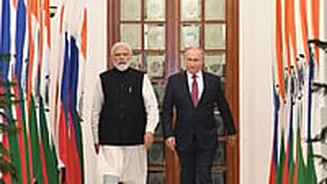

President Putin’s summit meeting with Prime Minister Modi would have been viewed by many as an unqualified success. However, observers did not fail to notice that both leaders did not elaborate on the
issue of Russian oil exports to India. Nor did they elaborate on Russian defence sales, despite the Russian Duma ratifying the Reciprocal Exchange of Logistics Support (RELOS) agreement a day before the Russian president touched down in New Delhi.
This lack of mention has led some to wonder if concerns regarding the US were a common factor for both New Delhi and Moscow. India is in the middle of talks of a free trade deal with the US, and Russia is also in the middle of talks with the Americans on the Ukraine issue.
Russia expert Gulshan Sachdeva, professor at the School of International Studies, JNU, and chief coordinator of the Global South Centre of Excellence at RIS, New Delhi, says that oil purchases by India from Russia has actually given a “new momentum” to India-Russia ties. “Except for the mobility issue, which is the new one this time, everything else has been talked about for the last 25 years.”
Asked about the reasons why both the Indian and Russian sides largely avoided any mention of oil, Professor Sachdeva said that New Delhi rather than Moscow may have been hesitant in doing so. “Russia doesn't care about these things, and that’s why Putin even mentioned that statement that we will continue to supply. Because for them asserting that others are buying, even if you have sanctions on us, suits their narrative, their purpose,” he said.
For India it was a different story. “It does not serve our purpose at this point in time. India is vulnerable, particularly on certain issues with the US. So that’s why we must have thought, we don’t want to unnecessarily provoke them (the US), and let’s continue with what we are doing,” said Professor Sachdeva.
Diplomats concur that India has walked the diplomatic tightrope well during the Putin visit. While celebrating the Russian president’s visit but not discussing key issues such as oil and defence, New Delhi has managed to maintain strategic autonomy. But Russia expert, and former Deputy National Security Adviser, Ambassador Pankaj Saran warned that New Delhi’s hedging was not guaranteed to yield the desired results.
Speaking about the US sanctions imposed on India against buying Russian oil, Saran said that even if New Delhi complied, there was no guarantee of any reward from the US. “The tragedy of it is that even if we wind down to zero and if there is a deal between Putin and Trump, which in my view is always possible, you may have a situation where the American companies will be buying the same oil that they didn’t allow you to buy,” he said.
“So the US multinationals will land up in Russia and occupy that energy space which the Chinese already have occupied. We are then faced with a difficult situation where we are told, “Don’t buy Russian oil.” But the Chinese are swallowing it up and the next consumers will be the Americans.”
Saran’s assessment suggests that New Delhi would have to exercise its strategic options very carefully, especially with a US president who had adopted a “with us or against us” mentality.
The other issue is how could New Delhi practically cut Russian oil supplies to zero? Sumit Ritolia, Lead Research Analyst (Refining & Modelling) at Kpler believes neither New Delhi, or Moscow has to do that. “Kpler data shows the rise of new Russian crude oil intermediaries reflects a fundamental restructuring of Russia’s energy export system.”
Experts say that these intermediaries, which consist of trading firms, resellers, shipping-operators or shell-company networks, render the US sanctions on Russia’s two state oil firms Rosneft and Lukoil redundant. “Russia’s seaborne crude is increasingly being marketed by offshore intermediaries rather than traditional players like Rosneft and Lukoil. This shift highlights both the resilience of Russian crude flows and the emergence of new supply chains and trading patterns built around additional intermediaries,” said Ritolia.
Coming to defence, what was interesting to note is that both leaders did not mention any major deals in their remarks, and no mention of defence was made in the joint statement either. Professor Sachdeva believes that this was again because of India’s attitude to “not provoke” a decision further prompted by the US’s insistence that India procure the F-35 stealth jet. This is a proposal for which New Delhi has stated that “no formal talks” have been initiated.
With Russia it is a different story. India is believed to have requested Russia to expedite delivery of two S-400 defence squadrons which Moscow has promised to deliver by November 2026. Dmitry Shugaev, the head of Russia’s Federal Service for Military-Technical Cooperation (FSMTC) also said recently that Russia may export its most advanced S-500 Prometheus air-defence weaponry to India. Modernisation of India’s fighter jet fleet the Su-30MKI, in the aftermath of Operation Sindoor, is also believed to be in the offing.
Professor Sachdeva believes the majority of these deals have already been ratified by the Indian cabinet, and now both sides will be working on the logistics. “It is the same situation as in the case of oil. There is no direct benefit to us to call attention to these deals, though the Russians would have been fine if we had announced it."