
2025 started off on a shocking note with the economic war being evoked by the US President in the form of tariffs. It is this theme which has cast a shadow on the world economy, warring nations, central
banks and governments, as all policies have paid obeisance to this major disruption. This disruption was as potent as Covid and was a once-in-a-lifetime shock, administered by the most powerful nation in the world.
The president delivered on what he had threatened as higher tariffs were announced in April, which set a base of 10% that was much higher than the average of 3-4% average tariff that was prevalent all this time. This had led to several analyses of how things would pan out at the global as well as domestic levels. The tariffs were invoked from August onwards, and almost 5 months have passed, which makes a reality check relevant.
First, at a purely theoretical level, one nation imposing tariffs on the rest of the world should have logically led to countervailing tariffs being imposed by the other countries. In classic game theory, such policies are pursued so that there is collaboration subsequently and an optimal solution is reached. However, this was not evident in most cases. Almost all countries went back to the table to strike deals with the USA. This involved lower tariffs for US imports as well as a promise to invest more in America. Hence, Canada, the European Union, England, South Korea, and Japan, among others, had deals. This was a victory for the USA, as it got most trading partners to lower their tariffs on imports. This is not something the WTO was able to do.
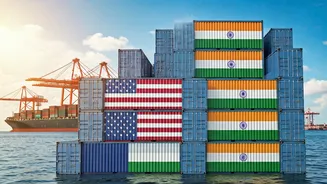
Two countries stood out. The first is India, which has stood its position notwithstanding the additional 25% tariff being imposed. Clearly, we would like to deal with the USA on terms which are not inimical to domestic constituencies like farmers. China, on the other hand, had the muscle to impose countervailing tariffs. They were able to do it because American exporters do rely on China as a major market for their goods.
Second was the impact of tariffs in the USA. Logically, higher tariffs, which were to average above 10% relative to 3-4% earlier, should have meant higher inflation in the USA. This was the reason why it was largely believed that the Fed would not be cutting rates, notwithstanding the pressure put on by the president. However, the Fed has cut the rates, and there could be another 2 in the offing in the next two years. The supporting factor has been inflation, which is at around 2.9%. This means that the absorption power of the system has been much better than was first imagined. This is one reason why the Fed has been able to cut the rates. This has also led to the dollar weakening instead of strengthening, which was expected when the tariffs were imposed.
The third fear was recession in the USA. This sentiment was based on two factors. The first is that with the inflation going up, the real purchasing power would be constrained, leading to lower production. Therefore, the fear of higher unemployment was palpable. The second was that with the work visa restrictions being placed by the government, there was a feeling that there would be a paucity of labour, leading to a slowdown in the economy. However, growth is projected to be 1.9% as per the Fed and will only improve in the coming years. Therefore, a slowdown that was expected has not materialised, and the economy is doing reasonably well. The unemployment rate is below the target rate of 4.6%, and, hence, there is no real worry here.
Fourth, India’s exports were expected to slow down on account of the US market contracting. The US is the largest export market for India, with around 16-18% being directed here. Higher tariffs were to be a negative factor for exporters, as competition from countries like Vietnam, Bangladesh, Sri Lanka, and Thailand would be able to enter the US at a lower price. However, performance of exports in the first 8 months has been marginally higher than last year at 2.7%. But interestingly, in the last 3 months, since the 50% tariff was invoked, export growth has been positive in 2 of the 3 years. This could mean that our exporters have done well to counter this wave of tariffs. Either they have negotiated with the customers in the USA or rerouted their goods through a third country.
Fifth, with exports being impacted, the effect on the GDP was also to be there, though not very significant. The impact of a 10% drop in exports to the USA would have led to a fall in the export growth by 0.4% or so. However, data on growth in the first two quarters has been impressive, which has also called for a revision in forecasts for the year to upwards of 7%. The RBI has an estimate of 7.3%, while that of the Bank of Baroda is 7.4-7.6%. Clearly the strength of the domestic economy has contributed to the growth in the economy, supported by major affirmative action from the side of the government in the form of GST reforms. In fact, all forecasts that started off in the range of 6-6.5%, when the tariffs were announced, have been revised to 7% plus by December, which does indicate the confidence in the growth story.
Therefore, it does appear that the world has steered through this new shock quite well, and while there are still talks of some slowdown in 2026, it would probably not be at the global level. It does look like that while countries have lowered their tariff rates, the overall path of growth is still on the path, and this major shock has been more or less absorbed.
The author is Chief Economist, Bank of Baroda and author of ‘Corporate Quirks: The Darker Side of the Sun’. Views are personal.