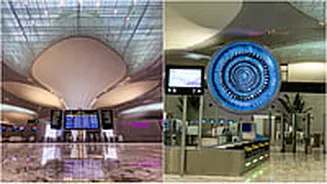









I have now been a passenger in and out of Navi Mumbai International Airport a few times as I write this. Having travelled extensively for many years across India and globally, I respect the value of an efficient
airport. I also understand how the minutest design detail and service decisions quietly shape a passenger’s entire journey.
Airports show their true character not during inaugurations or guided media tours, but on routine days, with ordinary travellers, when there is no ceremony and no spotlight. They are civic gateways and not merely infrastructure projects or balance sheet assets. They shape how citizens experience a city, a state, and often the country itself. Passenger experience is, therefore, the core product.
Approach and access
That experience begins well before one enters the airport. The approach road to this new airport would benefit significantly from clearer and more frequent signage with unmistakable airport markings. One regularly sees cars taking a wrong turn and then attempting to reverse, creating confusion and avoidable risk.
One also searches in vain for meaningful green cover on the approach and within the terminal precinct. For a greenfield airport, this absence is striking and suggests that attention to detail did not extend beyond concrete and glass. Sustainability may feature prominently in corporate presentations, but passengers experience it in trees, shade, and air that feels less engineered.
Design and wayfinding
A well-designed airport should guide passengers instinctively, and passenger experience is not about finishes and fittings. It is a systems problem, where signage, staffing, connectivity, and maintenance either work together quietly or fail together just as quietly.
Driving into the departure concourse, unfinished ceiling work is visible to any observant passenger. This has nothing to do with safety or aesthetics. It reminds one of a wedding mandap assembled quickly so that the muhurat is not missed, with finishing touches postponed. As a society, have we become immune to finesse in everything we do?
Efficiency and flow
To be fair, entry into the terminal is impressively fast. For passengers using DigiYatra and carrying hand baggage, the time taken from stepping out of the car to clearing security can be under five minutes. That is genuinely impressive. The more important question is whether this efficiency will hold once passenger volumes rise.
Despite currently low flight volumes, waiting times at the arrival baggage belt already feel longer than they should, suggesting either yet-to-be-smoothened operating procedures or turnaround times that are not being set with passenger experience in mind. The car pickup area, too, feels needlessly chaotic, with poor flow discipline and lighting that would benefit from brighter luminaries. If this is the experience at low volumes, one can only dread what awaits passengers when traffic inevitably scales up.
Accessibility and services
I have not yet experienced this airport from the perspective of passengers with special needs and so cannot comment on how friendly or inclusive it truly is. What is immediately visible, however, are rows of buggies lined up at the departure entrance, primed for passengers who have reserved them as a paid service.
Then comes the curious absence of mobile phone signals. If you do not already know this, you discover it only when messages fail and calls refuse to connect. The explanation lies in a familiar political economy tussle, with the mighty telecom companies complaining about high access fees demanded by the airport operator for allowing telecom infrastructure. When elephants fight, it is the grass that gets hurt. Here, passengers are the grass. But does anyone care?
Free Wi-Fi is available and generally connects well, with WhatsApp effectively functioning as the airport’s default digital backbone for now. Yet, OTPs often arrive in WhatsApp even before Wi-Fi fully connects, raising uncomfortable questions about data handling and control. There are also dark patches where connectivity drops. In an era where boarding passes, payments, and identity checks are digital, connectivity needs to be treated as basic infrastructure.
Given that the airport operator is part of a large and ambitious conglomerate, one assumes these teething troubles will be resolved swiftly if there is a passenger-first approach.
Retail, pricing and staff behaviour
It is reasonable that not all cafes and retail outlets are operational yet. No airport opens at full commercial throttle before volumes justify it. There is, however, a small but welcome surprise. A tea-coffee priced at Rs 110 stands out in an ecosystem where airport pricing often feels predatory.
What is harder to justify is the general demeanour of staff across the passenger touchpoints. The staff appear listless and less engaged, avoid eye contact and do not even smile. A consistent experience at this airport.
Airports are not just transport nodes. They are service environments. Human warmth shapes how efficiency is experienced. That’s why globally popular airports integrate ‘sensory branding’ to appeal to travellers.
Infrastructure gaps
For a modern airport built recently, the lack of a large number of charging stations is puzzling. Phones drain faster in airports than almost anywhere else. Power access should be abundant and intuitive, not something passengers search for.
Then there are the toilets. A brand-new airport has no excuse for poorly maintained restrooms. They should be dry, clean, and smell decent at all times. This is non-negotiable and shows attention to detail.
Operational resilience
One also wonders whether the airport’s proximity to surrounding hills could make it more prone to fog or low-visibility conditions. If so, it is worth asking how resilient its operations will be during Navi Mumbai’s winter mornings and monsoon months, when weather has a habit of testing infrastructure promises.
Conclusion
Warmth and character are often dismissed as soft concerns, but in large public spaces they determine whether efficiency feels humane or merely transactional. Airports, like cities, have personalities. That personality has to be built into their design, development, and existence. For a modern airport recently built, one would have wished that it had a soul, character, and life. To me, Navi Mumbai airport, as of now, is a practical airport, and importantly, one without even a smile.
Dr Srinath Sridharan is a policy researcher and corporate adviser. X: @ssmumbai