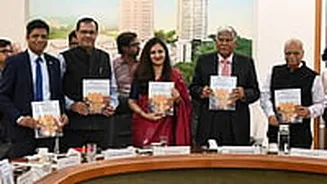








World Trade Center Mumbai in association with the All India Association of Industries (AIAI) and the Forum for Integrated National Security (FINS), convened a high-level Round Table Discussion on “Rare
Earths, Minerals, and Strategic Materials: Securing Supply Chains for National Resilience in a Multipolar World.” The event brought together senior government officials, policymakers, industry leaders, diplomats, and domain experts to deliberate on India’s strategic vulnerabilities and opportunities in critical mineral supply chains.
Adv. Bal Desai, Secretary General, Forum for Integrated National Security (FINS), underscored the fragility of global supply chains in a multipolar world. He noted “majority of global rare earth processing and refining capacity remains concentrated in China and that many critical minerals are geographically restricted to a few regions. He stressed that in the current strategic environment, control over processing and refining capabilities is more critical than merely possessing mineral reserves”.
“Digital infrastructure, defence, space, nuclear energy, clean energy, and advanced electronics all rest on vulnerable material foundations. Export controls and refining monopolies have replaced pure economic competition. Securing supply chains is no longer optional it is a strategic imperative,” Adv. Bal Desai added.
Delivering the theme address, Dr. Jaijit Bhattacharya, Senior Fellow, FINS, and President, Centre for Digital Economy Policy Research, the current scenario emerges from past geopolitical disruptions, including China’s rare earth export restrictions to Japan. He highlighted the limitations of focusing only on mining without parallel investments in refining, substitution technologies, recycling, and intellectual property creation.
Dr. Bhattacharya pointed to the paradox in India’s position, “noting that while India ranks among the top three countries globally in rare earth deposits, it faces persistent challenges in high-temperature processing, monazite sand mining, access to finance, information asymmetry, and IPR constraints. Referring to the National Critical Minerals Mission (NCMM) and the evolving MMDR framework, he observed that despite strong geological potential, India continues to face long gestation periods, limited processing capacity, and dependence on foreign technologies”.
H.E. Mr. José Mauro da Fonseca Costa Couto, Consul General of Brazil in Mumbai, said “There are vast opportunities for India–Brazil collaboration in the critical minerals space. Brazil currently consists of 27 rare earth projects spread across seven states and holds significant reserves of lithium, cobalt, nickel, graphite, copper, and germanium. He emphasized that strategic cooperation could help diversify global supply chains and support downstream integration beyond China-centric ecosystems”.
Dr. Deependra Singh, President, Rare Earth Association of India, and former CMD of IREL, highlighted key structural and operational challenges facing India’s rare earth sector. He emphasized that processing and separation capabilities are central to value creation and global partnerships, cautioning against the misconception that the mere availability of mineral reserves ensures strategic security.
“The rare earth elements derive value only when integrated into advanced applications such as permanent magnets and high-end manufacturing”. Dr. Singh also pointed out that while several rare earth deposits were explored decades ago, operational permissions have been granted only in recent years, with regulatory and environmental clearances continuing to shape project timelines.
“India has large reserves of rare earth oxides around 7 million metric tonnes, but we are still heavily dependent on imports for processed materials and magnets,” said Dr. Vijay Kalantri, Chairman, World Trade Center Mumbai and President, All India Association of Industries.
“There is huge potential for India to grow in this sector. However, we face challenges such as lack of large-scale processing and separation technology, environmental and social constraints, and gaps in coordination across institutions. While some regulatory processes are becoming easier, new challenges are emerging as the sector expands. Addressing bottlenecks in technology, processing, and governance will be key for India to fully utilize its rare earth resources,” Dr. Kalantri added
Dr. Kalantri also highlighted the strategic importance of rare earth elements across sectors, from microchips used in consumer electronics to high-precision defence applications.
India possesses significant reserves of uranium, thorium, and rare earth-bearing minerals; however, technology gaps, regulatory uncertainty, and long development timelines constrain commercialization. The event ended on the note that the advancements, economical, technological and geopolitical, over a decade, will solve the current prognosis of policy certainty and ecosystem development.