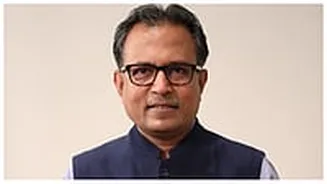










Nilesh Shah, MD-Kotak Mahindra Asset Management Company (AMC) and a leading market strategist, shares his insights in an exclusive discussion with Manoj Yadav, FPJ's Business Editor (Digital), on the factors
driving the rupee’s recent depreciation, covering both structural and short-term influences. He explains how the RBI manages growth, inflation, and currency stability while letting market dynamics operate. Shah advises investors to focus on quality, export-oriented sectors and maintain disciplined asset allocation to navigate global volatility. Despite short-term macro pressures, he highlights the resilience of India’s growth story and underscores that long-term investment opportunities remain strong, offering a clear roadmap for wealth creation.
------------------------------------------------------------------------------
Q: The rupee has been hitting new lows against the dollar. What, in your view, are the structural and short-term factors driving this weakness, and how concerned should Indian investors be right now?
Nilesh Shah: Destiny of the Rupee is to depreciate against global currencies. The rupee’s destiny is largely structural in nature. India’s inflation has historically been higher than that of our major trade partners, while productivity growth has lagged behind. This inflation-productivity differential naturally exerts downward pressure on the currency, as suggested by the Real Effective Exchange Rate (REER) model, which indicates a 2-3 percent (previously it was 5-7 percent) annual depreciation is required to maintain export competitiveness. India also runs second largest trade deficit in the world. Unfortunately we run more than 100 billion trade deficit with China and more than 50 billion trade deficit with Russia. Some of this deficit is structural as we don’t produce sufficiently many of the goods we need like Oil.
Short-term factors include global risk-off sentiment, portfolio outflows from emerging markets, and recent uncertainties around trade tariffs. That said, the current level around 90 to the dollar is the new normal, and the RBI wisely allows market forces to determine the rate while intervening only to curb excessive volatility. Indian investors need not be overly concerned- this is not a crisis but a managed adjustment that has happened in the past and will happen in the future so that we can maintain export competitiveness. If we are lucky and smart we may take advantage of sharp rupee depreciation against currencies like the Yen, Euro, and Renminbi.
Q: How do you see the RBI balancing growth, inflation management, and currency stability in the coming quarters?
Nilesh Shah: The RBI has struck a fine balance by focusing on inflation as its primary mandate while supporting growth in a benign inflationary environment. With inflation now at record lows and projected around 2 percent for FY26, the recent rate cut to 5.25 percent and liquidity measures like OMOs and forex swaps provide room to bolster growth without targeting any specific rupee level. The central bank intervenes judiciously to ensure orderly markets rather than defending a particular exchange rate. In the coming quarters, as growth remains robust (with FY26 GDP forecast upgraded to 7.3 percent), the RBI will likely maintain a neutral to pro growth stance, allowing transmission of lower rates to stimulate demand while monitoring imported inflation risks from a weaker rupee. Overall, this Goldilocks phase- strong growth with low inflation- gives the RBI flexibility to prioritize economic momentum.
Q: A weakening rupee often affects foreign flows. Do you expect FIIs to turn cautious, or do you see this as an opportunity for long-term global investors?
Nilesh Shah: Short-term FII flows may remain volatile due to global factors like higher US yields and trade uncertainties, leading to some caution. However, much of the recent selling appears behind us, driven by profit-taking in a high-valuation market and rotation to the US. For long-term global investors, this depreciation presents a clear opportunity- India’s growth story remains intact, with resilient domestic demand, structural reforms, and expected double-digit earnings rebound in FY27. No serious investor can afford to stay underweight on India indefinitely. As valuations normalize and earnings revive, flows will return, especially with domestic liquidity providing strong support.
Global media doesn’t miss an opportunity to build a negative narrative against India. While we all know even today Pakistan’s runways are shut due to the Indian strikes during operation sindoor, many global investors whom I met during my travel to Singapore, Japan, US and Abudhabi fed by biased media narrative believes Pakistan was a winner.
India must take biased media narratives head on with intense engagement with the investors.
As someone mentioned India is a market where risks are visible and opportunities are hidden. In most countries including China it is the other way.
Q: As the currency depreciates, which sectors do you believe stand to gain or lose the most, and how should investors reposition their portfolios?
Nilesh Shah: Exporters like IT services, pharmaceuticals, and chemicals stand to gain in the short term from a competitive rupee, aiding margins and global pricing power- IT, in particular, looks attractive with AI-driven opportunities and dividend yields. Manufacturing exporters could also benefit if we leverage this for market share gains. On the losing side, import-dependent sectors such as oil & gas, consumer durables with high imported inputs, and certain commodities face margin pressures from higher costs. Investors should reposition towards quality export-oriented themes, financials, discretionary consumption, healthcare, and select midcaps poised for outperformance. Focus on stock picking and sector rotation in a moderating returns environment, while maintaining disciplined asset allocation. Over long term currency depreciation has not helped our exports as market forces even out the Rupee depreciation.
Q: Despite global headwinds, India’s growth narrative remains strong. Do you believe the current macro pressures can derail this momentum, or is the economy resilient enough to sustain growth?
Nilesh Shah: India’s economy is resilient enough to sustain strong growth momentum. We’ve delivered robust GDP prints, with recent quarters showing 8 percent+ expansion driven by domestic demand, infrastructure push, and reforms. Global headwinds like tariffs and currency pressures are challenges but also opportunities to boost exports and deepen domestic markets. Fiscal discipline, digital ecosystem advancements, and rising domestic savings into equities provide a solid foundation. We are on track to be the fastest-growing major economy in CY26, with corporate earnings rebounding sharply. Macro pressures won’t derail the narrative- India’s decade is intact. We have our challenges but with our back to wall we deliver the best performance.
However investor must moderate return expectations. We are trading at a premium to peers. Our returns are likely to come from earnings growth rather than valuation re rating. If earnings are likely to be in high single digit to low double digit, returns can’t be far away from that.
Q: With imported inflation rising due to the weak rupee, what risks do you foresee for corporate earnings in the next two to three quarters?
Nilesh Shah: While a weaker rupee could elevate imported inflation in select areas like energy and commodities, overall inflation remains benign, giving companies breathing room. Risks to earnings are more from global demand softness and input cost pressures in import-heavy sectors. However, exporters will see margin tailwinds, and with domestic consumption holding up, we expect a sharp earnings rebound in FY27, potentially double-digit. The next two-three quarters may see moderated growth, but the outlook is positive as rate transmission supports credit-sensitive sectors and AI adoption enhances productivity.
Q: Retail investors are anxious with volatility rising. What asset-allocation strategy would you recommend in this environment of currency fluctuations and global uncertainty?
Nilesh Shah: In times of volatility, stick to disciplined asset allocation- equities for long-term growth, diversified across largecaps for stability and midcaps for alpha potential. Overweight quality themes like financials, consumption, healthcare, and export-oriented IT. Include gold as a hedge against uncertainty, given central bank buying and supply constraints. Fixed income offers attractive yields post rate cuts, and avoid sitting on excess cash as it yields nothing and depreciates. Continue SIPs relentlessly- volatility is an ally for rupee-cost averaging. Focus on fundamentals; India’s structural story outweighs short-term noise.
Most importantly moderate return expectations. Returns will be above inflation but not in high teens like last 5 years.
Q: Do you think the rupee fall or global volatility can meaningfully impact domestic mutual fund inflows, or is the retail investor base now structurally stronger?
Nilesh Shah: The retail investor base is now structurally much stronger, thanks to years of financialisation, distributor education, and SIP discipline. Domestic flows have held firm even amid FII outflows and volatility, proving resilience. Rupee depreciation or global uncertainty may cause temporary pauses, but the habit of systematic investing is ingrained. With demographics favoring savings and mutual funds demystifying equities, inflows will continue growing strongly. This domestic liquidity buffer is a key strength for our markets.
There are many naysayers on Indian economy and markets. Do listen to them but always remember pessimists will sound intelligent and appear your well wisher but only optimists makes money. You can’t learn swimming without jumping into the water.
Q: What reforms or structural changes do you believe can help deepen India’s financial markets and make them more resilient to global shocks?
Nilesh Shah: To deepen markets and build resilience, we need greater R&D investment to boost productivity and close the gap with trade partners- turning challenges like AI disruption into opportunities. Reforms in factor markets (land, labor) remain crucial for manufacturing scale-up. Enhancing export competitiveness through PLI extensions, easing FDI norms (e.g., revisiting Press Note 3), and internationalising the rupee would reduce dollar dependence. Further capital market deepening via broader participation, better governance, and innovation in products will attract sustained flows. India’s ‘India First’ approach- digital ecosystem, IBC, infrastructure- has already transformed us; building on these will make us far more shock-resistant.
India has lots of savings locked in Gold. No one knows how much gold we own. However it is well known that we are the largest owner of the gold in the world and it is lying in Tijori and bank lockers mostly in parallel economy. We must melt this iceberg ( frozen saving) to provide capital to our entrepreneurs.