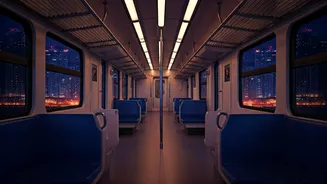

It is just past 10 pm at a suburban railway station. A family returning from a late dinner waits on the platform, a schoolbag slung over one shoulder, a child half-asleep against a parent. A migrant worker
scrolls through messages from home while watching the indicator board.
A young professional checks the time, calculating the last mile home. Around them, uniformed police personnel stand and watch: visible, steady, unremarkable in the best way possible. Safety here is no longer dramatic but a routine.
Mumbai has always been a city that never sleeps, powered by constant movement and people from every corner of the country. What is changing quietly, but decisively, is how protected that movement now feels. Beyond the packed trains and crowded streets, the city is building a safety net that touches families, children, migrant workers, students and women alike, reshaping Mumbai from a city that is simply liveable into one that feels more loveable.
In a city as dense and diverse as Mumbai, social security is increasingly being treated as a form of urban infrastructure in its own right, as essential as transport and housing. The aim is no longer just to move people efficiently, but to ensure they feel protected while doing so, regardless of the hour.
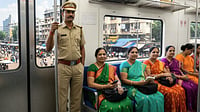
Over the past couple of years, the Government Railway Police (GRP) has significantly strengthened its late-night presence across the suburban rail network. Between 9 pm and 6 am, more than 1,200 uniformed personnel are deployed on platforms and inside women’s compartments, ensuring that commuters travelling in late-night trains are met with visibility and order rather than uncertainty.
For families travelling with children, elderly passengers navigating platforms and workers returning after long shifts, this presence offers reassurance that the system is alert even after dark.
In moments when security personnel are not immediately visible, commuters are encouraged to contact the railway helpline 1512, a small but critical layer of confidence for anyone navigating the network late at night. It reinforces a broader message: safety is not episodic but continuous.
This on-ground presence is supported by technology-driven awareness initiatives that allow commuters to raise concerns, share experiences and seek assistance in real time.
Dedicated safety apps and community engagement platforms — both official and citizen-led — have made safety information accessible across age groups and professions. For parents tracking their children’s commute, migrants unfamiliar with the city, or first-time travellers navigating new routes, these platforms help turn systems into support.
What strengthens these measures further is how Mumbai’s residents themselves have begun documenting the change. Neighbourhood WhatsApp groups circulate updates on safer routes and late-night connectivity.
Community pages share experiences of orderly platforms and responsive security. These everyday conversations exchanged between parents, workers, students and seniors help convert institutional initiatives into lived confidence.
The effort extends beyond railway stations. Across city streets, women traffic constables and patrol teams have taken on an informal but impactful role in monitoring late-night pedestrian zones, cab pick-up points and shared transport corridors.
Their presence contributes to smoother traffic movement, deters misconduct and offers reassurance to families waiting for transport, students returning from classes and workers ending late shifts. It subtly reinforces the idea that public spaces remain monitored and shared, even at night.
Students, interns and young professionals experience this shift in practical ways: fewer anxious late-night journeys, clearer information before travel and neighbourhood networks that share lighting updates and helpline numbers. What was once accepted as the unavoidable strain of urban life is slowly being replaced by predictability and care.
Infrastructure plays a key role in safety. State-of-the-art CCTV, metro lines, the one-click UTS app that reduces confusion about train timings, and much more help elevate the security of the city. Moreover, well-lit and well-planned roads, and projects like the coastal road and Atal Setu, help reduce congestion.
Furthermore, crowd management is better in Mumbai than in any other city in the country, be it during Ganpati Visarjan, Ambedkar Jayanti, or during the World Cup victory parade and the recent visit by Lionel Messi.
However, Mumbai’s transition from liveable to loveable is not defined by infrastructure alone but also by emotional security: the confidence that a city watches over its people, regardless of age, origin or occupation.
When safety becomes predictable rather than exceptional, a city begins to feel less like a system and more like a companion. Every patrol on a platform, every helpline response and every community-shared update builds that assurance.