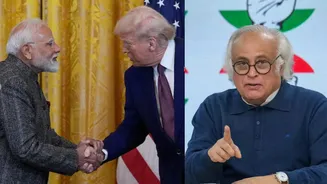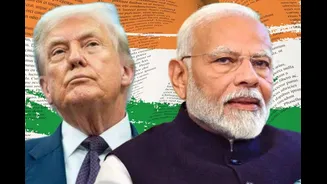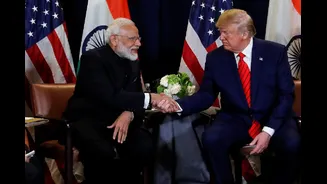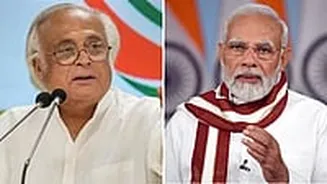

New Delhi: Senior Congress leader Jairam Ramesh on Monday criticised Prime Minister Narendra Modi and the Centre, claiming that India now gets to know about key national decisions from the United States
President Donald Trump or his appointees.
He termed this "Trump-nirbharta", meaning dependence on Trump, while citing last year's Operation Sindoor and the announcement of the India-US trade deal earlier in the day as examples.
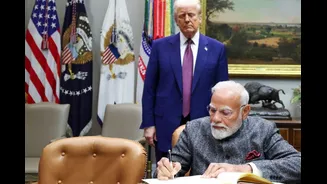
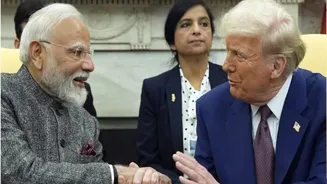
Ramesh's remarks came after US President Donald Trump said on his Truth Social that he had spoken to Prime Minister Modi earlier in the day and that India and the United States had agreed to a trade deal under which tariffs on Made in India goods would be reduced to 18 per cent.
The Congress leader claimed that details of Prime Minister Modi's conversation with Trump were first disclosed not by the Indian government but by US Ambassador to India Sergio Gor.
Congress Leader Jairam Ramesh's Tweet
"It seems that Prime Minister Modi and President Trump spoke to each other today. This information has been provided not by the Indian side but by the US Ambassador to India. This now seems to be the routine - India gets to know of its Govt's actions only from President Trump or his appointees. Trump-nirbharta," Ramesh wrote in a post on X.
In another post on X, made after Trump announced the trade deal but before Prime Minister Modi issued a statement, Ramesh referred to Operation Sindoor. He recalled that Trump had claimed he played a key role in de-escalating tensions between India and Pakistan during the operation, a claim the Indian government has denied, maintaining that no third party was involved.
Ramesh further took a jibe at the Prime Minister, suggesting that these instances showed Trump had leverage over Modi.
"He announced the halt of Op Sindoor from Washington DC. He announced the updates on India's oil purchases from Russia and Venezuela from Washington. He's now announced an India-US Trade Deal from Washington, the full details of which are awaited. President Trump clearly seems to have some leverage over Prime Minister Modi - who is now mortified of even being seen with him, let alone engage in the usual bout of hugs. It appears Mr. Modi has capitulated finally. Surely this cannot be the father of all deals. In Washington clearly Mogambo Khush Hai," he wrote on X.
PM Modi's Tweet
Prime Minister Narendra Modi later responded in a post on X, saying it was wonderful to speak with his "dear friend President Trump" and welcoming the tariff reduction for Indian goods.
"Wonderful to speak with my dear friend President Trump today. Delighted that Made in India products will now have a reduced tariff of 18%. Big thanks to President Trump on behalf of the 1.4 billion people of India for this wonderful announcement," the Prime Minister said.
Modi added that cooperation between the two countries would benefit their people and strengthen global stability.
"When two large economies and the world's largest democracies work together, it benefits our people and unlocks immense opportunities for mutually beneficial cooperation. President Trump's leadership is vital for global peace, stability, and prosperity. India fully supports his efforts for peace. I look forward to working closely with him to take our partnership to unprecedented heights," he said.
Meanwhile, India and the European Union on January 27 announced the conclusion of negotiations for a Free Trade Agreement, marking a major step in their strategic economic partnership.
In a statement, the Ministry of Commerce and Industry said the agreement responds to global challenges while enabling deeper market integration between the world's fourth- and second-largest economies.
"With a combined market estimated at over Rs 2091.6 lakh crore (USD 24 trillion), bringing unparalleled opportunities for the 2 billion people of India and the EU, the FTA unlocks significant potential for trade and innovation. The FTA delivers unprecedented market access for more than 99 per cent of India's exports by trade value, while preserving policy space for sensitive sectors and reinforcing India's developmental priorities," the ministry said.
(Except for the headline, this article has not been edited by FPJ's editorial team and is auto-generated from an agency feed.)