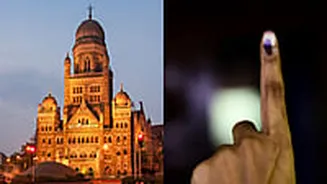









Mumbai: The political stage in Mumbai is set for the Brihanmumbai Municipal Corporation (BMC) elections, which are likely to be held in 2026. With the State Election Commission expected to announce the poll
dates for various local bodies today, Monday, December 15, the focus immediately shifts to the crucial battle for control over India's wealthiest civic body.
The five-year electoral cycle has historically been a contest for political supremacy in Mumbai, predominantly involving the Shiv Sena and its key rivals. A look back at the last five BMC general elections, spanning over two decades, reveals a consistent dominance by the undivided Shiv Sena, punctuated by the dramatic rise of the Bharatiya Janata Party (BJP) in the most recent contest. Take a look at when the last five elections of the country's richest civic body were held:
2017 Polls: The Closest Contest In History
The 2017 elections, held on February 21, stand out as the most nail-biting fight in the BMC's history. The then-undivided Shiv Sena (SS) maintained its position as the single largest party by winning 84 seats. However, its long-time alliance partner, the BJP, delivered a massive shock, winning 82 seats, a gain of over 50 seats from the previous election. The Congress (INC) was left far behind with 31 seats, signaling a profound shift in Mumbai's political landscape where the SS-BJP rivalry overshadowed all others.
2012 & 2007: Sena’s Comfortable Lead
In the 2012 polls on February 16, the Shiv Sena secured a relatively more comfortable victory, emerging as the largest party with 75 seats. The Congress (INC) was the second-largest contender with 52 seats, followed by the BJP with 31 seats. Similarly, the 2007 elections, held on February 1, saw the Shiv Sena secure 84 seats. Interestingly, in this term, the Congress was the primary opposition with a strong showing of 75 seats, while the BJP held only 28 seats, highlighting the changing dynamics of alliances and opposition over the years.
Early Dominance: The 2002 & 1997 Mandates
Deeper in history, the Shiv Sena's command was even more pronounced. The 2002 elections, which took place on February 10, gave the Shiv Sena a clear edge with 97 seats, putting it significantly ahead of the Congress (50 seats) and the BJP (35 seats). The party’s strength peaked in the 1997 elections, held on February 24, when the Shiv Sena won an outright majority with 103 seats. The BJP secured 40 seats, and the Congress finished with 34, confirming the Sena's deep roots and organisational power in the city's municipal politics at the turn of the millennium.
The historical record demonstrates that, despite shifts in alliances and the rise of new challengers, the BMC has remained a Sena stronghold. However, the current political environment, characterised by the split in the Shiv Sena and the formation of a ruling coalition with the Mahayuti partners, makes the upcoming 2026 election a highly anticipated and unpredictable event.
To get details on exclusive and budget-friendly property deals in Mumbai & surrounding regions, do visit: https://budgetproperties.in/