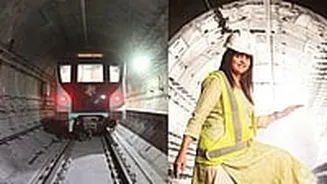

Mumbai: Senior IAS Officer & Managing Director of the Mumbai Metro Rail Corporation (MMRCL) Chief said that tunnelling has emerged as the most efficient solution for Mumbai’s future transport network,
as underground routes can connect to almost any point in the city without surface-level obstacles.
Mumbai Has Less Land Mass
While speaking on a YouTube Podcast, Powertrain by Aaskash Bhavsar, Bhide said that tunelling is better for a city like Mumbai, as it has very little land mass, as it is an island city. Being an island city with a narrow land stretch and several peninsular zones, Mumbai lacks the width required for major road expansion. She explained that because of this constraint, developing new public transport infrastructure often requires either elevated corridors or underground routes.
Challenges Of Elevated Corridors
However, she explained that elevated networks come with challenges as several things need to be followed, including strict road alignments, existing structures. In addition to this, elevated pillars also affect ongoing development work in dense areas.
She further explained, "Mumbai also has a heritage structure, especially South Mumbai, which is peninsular, where space is less. And if you make elevated structures near heritage, the beauty of the place is disturbed."
Confidence in the Underground Network Increased After Mumbai Metro 3
In the Podcast, she added that before the Mumbai Metro Line 3 project, there were doubts about tunnelling in a coastal city like Mumbai. But after the successful completion of Metro 3’s tunnelling work, where tunnelling of over 55 km was done for a 33.5 km corridor due to twin tunnels, those concerns have also been resolved. She added that tunelling will serve the city in a much better way, because it gives you the option of taking the most efficient route.
Giving an example, she explained how tunnelling drastically reduced travel distance and time on the Coastal Road project. In the Coastal Road project, two tunnels of about 2 km each that passed through Malabar Hill were built. Because of these tunnels, the travel distance between Haji Ali and Marine Drive became much shorter.
She further gave an example of the upcoming Thane–Borivali tunnel, which is being built by MMRDA. She explained that currently, travelling between Thane and Borivali by road takes a long time because it requires moving across the east–west corridor and building an elevated structure would make it difficult, as several surface-level structures need to be navigated, but with an underground tunnel, the distance will shrink to just 5–6 km, making the journey much faster and smoother.
"This is the real beauty of tunnelling, as you can bypass structures on the surface and have the most efficient route and can connect to any point," she added.
Ashwini Bhide calls Tunnel Boring Machines Safest
During the interview, she also called tunnel boring machines the safest and one of the most efficient ways of doing tunelling. "Only the place of the launching shaft and the place for the retrial shaft are needed. Once that is identified, then tunnelling becomes easier."