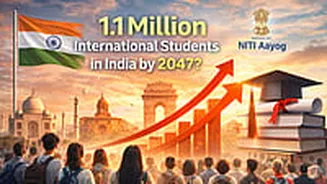









Mumbai: India has set its sights on a fundamental reimagining of its higher education ecosystem, aiming to emerge as a leading global academic destination by the centenary of Independence in 2047. A new
roadmap released by NITI Aayog projects that India could host as many as 1.1 million international students by that milestone, a target that would place the country firmly among the world’s foremost education hubs. The ambition, however, is matched by a clear warning: scale without quality will not suffice.
Details
The policy document argues that India’s demographic advantage and intellectual capital will yield dividends only if underpinned by sustained reforms, stronger institutional governance, globally benchmarked teaching standards and transparent, measurable outcomes for students. Without these, the report cautions, the country risks falling short of its international aspirations. Titled Internationalisation of Higher Education in India: Prospects, Potential, and Policy Recommendations, the report was released by NITI Aayog Vice Chairman Suman Bery, Members V.K. Paul and Arvind Virmani, and Chief Executive Officer B.V.R. Subrahmanyam, in the presence of senior officials from the Ministry of Education and the All India Council for Technical Education (AICTE).
It has been prepared by a consortium led by IIT Madras, drawing on extensive consultations across the sector. At the heart of the strategy is the concept of “internationalisation at home”. Rather than relying predominantly on Indian students travelling abroad, the roadmap seeks to embed global academic practices, research cultures and partnerships within domestic campuses. The objective is to expand India’s international footprint while preserving affordability, widening access and retaining national oversight of higher education. Despite operating the world’s second-largest higher education system, India attracts a relatively modest number of foreign students.
While millions of Indian students pursue degrees overseas, inbound enrolment remains limited, exposing what the report describes as a structural imbalance. Addressing this gap, it argues, is as much about credibility and outcomes as it is about capacity. Speaking at the launch, Bery described internationalisation as both an economic opportunity and a diplomatic instrument, positioning education as a key pillar of India’s soft power. V.K. Paul linked the roadmap to the National Education Policy and the broader Viksit Bharat 2047 vision, stating that India should aim to host at least 100,000 international students in public universities by 2030 as an interim milestone.
The report is grounded in surveys of 160 higher education institutions across 24 states, feedback from national and international stakeholders, and interviews with global experts from 16 countries. Virmani underlined the long-term strategic value of educating international students in India, noting that such graduates can contribute to global knowledge systems while strengthening India’s global networks and influence. Subrahmanyam highlighted the domestic benefits, arguing that deeper international engagement would improve curricula, expand research partnerships and reduce the substantial foreign exchange outflows incurred by Indian families funding overseas education. Industry experts broadly welcomed the vision but cautioned that ambition must be matched by disciplined execution.
Statement Of Aritra Ghosal, Founder & Director Of OneStep Global
Aritra Ghosal, Founder and Director of OneStep Global, said India’s goal of hosting up to one million international students by 2047 was achievable only with strong institutional delivery. “Student inflows must be matched with recognised qualifications, meaningful research opportunities and credible employability pathways,” he said, adding that international credentials alone do not guarantee higher earnings without relevant skills, experience and employer recognition. Ghosal emphasised that long-term success would depend on how effectively institutions and states build recruitment governance, conversion capabilities and on-ground student success systems capable of delivering consistent outcomes at scale.
Statement Of Tripti Maheshwari, Co-Founder & Director Of Student Circus
Tripti Maheshwari, CoFounder and Director of Student Circus, echoed the outcome-driven nature of contemporary student choice. “What will matter most is not how many international students India attracts, but what students gain from choosing to study in India,” she said. While the entry of global universities into India sends an early signal of credibility, she noted that students ultimately assess quality, career pathways and long-term value. Combined with India’s cultural depth and heritage, she argued, this could position the country as a serious alternative in an intensely competitive global market.
Statement Of Ganesh Kohli, Founder Of The IC3 Movement
Ganesh Kohli, Founder of the IC3 Movement, said progress was already visible but required sustained focus. He pointed to forward-looking policies, improving infrastructure and the strong performance of Indian graduates globally as reinforcing India’s appeal. “The report rightly underscores the importance of academic quality, global collaboration, research opportunities and institutional readiness,” he said, adding that informed counselling would be critical as India builds its international reputation.
From the government’s perspective, coordination across the sector will be essential. Higher Education Secretary Vineet Joshi said public and private universities must work in tandem if India is to realise its global ambitions, noting that recent regulatory reforms had already facilitated the entry of foreign institutions.
AICTE Chairman T.G. Sitharam added that India should prioritise attracting students from the Global South, particularly in engineering, technology and management disciplines where it enjoys comparative strengths. The roadmap sets out 22 policy recommendations and a series of action plans spanning regulation, funding, branding, curriculum reform and campus culture.