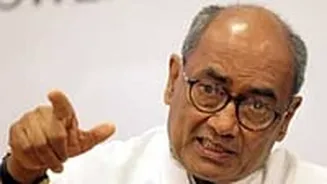

Veteran Congress leader Digvijay Singh has stirred up a storm in a teacup without any apparent reason. His tweet praising the RSS, saying that an ordinary worker in the RSS can reach the pinnacle of glory,
with a reference to Narendra Modi, has sparked a debate that Congress should also focus on organisation building. The picture he has posted, in which Modi is sitting on the ground, along with the comment, has definitely sparked a discussion: if Congress has to regain its past glory, it has to imitate or copy the RSS style of organisation-building. I know this whole debate embarrasses the Congress leadership, especially Rahul Gandhi, and I am sure Rahul Gandhi will be mocked once again by the BJP and its leaders, but a few things need to be understood before passing judgement.
Let’s not forget that the RSS was started by K.B. Hedgewar with the idea of uniting Hindus to face the challenges of other religions. Hedgewar and others, in their diagnosis, had concluded that Hindus remained slaves first under Islam for 700 years and afterwards under Christianity till India got independence because they were never organised. It was the lack of organisation in the Hindu community that proved to be their biggest weakness and the reason for being ruled by other religions for such a long time. Therefore, Hedgewar created an institution whose basic ethos and lifeline is organisation, and if one removes this ethos of organisation, then the RSS is a big zero. Without organisation, the RSS and other bodies it has created will be like any other social-political group of individuals, which will defeat its civilisational project of Hindu unity.
Whereas the Congress was created for a different purpose. It was to awaken the people of India from their deep slumber, inspire them to fight the British rule, and gain independence. Raising the collective consciousness of the people to fight for their rights and to throw off the yoke of colonialism was its prime objective. Fighting an empire was a Herculean task. It required immense desire and divine fearlessness. The fear of the British Empire’s oppressive rule was overwhelming. A large section of the Indian elite preferred to be in the good books of the British to survive and flourish till the late 19th century. To break the shackles of the British Raj required a spiritual awakening, moral cleansing, and a mass uprising. The first prime minister of independent India, Jawaharlal Nehru, wrote in ‘The Discovery of India‘, that Gandhi’s biggest contribution was to make the Indian people free from the fear of the British Raj.
Nehru writes, “The greatest gift for an Individual or a nation, so we had been told in our ancient books, was ‘Abhay’ (fearlessness), not merely bodily courage but the absence of fear from mind. Janak and Yajnavalka had said at the dawn of our history that it was the function of the leaders of a people to make them fearless. But the dominant impulse in the India under British rule was that of fear—pervasive, oppressing, strangling fear; fear of the army, the police, the widespread secret service; fear of the official class; fear of laws meant to suppress and of prison; fear of the landlord’s agent; fear of the moneylenders, fear of unemployment and starvation which were always on the threshold. It was against this all-pervading fear that Gandhi’s quiet and determined voice was raised: Be not afraid.”
Gandhi knew that force and violence would not be enough because the British rule was too powerful; it had to be countered by a mass awakening. He used non-violence to create the biggest mass movement in the history of mankind. It was this mass movement that made the British realise their inability to control such a vast, awakened humanity. They were left with no option but to leave India to be ruled by Indians. No doubt, Gandhi did create an organisation, but Congress’s biggest impulse is sentiment and emotionalism, not organisation. The RSS had the luxury of a huge organisation, but it remained a fringe player in Indian society for more than two-thirds of its existence. It became a principal player when emotionalism became the RSS’s prime value. Ram Mandir was an emotional journey anchored by the RSS. It was emotions built around Ram that made the BJP a big political organisation with a substantial social base. And it was the charisma of Modi, built around emotion, which helped the BJP get a majority in two parliamentary elections. I am not discounting the role played by the organisation, but the organisation alone was not enough.
The Congress party never had an RSS-like organisation, but it has an emotional connection with the people. Over time, that connection has eroded substantially. The Nehru-Gandhi family served as a bridge between the people and the Congress. Those who advocate that the Congress needs to build an organisation to defeat the BJP are failing to understand that an organisation takes decades to take shape; it’s not created in seconds, hours, days, or even months. Secondly, organisation is not the basic nature of the Congress.
If the Congress is to emerge from the present crisis, it must identify an issue with which people have an emotional connection to build a mass movement; it must also free itself from the fear of the system created by the RSS, whose outward face is Modi. Rahul Gandhi has embarked on that journey. He is trying to instil fearlessness by his own example in the party, but the problem with the Congress is that it has lived in the cosy comfort of power for too long, has lost the will to fight, and a large section of its leadership is too fearful of Modi and Shah. The Congress needs fresh blood, represented by ‘Abhay’, not the old guard like Digvijay Singh. Their time is now gone. That is what the Congress party must realise.
The writer is Co-Founder, SatyaHindi.com, and author of Hindu Rashtra. He tweets at @ashutosh83B