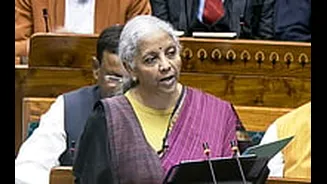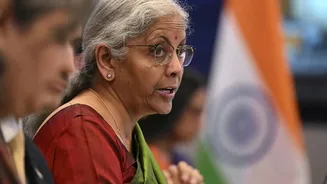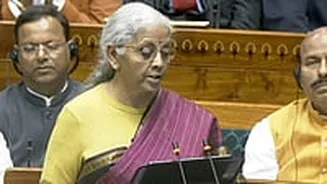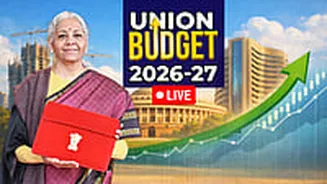






New Delhi: Finance Minister Nirmala Sitharaman on Sunday (February 1) presented her ninth consecutive Budget, the Union Budget 2026. It was the ninth time that Sitharaman will present the Union Budget.
She is now just behind former Prime Minister Morarji Desai, who had presented 10 budgets over multiple tenures as finance minister.
Catch LIVE Updates Below:
12:22 pm:
Boost For Domstic Manufacturing:
"My proposals for Customs and fiscal excise aim to further simplify the tariff structure, support domestic manufacturing, promote export competitiveness and correct inversion in duty. To continue weeding out long continuing customs duty exemptions, I propose to remove certain exemptions on items which are being manufactured in India or where the imports are negligible. Similarly, to further simplify the process of ascertaining the rate of duty applicable on a particular item. I propose to incorporate certain effective rates in various customs notifications to the tariff schedule itself," says the FM.
12:19 pm:
Sitharaman proposes to exempt 17 drugs, primarily used in cancer treatment from customs duty.
12:17 pm:
Simplified ITR Filing Deadlines
In a move to provide greater clarity and streamline the compliance process, Finance Minister Nirmala Sitharaman confirmed that the income tax return (ITR) filing deadlines will remain largely consistent for various categories of taxpayers. For individuals filing ITR-1 and ITR-2, the deadline continues to be July 31, providing a stable window for salaried employees and those with simple income profiles. However, in a significant procedural update, the government has announced that non-audit business cases and trusts will be granted an extended filing window, with their deadline set for August 31. This tiered approach is designed to reduce the last-minute rush on the tax portal while ensuring that entities with slightly more complex reporting requirements have the necessary time to finalise their accounts.
12:14 pm:
FY27 Fiscal Outlook And Market Borrowing
In her Union Budget 2026 address, Finance Minister Nirmala Sitharaman presented a high-growth fiscal roadmap for the 2026-27 financial year (FY27), estimating total non-debt receipts at ₹36.5 lakh crore. A significant portion of this revenue is expected to come from net tax receipts, which are projected to reach ₹28.7 lakh crore. On the spending side, the government has revised its capital expenditure for the current year (FY26) to ₹11 lakh crore, while simultaneously announcing an aggressive push for the upcoming year by raising the FY27 capex target to ₹12.2 lakh crore. To bridge the funding gap while maintaining a fiscal deficit of 4.3% of GDP, the government plans to manage gross market borrowings of ₹17.2 lakh crore, with net market borrowing from dated securities estimated at ₹11.7 lakh crore.
12:11 pm:
Tax Filing Time Frame:
"I propose to extend time available for revising returns from December 31 to up to March 31 with the payment of a nominal fee. I also propose to stagger the timeline for filing of tax returns. Individuals with ITR1 and ITR2 returns will continue to file till July 31 and non-audit business cases or trusts are proposed to be allowed time till August 31," announces Sitharaman.
12:10 pm:
TCS Rate Reduced:
"I propose to reduce TCS rate on the sale of overseas tour program package from the current 5% and 20% to 2% without any stipulation of amount," says Sitharaman.
12:07 pm:
Govt launches six-month foreign asset disclosure scheme
Finance Minister Nirmala Sitharaman introduced several measures to simplify compliance and encourage voluntary tax transparency. A major highlight is the launch of a six-month foreign asset disclosure scheme, providing taxpayers a time-bound window to declare previously undisclosed overseas holdings and avoid the severe penalties typically associated with the Black Money Act. Complementing this, the FM announced a reduction in the Tax Collected at Source (TCS) on foreign remittances for medical and education purposes, lowering the rate from 5% to 2% to ease the financial burden on families. Regarding routine compliance, the Minister confirmed that the traditional July 31st deadline for filing Income Tax Returns (ITR-1 and ITR-2) will remain unchanged for the upcoming assessment year, ensuring a stable and predictable filing calendar for individual taxpayers.
12:02 pm:
"To diversify farm outputs, increase productivity, enhance farmers' incomes and create new employment opportunities, we will support high-value crops such as coconut, sandalwood, cocoa, and cashew in the coastal areas. Agar trees in the Northeast and nuts such as almonds, walnuts, and pine nuts in our hilly regions. All of them will be supported," says the Finance Minister.
12:01 pm:
Fiscal deficit retained at 4.3% of GDP for FY27
In her Union Budget 2026 address, Finance Minister Nirmala Sitharaman announced that the fiscal deficit for the 2026-27 financial year is targeted at 4.3% of GDP, a figure that landed slightly above initial market expectations of 4.2%. This consolidation path is accompanied by a set debt-to-GDP ratio of 55.6% for FY27, as the government shifts toward using debt sustainability as its primary fiscal anchor. To fund these budgetary requirements, the government has estimated gross market borrowing at ₹17.2 lakh crore. While this borrowing figure is higher than previous estimates due to a heavy redemption calendar, the move reflects a deliberate strategy to sustain high capital expenditure while gradually bringing the deficit down from the 4.4% recorded in the previous year.
11:58 am:
Govt Accepts Recommendations of 16th Finance Commission
In a significant move for fiscal federalism, Finance Minister Nirmala Sitharaman announced that the government has accepted the recommendations of the 16th Finance Commission. Under this framework, the vertical devolution of taxes to states will be retained at 41%, ensuring a stable and predictable flow of resources to provincial governments. To support this mandate, the Union Budget has allocated ₹1.4 lakh crore specifically for states in the 2026-27 fiscal year (FY27) in the form of State Finance Commission (SFC) grants, reinforcing the center's commitment to cooperative federalism and regional development.
11:55 am:
Proposes Launch Of Khelo India Mission:
The Sports Sector provides multiple means of employment, skilling and job opportunities. Taking forward the systematic nurturing of sports talent which is set in motion through the Khelo India programme, I propose to launch a Khelo India Mission to transform the Sports sector over the next decade: Sitharaman
11:52 am:
Sarnath, Hastinapur among 15 locations to take avatar as vibrant cultural destinations
In her Union Budget 2026 address, Finance Minister Nirmala Sitharaman announced a transformative cultural and sporting agenda aimed at fostering national pride and local employment. A cornerstone of this vision is the proposal to develop 15 archaeological sites including historically significant locations like Sarnath and Hastinapur into vibrant cultural destinations equipped with world-class amenities for tourists.
To preserve and share India's vast heritage, the government will establish a Digital Knowledge Grid, a comprehensive platform designed to document all places of significance. This initiative is expected to create a dynamic new ecosystem of jobs, specifically benefiting local researchers, historians and technology partners. Furthermore, the minister reinforced the government's commitment to youth and fitness by announcing the next phase of the Khelo India mission aligning with India’s long-term aspirations to host major global sporting events like the Olympics.
11:49 am:
High-Powered ‘Education to Employment and Enterprise’ Standing Committee:
"I propose to set up a High-Powered ‘Education to Employment and Enterprise’ Standing Committee to recommend measures that focus on the Services Sector as a core driver of Viksit Bharat. This will make us a global leader in services, with a 10% global share by 2047. The Committee will prioritise areas to optimise the potential for growth, employment and exports. They will also assess the impact of emerging technologies, including AI, on jobs and skill requirements and propose measures thereof," says Sitharaman
11:48 am:
Govt plans girls' hostel in every district
Finance Minister Nirmala Sitharaman unveiled a sweeping social and sectoral roadmap focussed on inclusivity, specialised education and heritage preservation. Key announcements include the establishment of a girls' hostel in every district to boost female education and a new loan-linked capital subsidy scheme for veterinary colleges to modernise animal healthcare infrastructure. To address critical gaps in the medical sector, the FM committed to creating 1 lakh allied health professionals across ten disciplines including optometry and radiology and 1.5 lakh specialised caregivers for geriatric care over the next five years. Additionally, the government has launched an ambitious cultural project to document all places of spiritual and heritage importance, ensuring the preservation of India's historical identity alongside its modern economic growth.
11:44 am:
7 High Speed Rail Corridors In The Offing Between Cities
In a major push for high-speed mobility, Finance Minister Nirmala Sitharaman announced the development of seven high-speed rail corridors designed to serve as "growth connectors" between India’s major economic hubs. This ambitious infrastructure plan includes the expansion of bullet train connectivity across several key routes: Mumbai-Pune, Hyderabad-Pune, Hyderabad-Bengaluru, Chennai-Bengaluru, Delhi-Varanasi and Varanasi-Siliguri. By linking these metropolitan centres with rapid rail technology, the government aims to reduce travel time significantly, spur regional trade and catalyse industrial development along these high-traffic corridors.
11:40 am:
20 new National Waterways to come up
In her Union Budget 2026 address, Finance Minister Nirmala Sitharaman unveiled a strategic five-year roadmap to operationalise 20 new National Waterways, beginning with National Waterway-5 in Odisha to connect the mineral-rich Talcher and Angul regions with major ports. To support this expansion, the government will establish a network of regional institutes of excellence dedicated to specialised training and workforce development within the waterways sector. Furthermore, the FM announced the creation of a robust ship repair ecosystem specifically for inland vessels, with key hubs to be developed in Varanasi and Patna, ensuring long-term operational sustainability and reduced maintenance downtime for the nation's growing river fleet.
11:39 am:
200 Legacy Industrial Clusters:
"I propose to introduce a scheme to revive 200 legacy industrial clusters to improve their cost competitiveness and efficiency through infrastructure and technology upgradation. Creating champion SMEs and supporting micro enterprises. Recognising MSMEs as a vital engine of growth, I propose a three-pronged approach to help them grow as champions. I propose to introduce a dedicated Rs 10,000 crores SME growth fund to create future champions, incentivising enterprises, enterprises based on select criteria. I also propose to top up the Self Reliant India Fund set up in 2021 with Rs 2000 crores to continue support to micro enterprises and maintain their access to risk capital," says Sitharaman.
11:36 am:
Capex to be hiked to Rs 12.2 lakh crore
In her 2026 Budget Address, Finance Minister Nirmala Sitharaman announced a monumental increase in the capital expenditure outlay to ₹12.2 lakh crore for the 2026-27 fiscal year, a significant rise from the ₹11.2 lakh crore allocated in the previous budget. This 9% jump is designed to maintain the strong momentum in national infrastructure spending that has seen capex grow manifold from just ₹2 lakh crore in 2014-15. To de-risk this massive expansion, the FM proposed an Infrastructure Risk Guarantee Fund to provide credit guarantees for lenders, alongside a plan to recycle CPSE assets through the establishment of dedicated Real Estate Investment Trusts (REITs). The connectivity roadmap includes the creation of new dedicated freight corridors and a major push for inland navigation by operationalizing 20 new waterways, starting with a primary project in Odisha.
11:35 am:
3 Kartavyas:
Given that this is the first Budget prepared in Kartavya Bhavan, we are inspired by 3 kartavya.
First kartavya is to accelerate and sustain economic growth by enhancing productivity and competitiveness and building resilience to volatile global dynamics.
Second kartavya is to fulfill aspirations of our people and build their capacity, making them strong partners in India's path to prosperity.
Third kartavya, aligned with the vision of Sabka Saath Sabka Vikas, is to ensure that every family, community, region and sector has access to resources, amenities and opportunities for meaningful participation.
11:30 am:
Markets remain in green, up over 270 points.
11:29 am:
FM Sitharaman proposes to top up Self Reliance India Fund with Rs 4,000 cr in FY27 to support MSMEs
11:28:
Scheme For Rare-Earth Metals:
"A scheme for rare earth permanent magnets was launched in 2025. We now propose to support the mineral-rich states of Odisha, Kerala, Andhra Pradesh, and Tamil Nadu in establishing dedicated rare-earth corridors," says Sitharaman.
11:27 am:
Samarth 2.0 To Focus On Large-scale skilling and Productivity Enhancement:
In her ninth consecutive Union Budget, Finance Minister Nirmala Sitharaman has introduced a series of robust measures aimed at revitalising India’s textile sector. A primary highlight is the introduction of a dedicated textile expansion and employment scheme designed specifically to modernise existing textile clusters and boost job creation. To address the sector's evolving needs, the government has announced Samarth 2.0, which will focus on large-scale skilling and productivity enhancement for workers. Furthermore, the minister proposed the establishment of mega textile parks using a "challenge mode" to ensure competitive selection and high-quality infrastructure. Complementing these industrial efforts, the new Mahatma Gandhi Gram Samaj initiative was launched to provide targeted support and global visibility for the traditional Khadi and handicraft sectors.
11:25 am:
"To accelerate and sustain economic growth, I propose interventions in six areas -Scaling up manufacturing in 7 strategic sectors; Rejuvenating legacy industrial sectors; Creating champion MSMEs; Delivering a push for infra; Ensuring long-term security and stability; Developing city economic regions," says Sitharaman.
11:23 am:
Electronics Gets A Fiscal Boost
Building on the current momentum of the national electronics strategy, India has launched the Semiconductor Mission 2.0, significantly boosting its financial commitment with an increased outlay of Rs 40,000 crore. This second phase shifts focus toward high-level, industry-led research and the establishment of dedicated training centers to cultivate a specialised workforce. Parallelly, the mission seeks to leverage domestic resources by providing targeted support to mineral-rich states, specifically Odisha, Kerala, Andhra Pradesh and Tamil Nadu, to ensure a robust and localised supply chain for essential raw materials
11:20 am:
Six Key Pillars Of Growth
In her budget presentation, Finance Minister Nirmala Sitharaman has outlined a comprehensive economic strategy centred on six key pillars of growth. The proposal begins with a focus on scaling up manufacturing within seven strategic and frontier sectors while simultaneously rejuvenating legacy industrial sectors to ensure traditional strengths are not left behind. Central to this vision is the creation of champion MSMEs and a powerful push for infrastructure to drive national connectivity and efficiency. Finally, the plan prioritises long-term security and stability for the economy, complemented by the development of city economic regions to transform urban centers into primary engines of growth.
11:14 am:
Sitharaman says, "Keeping Aatmanirbharta as a lodestar, we have built domestic manufacturing capacity, energy security and reduced critical import dependencies. Simultaneously, we have ensured that citizens benefit from every action of the Government, undertaking reforms to support employment generation, agricultural productivity, household purchasing power and universal services to people. These measures have delivered a high growth rate of around 7% and helped us make susbstantial strides in poverty reduction and improvement in the lives of our people."
11:14 am:
"To develop India's global bio-pharma hub, I propose Biopharma Shakti with Rs 10,000 crore outlay for over 5 years": Finance Minister Nirmala Sitharaman
11:13 am:
Our Kartavay is to accelerate and sustain economic growth, fulfil aspirations of people: FM Sitharaman
11:11 am:
"We have pursued far-reaching structural reforms. Fiscal prudence and monetary stability, while maintaining a strong thrust on public investment, keeping self-reliance as a pillar. We have built domestic manufacturing capacity, energy security and reduced critical import dependencies," says the Finance Minister.
11:08 am:
Sitharaman says, "Since we assumed office 12 years ago, the country's economic trajectory has been marked by stability, fiscal discipline, sustained growth and moderate inflation. This is the result of conscious choices we have made even in times of uncertainty and disruptions."
11:07 am:
"This government led by PM Modi has chosen action over ambivalence, reforms over rhetoric and people over populism," says Nirmala Sitharaman
11 am: FM begins Budget speech
As the clock strikes 11 am, Union Finance Minister Nirmala Sitharaman unveils her 9th consecutive budget.
10.49 am:
Hindustan Zinc shares take hit ahead of Budget
Hindustan Zinc shares crashed over 20 percent in two sessions after a record fall in global silver prices. The stock hit lower circuit on Budget day, wiping out Rs 60,000 crore in value. High leverage, silver price collapse, and Vedanta’s OFS added strong selling pressure. (Read more)
10.39 am:
Let's see, says Priyanka Gandhi
On the Union Budget 2026, Congress MP Priyanka Gandhi Vadra said that she did not have much expectation, but suggested they should wait and see.
10.41 am:
Sensex in green zone
As of 10:41 am on February 1, 2026, the market index is currently trading at 82,533.59, reflecting a positive gain of 263.81 points. This movement represents a percentage increase of 0.32% since the market opened for the session.
10.38:
Roadmap for India's economic growth: Saurabh Shah
Saurabh Shah, Co-Chairman of the IMC Chamber of Commerce and Industry, said that the budget presented that day was not only going to be about numbers but would also serve as a roadmap for India's economic growth. Regarding the middle class, he suggested that there should be a rationalisation of personal income tax slabs in the budget. He further noted that incentives would be provided to startups, MSMEs, and technological entrepreneurs. Additionally, he expressed hope that there would be synchronization of compliances and regulations between state and federal governments to ensure ease of doing business at the ground level, enabling foreign businesses to enter India and Indian businesses to expand.
10.33:
Structural problems in Indian economy, says Congress MP Manish Tewari
10.24:
"Reform Express' will move forward speedily," says Kiren Rijiju
Union Minister Kiren Rijiju stated that it would be a historic budget and that the Prime Minister's 'Reform Express' would move forward speedily towards Viksit Bharat.
10:11 am:
'Scoop of good luck' from President Murmu
Ahead of the presentation of the Union Budget 2026 in Parliament, President Droupadi Murmu on Sunday offered dahi cheeni to Union Finance Minister Nirmala Sitharaman as she arrived at Rashtrapati Bhavan, marking a traditional and auspicious beginning to Budget Day.
10:01 am
Sameer Puri, Managing Director, Kestone Utsav
India’s economic backdrop is resilient, with GDP growth projected at around 6.5% in the upcoming fiscal year, supported by strong consumption and services demand. The wedding industry alone is a major economic pillar valued at around $130 billion annually, creating millions of jobs and contributing close to ₹6.5 lakh crore in economic activity during the peak 45-day season. With roughly 8–10 million weddings every year and robust consumer spending, targeted budget support for tourism, events, and MSMEs can further catalyse growth across hospitality, logistics, and creative sectors
10.00 am
Kauhal Mehta, Managing Director at Walpalst Pvt Ltd
India continues to be the fastest-growing major economy, driven by strong domestic demand and robust public capital expenditure. The construction sector, contributing nearly 18% to India’s GVA, remains a vital engine of growth and employment, supported by sustained investments in infrastructure, urban development, and housing. Looking ahead, GDP growth of 6.5–7% and construction growth of 8–10% are expected next fiscal, led by government-led infrastructure spending and a gradual revival in private capex. Policy continuity, stable energy costs, and incentives for sustainable construction materials will be key to maintaining this growth momentum.
9.59 am:
Dr Vandana Singh- Chairperson, Aviation Cargo, Federation of Aviation Industry in India (FAII)
India’s economy is showing resilience with real GDP growth around 6.5% in FY25, underpinning broader industrial expansion. The logistics market, projected at ~US$384 billion in 2026 and growing at about 9% CAGR, is a vital growth engine. Air cargo throughput, now over 3.8 million tonnes, is forecast to expand at ~11.5% CAGR through 2033, highlighting rapid demand from e-commerce and exports. In aviation, India ranks among the top five global markets, underscoring the need for targeted budget support in cargo infrastructure, multimodal connectivity, and digitisation to sustain trade and competitiveness.
9:52 am:
Union Finance Minister Nirmala Sitharaman along with Minister of State For Finance Pankaj Chaudhary arrives at Parliament to present the Budget. FM Sitharaman shows the digital tablet, containing the Budget document, enclosed in a traditional red 'bahi-khata' style pouch.
9:49 am:
Sanchita Mukherji, Business Economist and Managing Partner, Talk The Walk
As we approach the Union Budget 2026, the conversation must shift decisively from what we want to how we build resilience within India’s domestic economy. External forces such as global tariffs, trade wars and geopolitics are largely outside our control, but our internal policy response is not. The budget must therefore focus on strengthening domestic fundamentals rather than reacting to global volatility.
A key priority should be converting the government’s significant public capital expenditure of recent years into a strong magnet for private investment. This requires moving beyond assembly-led growth to deep manufacturing and higher domestic value addition. Production-linked incentives should increasingly support component manufacturing and import substitution, not by raising protectionist walls, but by strengthening India’s manufacturing base and competitiveness.
Equally important is spurring consumption without triggering inflation. Rational measures such as increasing the standard deduction and enhancing housing loan interest caps can put more disposable income in the hands of the middle class, driving demand organically across sectors like housing, consumer goods and services.
The banking system, now among the healthiest it has been in a decade, must evolve from being cautious to becoming catalytic. While large corporates have access to capital, MSMEs require stronger credit guarantee mechanisms. Reforms in NBFC lending and faster recovery frameworks can further unlock credit flow into the real economy.
Finally, the budget should accelerate public-private participation through monetisation of brownfield assets, divestment 2.0 and innovative risk-sharing models. With India’s per capita income expected to rise sharply by 2031, last-mile implementation, faster clearances and cutting red tape will matter more than headline allocations. Execution is the true growth multiplier.
9:48 am:
Pankaj Goyal, Co-Founder & COO of AutoNXT
As the Union Budget approaches, we hope to see continued policy support for the electrification of agriculture. Incentives for electric farm machinery, easier access to green financing for farmers, and investments in rural charging and battery infrastructure can significantly accelerate adoption. EV tractors not only reduce operating costs for farmers but also contribute to cleaner, more sustainable farming practices. A clear roadmap for indigenous manufacturing and R&D support would further strengthen India’s position as a global hub for electric agricultural equipment.
9:46 am:
Yachneet Pushkarna, Chief Seva Officer & CEO, Haribol:
As India approaches the Union Budget, we hope to see a focused policy push to bring greater transparency to the dairy sector through AI and digital technologies. The future of Indian dairy depends on replacing opaque systems with verifiable, data-led practices that build trust across the value chain, from cow health and milk quality to processing and storage.
We hope the Budget introduces targeted subsidies for dairies investing in AI-enabled health monitoring, digital traceability, automated quality testing, and transparent processing, making these technologies accessible to small and mid-sized players.
By rewarding transparency, the government can help the sector move from claims to proof, an approach already being demonstrated by HariBol Foods, an ISKCON impact project for sustainable food and dairy, recognised among the world’s top initiatives by the World Economic Forum. With the right policy support, AI can become the backbone of a more accountable, resilient, and globally trusted Indian dairy ecosystem.
9:45 am:
Vinesh Menon, Education Policy Expert & CEO, ARISE
India’s education challenge is not a lack of intent, spending announcements, or ambition it is fragmented execution. While successive budgets have spoken about reform, skill development, and digital infrastructure, education spending remains stuck at around 3% of GDP, far below what a modern, future-ready system demands.
Budget 2026 must decisively move away from schemes to systems by trusting teachers as nation-building partners, investing in teacher capacity, and creating scalable, permanent institutional structures rather than short-term pilot projects. Regulatory overload and the absence of an independent, trust-based oversight mechanism continue to stifle innovation and private participation.
We need single-window digital compliance, clear separation of regulation and administration, and formal recognition of private schools as partners in national development. Without addressing equity, teacher preparedness, and technology integration at scale, India risks widening the learning divide where children in the same country grow up with vastly different outcomes.
Fixing education today is essential if India is serious about building a skilled workforce and achieving its long-term growth vision.
9:43 am:
Finance Minister Nirmala Sitharaman with officials outside the Ministry of Finance in New Delhi before the presentation of the Union Budget 2026-27.
9:35 am:
Union Finance Minister Nirmala Sitharaman presents copy of Budget to President Droupadi Murmu.
9: 33 am:
Union Finance Minister Nirmala Sitharaman calls on President Droupadi Murmu before presenting her ninth consecutive Union Budget.
9:30 am:
Nifty, Sensex Open Flat In Special Budget Session:
Domestic stock markets opened largely flat on Sunday during a special budget session, as Union Finance Minister Nirmala Sitharaman is set to present her ninth consecutive Union Budget at 11 am. The Nifty 50 index opened at 25,333.75, registering a marginal gain of 13.10 points or 0.05 per cent, while the BSE Sensex opened at 82,445.97, up by 176.19 points or 0.21 per cent.
9:28 am:
'Jobless Growth Doesn't Help Anyone...': Shashi Tharoor
"We are all looking forward to hearing what the Finance Minister has to tell us. The Economic Survey projects good economic growth...Whether that growth is going to be accompanied by jobs? Jobless growth doesn't help anyone. So, we are anxious to see what kind of schemes they have in mind to generate more jobs in this country for young people of India," the Congress leader said.
"Apart from that, there will be many things. We in Kerala, with an election coming up, are looking to see what benefits the Central Govt might give us," Tharoor added.
9:17 am:
Union Finance Minister Nirmala Sitharaman heads to Rashtrapati Bhawan to call on President Droupadi Murmu before presenting her ninth Union Budget.
9:12 am:
Big Tax Announcements Expected For Middle Class, Seniors & Salaried Taxpayers: Everybody's eyes will be on the Union Budget 2026, to see whether the government will make changes to income tax slabs or not. According to a recent report by Morgan Stanley, the government had reduced personal income tax rates in the previous budget, which directly affected tax collections. However, the report also suggests that the finance minister may still announce selective relief for certain groups, especially the middle class and salaried taxpayers.
9 am:
Madhya Pradesh Deputy CM Jagdish Devda said he belives that the uNion Budget 2026 will be people-centric.
8:57 am:
Sitharaman arrives at Finance Ministry ahead of the Union Budget 2026.
8:10 am
7:50 am
Nirmala Sitharaman's sweeping income tax and GST cuts, together with spending on infrastructure and the RBI's interest rate reductions, have so far helped the Indian economy withstand the punitive 50 per cent tariff US President Donald Trump has imposed on Indian goods. But now, she has to come up with measures to sustain the momentum. (PTI)
7:30 am
Finance minister Nirmala Sitharaman announced a huge respite for taxpayers In Union Budget 2025, informing there will be zero income tax up to an annual income of ₹12 lakh.
7:20 am
Citizens can watch the broadcast of Sitharaman's speech through the Lok Sabha and Rajya Sabha LIVE feeds on the “Sansad TV” YouTube channel or via state-run Doordarshan (DD) television channels.
10:00 pm
BJP leader Ghulam Ali Khatana On Budget
"The country is progressing under the leadership of Prime Minister Modi...Nirmala Sitharaman is experienced. She will present a better budget than the previous government's. This budget will be for everyone, from infrastructure and technology to Digital India, farmers, and common people... Through 'Local for Vocal' and startups, PM Modi has put the country in the hands of its youth," BJP leader Ghulam Ali Khatana said on budget 2026.
9:00 pm
FM Nirmala Sitharaman To Focus More On Part B Of Budget Speech
Finance Minister Nirmala Sitharaman will reportedly focus more in detail on Part B than Part A of her budget speech. During earlier Union Budgets, most of the substance lay in Part A, while Part B was confined to tax and policy announcements. This time, Part B is expected to outline both short-term and long-term economical goals.
7:00 pm
Elderly Rights Groups Urge FM Nirmala Sitharaman To Restore Rail Concessions
Senior citizens’ organisations from Maharashtra have urged Finance Minister Nirmala Sitharaman to overhaul policies for the elderly ahead of the Union Budget 2026. The Joint Action Committee demanded restoration of railway concessions, GST removal on elder care services and a universal monthly pension of ₹3,000 for non-taxpaying seniors.