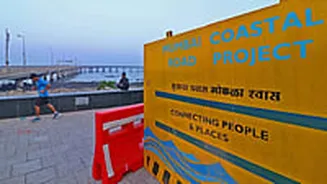

This past weekend came bearing more news that begged the question: how much destruction of natural ecology in a city is fair enough to satisfy ambitious road projects that benefit a small section of people?
The trigger was, of course, the Bombay High Court’s permission to the Brihanmumbai Municipal Corporation (BMC) to fell 45,675 of the nearly 60,000 mangroves to facilitate the construction of the northern arm of the coastal road, which will connect Versova to Bhayander. A total of 102 hectares of forest land would be affected, the BMC counsel informed the HC.
This 26.3 km section of the coastal road, set to cost Rs 20,000 crore and be completed by 2028, is slated to considerably cut road travel time between Mumbai’s western suburbs and the Bhayander-Vasai area in the Mumbai Metropolitan Region. While permitting the felling, the division bench of Chief Justice Shree Chandrashekhar and Justice Gautam Ankhad directed compensatory afforestation and stated that the BMC plea would be kept pending for ten years, during which the civic body would have to file annual reports on the compensatory plantation. This, unbelievably, will be in Chandrapur, which is approximately 850 kilometres away on the Samruddhi Mahamarg and a densely forested part of Maharashtra bearing little ecological relevance to Mumbai.
In any other context, this might have been considered absurd. One, that a coastal road as expensive as this, financially and ecologically, is being executed; two, that the compensatory afforestation has been allowed so far away; and three, that the total environmental impact assessment of the coastal road along its entire north-south length is far from being comprehensive. But given the single-track focus on installing mega infrastructure projects that the Devendra Fadnavis government has had from the start, absurdities and ecological concerns are brushed away.
Mangroves are destroyed with permission of the courts. Salt pans spread over hundreds of acres are landfilled to house the people evicted from Dharavi. The eco-sensitive zone of the Sanjay Gandhi National Park is sought to be opened up for commercial development and eco-tourism facilities. The Aarey forest is under threat of being cleared for infrastructure projects. Trees are routinely hacked or unscientifically trimmed, and buildings are permitted without allowing open space on the ground for trees. Waterbodies are in as pathetic a state as they used to be. The cumulative impact of these cannot be ignored or wished away as it unfolds in the decades to come.
The cumulative and comprehensive picture is what the BMC would rather not let us have. The coastal road project has been executed in sections, with each one being treated separately, almost independently, with budgets allocated and clearances sought as per requirements, thereby making it difficult for us to grasp the total cost and comprehensive impact. By the time it is completed up to Bhayander, it may cost nothing less than Rs 65,000 to Rs 75,000 crore, allowing for cost over-runs. But this, it must be emphasised, is not the complete cost—it excludes the ecological price and its true impact on the city that will be spread out over the next few years. The fragmentation of the project, the costs, and the environmental impact help the BMC, not people or environmentalists. It is harder to keep track of the piecemeal permissions and track the compensatory afforestation in each case.
Curiously, another bench of the Bombay HC earlier in December, when deciding on permission for Extra High Voltage towers and transmission lines at Kasheli, had ordered the state forest department to tighten and reform how it monitors the cutting and replanting or afforestation of mangroves and had laid down detailed instructions that would apply to all projects. Among other aspects, these said that mangroves must be replanted close to the affected site itself. The court said it was forced to do so because of major lapses between its permissions and on-ground afforestation.
On mangroves, court approvals have been necessary because, in 2018, the HC had imposed a “total freeze” on destruction of mangroves, and every instance of felling required special court permission. The case was filed by the NGO, Bombay Environmental Action Group (BEAG). In that ruling, the court had held that all mangrove land falls in Coastal Regulation Zone-I as per the CRZ notifications of 1991 and 2011, and “the destruction of mangroves offends the fundamental rights of citizens”.
However, this year alone, the HC has allowed felling in several instances. The Adani Electricity Mumbai Infra got permission to fell 209 mangroves, despite its initial estimate being only 79, near the Vasai Creek, close to where the mangroves will be cut for the coastal road. The Indian Navy was allowed to fell 45 mangroves, twice its initial estimate in the Environmental Impact Assessment, for a 400 m jetty at Uran in Navi Mumbai. In 2022, the HC had allowed the National High Speed Rail Corporation to cut 21,997 mangrove trees in Mumbai-Palghar-Thane for the Mumbai-Ahmedabad bullet train project; the corporation had initially sought to cut 53,467 mangroves.
Mangroves are globally recognised as the natural barriers against the impacts of climate change in coastal cities, protecting them from sea level rise, erosion, rising incidences of cyclones, and so on. Despite this knowledge and the HC’s own ruling of “total freeze” on the felling of mangroves, Mumbai and the larger MMR area have lost the greens. The compensatory afforestation, by the court’s own observation, has lapses. This “balance” between infrastructure projects and environmental protection is clearly out of sync.
Mumbai’s coastal road, to put it mildly, is turning out to be a road for the wealthy few, paid for by every taxpayer in the city, whose cumulative ecological cost may never be fully known.
Smruti Koppikar, an award-winning senior journalist and urban chronicler, writes extensively on cities, development, gender, and the media. She is the Founder Editor of the award-winning online journal ‘Question of Cities’ and can be reached at smruti@questionofcities.org.