






An attempt to forecast the Opposition’s future must necessarily read its past with counterfactual imagination and realism. Such a reading will underscore Bihar Chief Minister Nitish Kumar’s pivotal role
in the 2024 Lok Sabha elections.
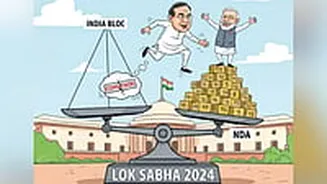
He deserted the INDIA bloc, comprising the stronger of the Opposition parties, after he was denied the post of its convenor. Kumar, in pique, crossed over to the National Democratic Alliance, which won 30 out of 40 seats in Bihar.
Take out, say, 25 of those 30 seats from the NDA’s eventual tally of 293—a distinct possibility without Kumar in that alliance—and Narendra Modi would have struggled to become the Prime Minister. India’s politics would have traversed a trajectory different from that in the present.
Realism must, however, temper the counterfactual reading of the past. Instead of battering a weakened Bharatiya Janata Party, the Opposition, in finer fettle than it had ever been since 2014, lost, in a little over a year, state Assembly elections in Maharashtra, Haryana, Delhi and Bihar. The Opposition returned to looking debilitated, depressed and terminally ill. Worse, the causes of its illness ostensibly seem incurable. A factor behind the Opposition’s defeat in the aforementioned states was the transfer of doles, in cash, or the promise of it, to people before they voted. The BJP and its allies will likely repeat this winning formula before Assembly elections in the 21 states and Union Territories where they are in power. Money in the voter’s bank account counts more than the Opposition’s promise of bettering the deal for him or her, effectively neutralising anti-incumbency.
The Opposition routinely ascribes its defeat to the Election Commission’s partisanship. Indeed, Congress leader Rahul Gandhi has established beyond doubt the presence of duplicate and fake voters on the voter list and the illegitimate deletion of names from it. But he has still to conclusively prove that systematic rigging of elections is afoot in India, with the ECI’s connivance.
What’s undeniable, though, is that the ECI tilts the playing field against the Opposition. For instance, it sprang the Special Intensive Revision of Bihar’s electoral rolls on the Opposition months before the Assembly election, distracting it from poll preparations. It allowed the government to transfer Rs 10,000 to Bihari women even after the model code of conduct kicked in.
It’s inconceivable that the Opposition’s criticism will prompt the ECI to alter its conduct. The bribing of the voter will similarly persist, as will the Modi dispensation’s autocratic method of raiding and filing corruption cases against political rivals, sullying their image and making them financially vulnerable before elections. These hurdles the Opposition will find hard to surmount in the future, too.
The winter for the Opposition would become prolonged if the Modi government introduces, against all odds, the One Nation, One Election scheme and implements the constitutionally mandated delimitation process. Issues with a pan-India echo would overwhelm local ones if Lok Sabha and Assembly elections are held simultaneously. ONOE will be advantageous to national parties, among whom the BJP is the most dominant, and disadvantageous to regional parties, which together occupy substantial Opposition space.
This space will further shrink after delimitation on the basis of population is conducted. This is because it will reduce the number of seats that Kerala, Tamil Nadu, Telangana, Karnataka, Punjab and Andhra Pradesh currently have in the Lok Sabha. These states are bastions of regional parties. It will, conversely, increase the Lok Sabha seats of north Indian states, where the BJP deploys Hindutva against religious minorities, particularly Muslims, with telling electoral and social consequences.
The Opposition identifies Hindutva, or the politics of hate, and the flawed conduct of elections, labelled as vote-chori, as its principal challenges. To tackle them, Gandhi embarked on the Bharat Jodo Yatra in 2023 and, more recently, in Bihar, on the Voter Adhikar Rally. Both drew crowds, but do not seem to have altered the national consciousness.
Yatras are the preferred Indian method of political mobilisation. Only two of these were resoundingly successful, with a pan-India sweep—the Mahatma’s Dandi March in 1930 and, seven decades later, L.K. Advani’s rath yatra. Both were designed to break laws, triggering intense excitement and goading people into defying the establishment and changing the status quo.
The Bharat Jodo Yatra, in contrast, sought to tap into the spirit of tolerance supposedly inherent in Indians. After passing through a village or city, Gandhi’s walkathon left behind for its residents a memory and a noble intent to reflect upon—but without giving them a blueprint for action. He failed to create symbols articulating the idea of India as an inclusive, pluralist, democratic society, in contrast to the homogenising and exclusivist project of Hindutva.
Gandhi’s failure to build a movement against Hindutva can be located in his dynastic background. Academic Kanchan Chandra’s Democratic Dynasties: State, Party and Family in Contemporary Indian Politics persuasively argues against simplistically perceiving political dynasties as a backsliding of democratic values. But the relatively privileged, insulated lives of dynasts do not whet their hunger for street politics and deprive them of the experience required to master the grammar of launching enduring political movements.
Critics will likely argue that in the neo-liberal economic order, Indians are inclined towards the politics of transaction—direct benefit transfer, subsidies, etc.—rather than the politics of agitation and movement. This isn’t true. Recall the protests against the Citizenship Amendment Act, the dilution of the Scheduled Castes and the Scheduled Tribes (Prevention of Atrocities) Act, and the corporate-friendly farm laws. The Opposition failed to build upon them.
It would be inviting its own decimation if it still cannot harness the disquiet over its own slogan of vote-chori or the new labour codes to build a movement. Without it, the Opposition’s future will depend on the vagary of someone from the NDA stable doing to it what Nitish Kumar did to the INDIA bloc.
The author is a senior journalist and writer of Bhima Koregaon: Challenging Caste.